All species › Parrots › Old World parrots › Double-eyed Fig-Parrot
Double-eyed Fig-Parrot | Cyclopsitta diophthalma
Dubbeloogvijgpapegaai | Lorito dobleojo
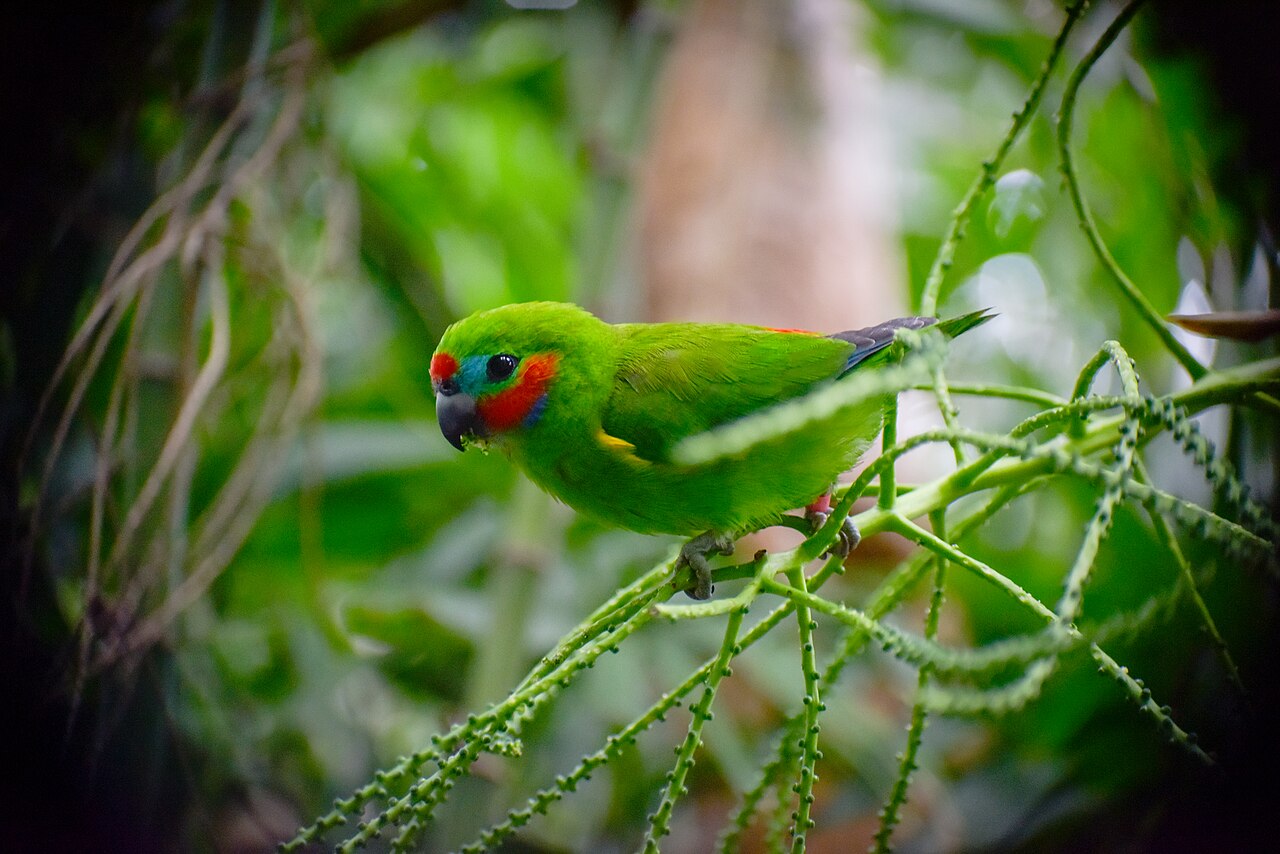
The Double-eyed Fig-Parrot is Australia's smallest parrot: a fourteen-centimetre ball of grass green with a disproportionately large head and heavy bill and a tail so short that in flight the bird looks almost tailless. On the face sits a pattern of red and blue that differs from subspecies to subspecies. It lives on figs, high in the rainforest canopy, and gives itself away by falling fig fragments rather than by its voice.
Voice
The call is high, clipped and unparrotlike: a sharp tseet-tseet or zzzt-zzzt of two or three notes, usually given in flight as the birds whirr over the canopy. Feeding birds are all but silent; the only sound is the gnawing at figs and the rustle of falling fruit pieces. While a nest chamber is being cut out there is a soft, regular tapping.
No recording with a suitable Creative Commons licence has been found for this species yet; what to listen for is described below.
Identification
A tiny, stubby parrot with a heavy, domed head, a thick grey bill and a nearly invisible tail; the silhouette is top-heavy and round, with broad, rounded wings and a fast, whirring, direct flight. The body is plain grass green, yellower on the belly, with blue in the shoulder and on the flight feathers. The face pattern varies by subspecies: in macleayana of the Wet Tropics the male has a red forehead with a blue band above it and a red cheek with blue below, while the female's cheek is buff-brown; in marshalli of Cape York the red on the face is more extensive; in the nearly vanished coxeni of the south-east the face is largely blue-green with only a small red patch at the side. Females everywhere carry less red and more silvery blue than males.
Confusion species
Little Lorikeet (Parvipsitta pusilla) is just as small and also green with red on the face, but has a pointed tail, narrower wings and a thin screeching call, and its red forms a mask around bill and eye rather than separate patches. Scaly-breasted Lorikeet (Trichoglossus chlorolepidotus) and Rainbow Lorikeet (Trichoglossus moluccanus) are clearly larger, longer-tailed and far noisier. The mark that always works is shape: no other parrot in Australian rainforest is so domed in the head and so short in the tail that in flight it suggests a bumblebee.
Habitat
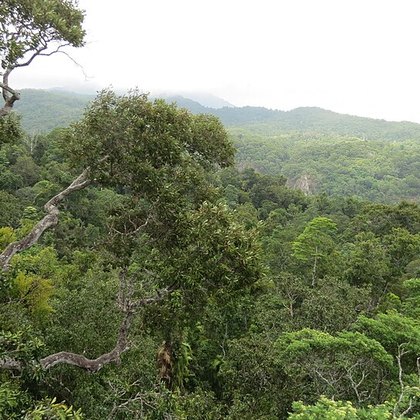
Tropical rainforest and its edges, monsoon forest and vine thicket, and riparian forest with figs along the creeks; in the Wet Tropics also the streets, parks and gardens of Cairns and the Atherton Tableland, wherever fruiting figs stand. Its food is mainly the seed inside the figs of strangler figs and their relatives, with berries, nectar and wood-boring insect larvae besides. Unlike almost all other parrots it does not use an existing hollow but cuts its own nest chamber in a soft, rotten trunk or a dead branch.
Where the bird is most often found, arranged by main group and formation.


Range and movements
Three separate areas on the eastern side of the continent. In the north marshalli holds Cape York Peninsula, around the Iron Range and the McIlwraith Range. The largest and most numerous area is that of macleayana in the Wet Tropics, from Cooktown south to about Paluma and Townsville, with Cairns and the Atherton Tableland as the core. Far to the south coxeni survives between Gympie and the Blackall Range in south-eastern Queensland and in north-eastern New South Wales as far as the Macleay River. It does not occur in New Zealand.
- Resident
- dark = core range, pale = thinly spread
Where and when to look
Find a large fruiting strangler fig on a rainforest track or in a Cairns street and watch the ground rather than the birds: a rain of gnawed fig skins gives them away. Then work the branches directly above that spot with binoculars, because they feed motionless and silent and are all but invisible in green foliage. In flight the sound is the only handle: that sharp tseet-tseet high over the canopy is nearly always this species.
Conservation
The species as a whole is Least Concern (LC) and the Wet Tropics form is locally common, but the southern subspecies coxeni is one of Australia's most endangered birds. Fewer than two hundred accepted records exist since 1866, and the last assessment put the survivors at probably no more than a hundred mature birds scattered over isolated forest remnants. The cause is the near-total loss of the lowland subtropical rainforest of south-eastern Queensland and north-eastern New South Wales, cleared for farming and housing, and the fragmentation of what is left, so that the fig trees no longer work as a connected food network through the year. Queensland, New South Wales and the Commonwealth all list it as endangered.
Scientific name
Cyclopsitta diophthalma | (Hombron & Jacquinot, 1841)
Hombron and Jacquinot described the species in 1841 as Psittacula diophthalma; because it later moved to another genus, authors and year stand in parentheses. The genus Cyclopsitta was introduced by Reichenbach in 1850 and combines the Greek Cyclops, the one-eyed giant, with the Latin psitta, 'parrot'. The epithet diophthalma means 'two-eyed', after the two eye-like colour patches on the face — exactly what the English and Dutch names express as well. The type locality is the southern coast of New Guinea, more precisely Triton Bay.