All species › Parrots › Old World parrots › Papuan Eclectus
Papuan Eclectus | Eclectus polychloros
Edelpapegaai | Loro eclecto
The Papuan Eclectus is the heavy rainforest parrot of the far north of Cape York, and the textbook case of sexual dimorphism among birds: the male is emerald green, the female scarlet with blue. The two look so unlike each other that for a century they were taken for separate species. With its broad wings, short square tail and slow, heavy beat, it looks in flight over the canopy quite unlike any other Australian parrot.
Voice
The flight contact call is a shrill, raucous kraa-ak that carries far over the rainforest and is usually the first sign that an eclectus is passing. Feeding birds are much softer, giving at intervals a friendly two-syllable chu-wee, chu-wee. The species also has a series of chuckling and bell-clear notes that in the crown of a fruiting tree sound almost unobtrusive. At the nest hollow the female calls loudly to the males that come to feed her.
No recording with a suitable Creative Commons licence has been found for this species yet; what to listen for is described below.
Identification
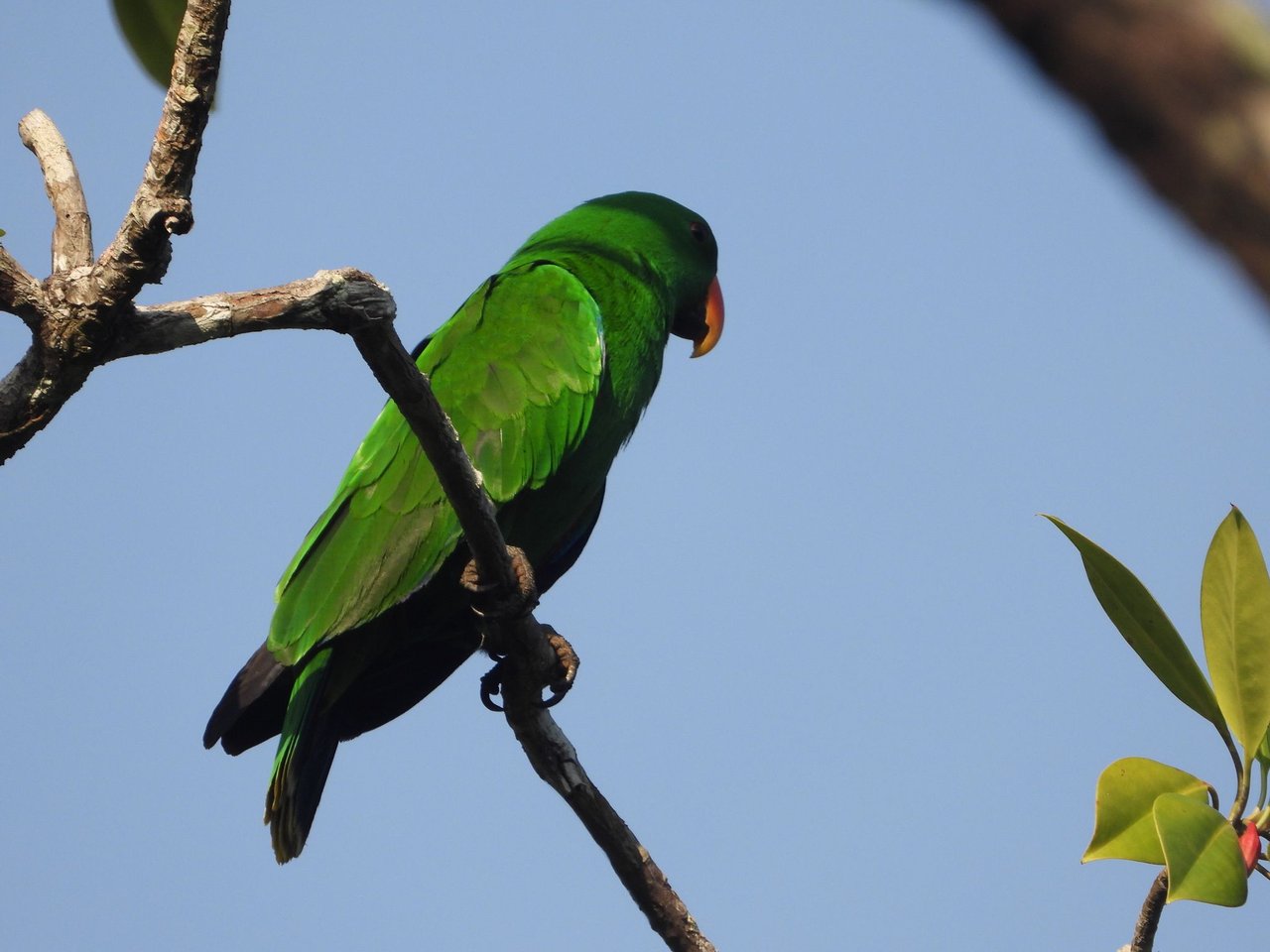
The main mark is the difference between the sexes, which in the field settles everything at once. The male is plain emerald green, with blue on the wing bend, dark blue primaries, scarlet underwing coverts and flanks that flare only in flight, and a yellow edge to the tail tip; the upper mandible is coral-orange with a yellow tip and the iris orange. The female is vivid scarlet on head, neck and back, with a blue-violet band across the belly, a blue collar on the nape, blue underwing coverts, an entirely black bill and a pale yellow iris in a blue eye-ring. Both sexes are heavily built, with a thick head, broad rounded wings and a short, square-cut tail — a silhouette with nothing of a parakeet about it.
Confusion species
Females are unmistakable: no other Australian parrot is red with blue. Males at range can suggest another large green parrot, but Red-winged Parrot (Aprosmictus erythropterus) is far slimmer, with a long tail and a large red wing panel, and its male also has a black mantle. Red-cheeked Parrot (Geoffroyus geoffroyi) shares the short tail and the Cape York rainforest but is less than half the length, and its male has a red face with a lilac crown. Australian King-Parrot (Alisterus scapularis) reaches no further north than Cooktown and so is absent from this country. For anyone seeing the silhouette alone: the slow, heavy, almost crow-like wingbeat over the canopy is enough on Cape York.
Habitat
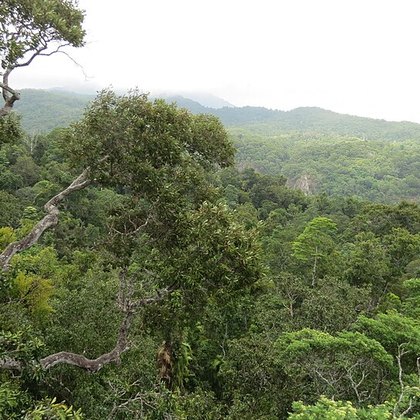
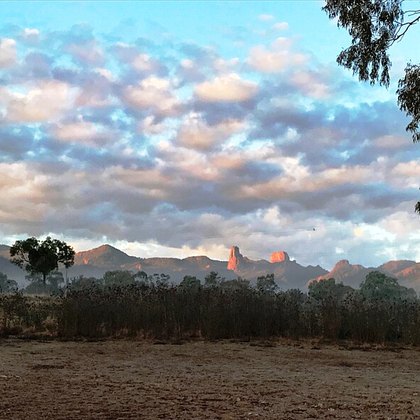
The canopy of lowland and foothill rainforest, together with gallery forest along the creeks, monsoon forest and the adjoining eucalypt woodland it comes out to feed in. It eats fruit, seed, nuts and blossom, figs above all, and stays largely in the crown. The nest is a very deep hollow, half a metre to six metres deep, in a thick emergent rainforest tree; such hollows are scarce and are used for decades on end. The female guards the hollow and is fed by several males — a mating system all but unique among parrots.
Where the bird is most often found, arranged by main group and formation.


Range and movements
Within this map window, only the eastern side of Cape York Peninsula in far northern Queensland, from the Pascoe River south to Massey Creek and inland to the McIlwraith Range. The classic ground is the Iron Range, now Kutini-Payamu National Park, where it is locally common. It occurs nowhere else in Australia, and not at all in New Zealand; beyond this window the range continues across New Guinea and the islands to its east.
- Resident
- dark = core range, pale = thinly spread
Where and when to look
Stand at Kutini-Payamu at first light in a clearing or on a forest road with a view over the canopy and wait for the birds to move from roost to fruiting trees: they pass high, call shrilly, and the colour tells you the sex at once. On a male, watch the underwing, because that scarlet is the only red he shows. A female will often sit for a long time in the mouth of her nest hollow with only the red head out.
Conservation
Least Concern (LC) on the world list, since most of the range lies on New Guinea, but in Australia the species is listed as Vulnerable both nationally and in Queensland. The Australian population is small and confined to a very limited area. The chief threat is late dry-season fire, which kills the big old trees with deep hollows; since the species uses the same hollow for decades and suitable ones are few, every nest tree lost is a lasting loss. Illegal trapping for the bird trade and disturbance at nest trees play their part as well.
Scientific name
Eclectus polychloros | (Scopoli, 1786)
Scopoli described the species in 1786 as Psittacus polychloros; because it later moved to another genus, author and year stand in parentheses. The genus Eclectus was introduced by Wagler in 1832, from the Greek eklektos, 'select' or 'chosen'. The epithet polychloros is built from poly, 'much', and chloros, 'green' — a name that fits the male alone, because Scopoli did not recognise the red female as the same bird. The original description gives no locality; it rests on a bird Sonnerat brought back from New Guinea. The English name Papuan Eclectus dates only from the recent split of the old Eclectus roratus; the Australian birds belong to the subspecies macgillivrayi, the largest form of the species.