All species › Parrots › Old World parrots › Red-cheeked Parrot
Red-cheeked Parrot | Geoffroyus geoffroyi
Roodwangpapegaai | Lorito carirrojo
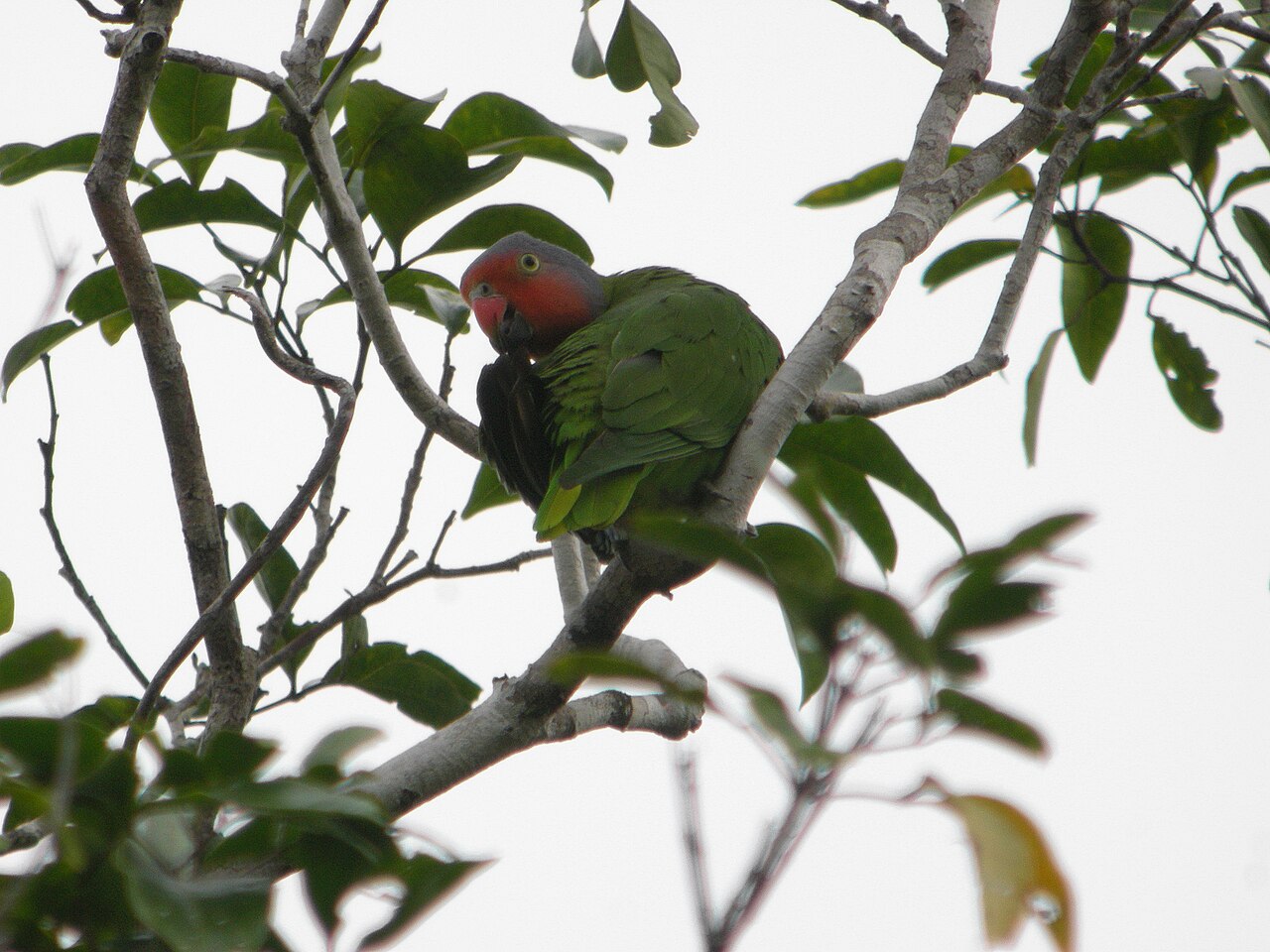
The Red-cheeked Parrot is a small, stocky green parrot of the Cape York rainforest, with a short, square-cut tail and a fast, agile flight high over the canopy. The male has a rose-red face with a lilac-blue crown and nape; the female's head is entirely brown. It is quiet and inconspicuous while feeding, but gives itself away in transit with a metallic, rattling call.
Voice
In flight it gives a metallic, shrieking series of notes repeated rapidly: tshang-tshang-tshang, usually from birds shooting high and unseen over the forest. It also has a two-syllable call that bends upward at the end, and in a fruiting tree an assortment of croaking, chattering and shrill piping notes. A feeding party once under way becomes noisy and conspicuous, in sharp contrast with its shyness at all other times.
No freely licensed recording has been found for this species yet; what to listen for is described below.
Identification
A stocky parrot of just over twenty centimetres, with a heavy head, broad rounded wings and a short, all but square tail — a pocket-sized eclectus in silhouette. The body is bright grass green, yellower below, with blue underwing coverts that light up in flight. The male has a rose-red forehead, face and cheek with a lilac to blue-violet crown and nape above and behind it, and a coral-pink upper mandible over a grey lower one. The female has an entirely dull brown head with no red or lilac, cutting sharply against the green body, and an all brown-grey bill. Young birds have a greenish head. The flight is fast and direct, with shallow, hurried beats and sudden turns.
Confusion species
Papuan Eclectus (Eclectus polychloros) shares the short tail and the Cape York forest but is more than twice the length and far heavier, and its female is red rather than brown-headed. Red-winged Parrot (Aprosmictus erythropterus) has a long tail, a large red wing panel and a much slower, undulating beat. Double-eyed Fig Parrot (Cyclopsitta diophthalma) is smaller still and shorter-tailed again, with red and blue in separate patches on the face of both sexes. Lorikeets such as Scaly-breasted (Trichoglossus chlorolepidotus) and Rainbow (Trichoglossus moluccanus) have pointed tails and streaked or scaled breasts. The brown female is the easiest bird to name in this country: no other green parrot on Cape York has an entirely brown head.
Habitat
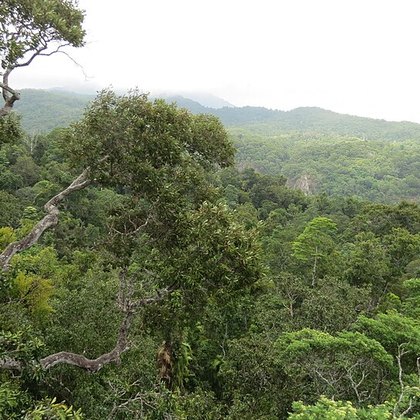
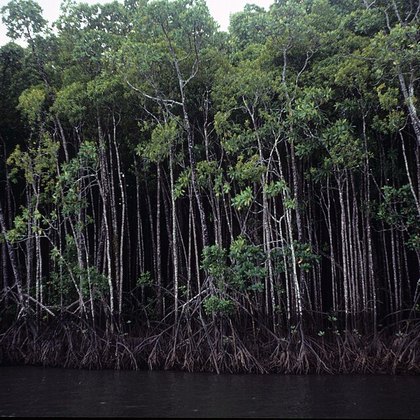
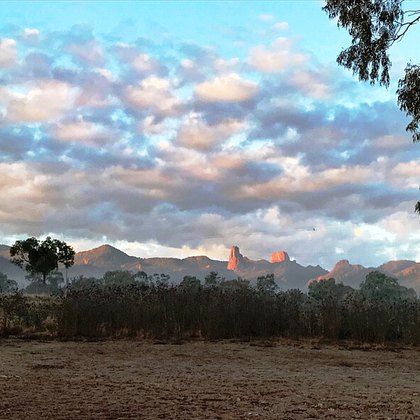
Rainforest and rainforest edge, monsoon forest and vine thicket, mangrove, and the eucalypt and gallery forest bordering the rainforest. It feeds high in the crown, on figs above all, with seed, blossom and nectar besides. The nest is unusual: the female cuts her own chamber in a rotting branch or a dead section of trunk, often high up and in an opening in the forest, and lays as a rule three eggs.
Where the bird is most often found, arranged by main group and formation.

Range and movements
Within this map frame, only Cape York Peninsula in far northern Queensland: from the tip at Bamaga and the Lockerbie Scrub southward, with the Iron Range — Kutini-Payamu National Park — and the McIlwraith Range as the places where it is most numerous, reaching roughly the Archer and Rocky Rivers. It is also seen on the islands of Torres Strait. It occurs nowhere else in Australia, and not at all in New Zealand; beyond this frame its range runs on across New Guinea and the Lesser Sundas to Timor.
- Resident
- dark = core range, pale = thinly spread
Where and when to look
Stand in a clearing or along the forest road at Kutini-Payamu and look up: the species mostly passes in flight, high and fast, and then the metallic rattle is the only handle. To see one perched, find a fruiting fig and wait for a party to betray itself with a sudden burst of chatter. Check the head of every bird first: red-and-lilac is a male, plain brown a female — one of the few parrots you can sex on head colour without seeing anything else.
Conservation
Least Concern (LC). The species has a wide range from Timor across New Guinea to Cape York and is common over most of it. In Australia it is a small edge population in a modest block of rainforest, largely within national park and not being logged; the risks there are indirect — fire pushing into the forest late in the dry season, and the loss of the large rotting limbs in which it cuts its nest chamber. No demonstrable decline is under way.
Scientific name
Geoffroyus geoffroyi | (Bechstein, 1811)
Bechstein described the species in 1811 as Psittacus geoffroyi, in his German edition of Latham's general synopsis of birds; because it later moved to another genus, author and year stand in parentheses. The genus Geoffroyus was introduced by Bonaparte in 1850. Both the genus name and the epithet honour Étienne Geoffroy Saint-Hilaire, the French zoologist. The type locality was originally given as 'New Holland', after Levaillant's plates, but that was an error: it has been corrected to Timor.