All species › Passerines › Honeyeaters › Mangrove Honeyeater
Mangrove Honeyeater | Gavicalis fasciogularis
Mangrovehoningeter | Mielero de manglar
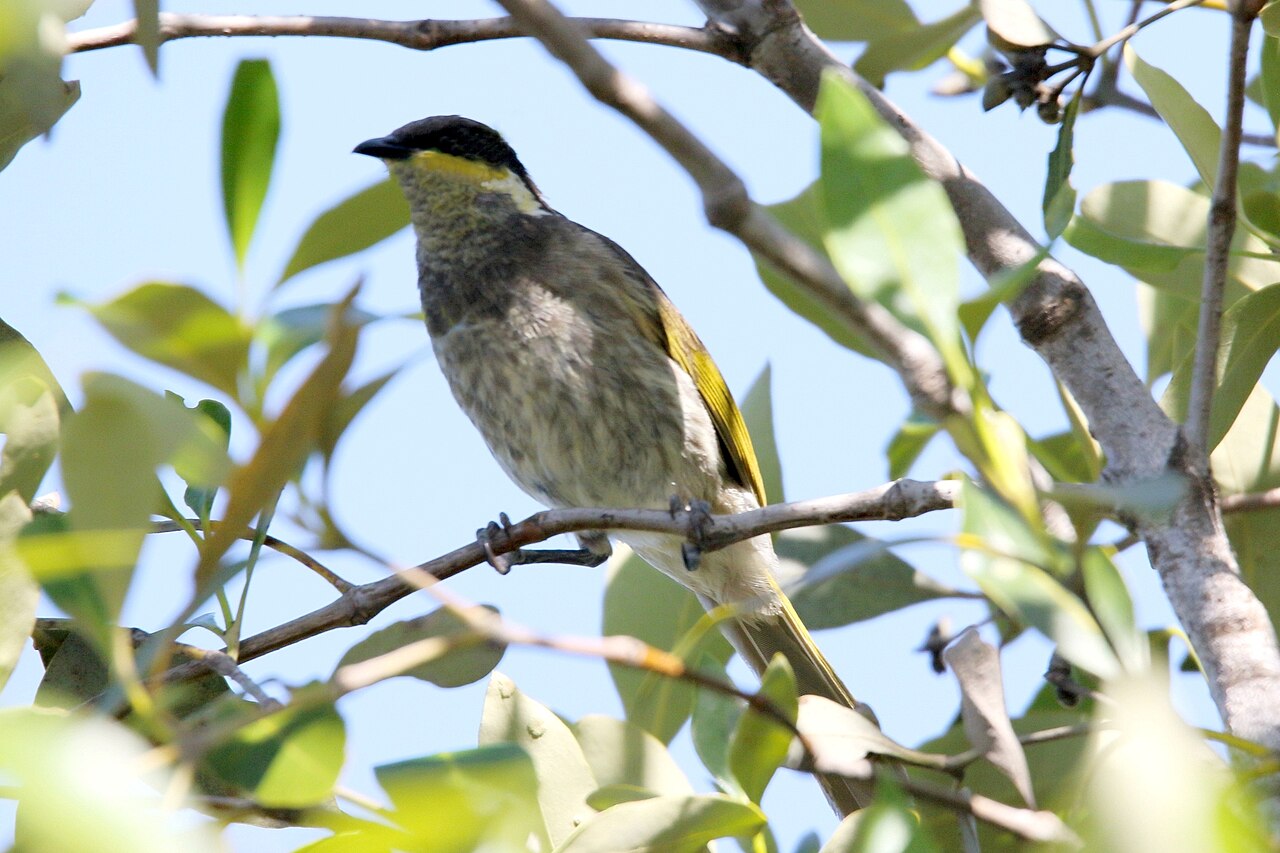
The Mangrove Honeyeater does exactly what its name promises: it lives in the mangroves of the Australian east coast and hardly ever leaves them. Walk along a bay or estuary near Brisbane or Mackay and you will hear it before you see it — a loud, clear, ringing song taken up at sunrise through the whole mangrove forest. When you do see it, it proves to be an olive-brown bird with a black eye band, a narrow yellow moustachial streak and, decisively, a grey throat finely barred with pale, from which the species takes its scientific name.
Voice
Loud, melodious and ringing, but varying greatly from phrase to phrase — no fixed strophe to memorise, but a run of rich, carrying whistles delivered with force. In the mangrove the sound is particularly dominant, because birds answer one another at first light until the whole forest is in chorus. There is also a sharp chattering scold used by parties against intruders and against each other. The voice carries far over water, and at the edge of a bay it is often the first sign of the species' presence, well before you have found a bird in the tangle of roots.
No freely licensed recording has been found for this species yet; what to listen for is described below.
Identification
A medium-sized honeyeater of about nineteen to twenty centimetres with a fairly long tail, slender dark grey legs and a stout, slightly down-curved bill. The upperparts are plain olive-brown, with yellow edges on the wing and tail feathers. A broad black band runs across the face from the base of the bill through the eye and back, with a narrow, bright yellow moustachial streak immediately below it. The decisive mark is on the throat: not plain but grey with fine whitish cross-bars, a scalloped or banded pattern you see at once with good binoculars at close range. The rest of the underside is grey-brown with faint streaking. The birds are usually in pairs or loose parties in the mangrove canopy.
Confusion species
The species belongs to the cluster of former Lichenostomus species now divided between Gavicalis and Stomiopera, and that is where the problems lie. Singing Honeyeater (Gavicalis virescens) is the closest relative and looks much like it in build and face pattern, but has a plain white throat and upper breast and clear fine streaking below, and sits in dry inland and western shrubland rather than coastal mangrove. Varied Honeyeater (Gavicalis versicolor) is the most similar bird in mangrove, but is yellower on face and underside and sits further north, from Townsville across Cape York to New Guinea; around Townsville the ranges meet and some genuine genetic exchange has been demonstrated, which can make an individual bird there hard to place. Yellow Honeyeater (Stomiopera flava) and White-gaped Honeyeater (Stomiopera unicolor) share parts of the coast, but are respectively bright yellow and plain olive-green with no black face band and no barred throat. In doubt, look only at the throat: barred grey means Mangrove Honeyeater.
Habitat
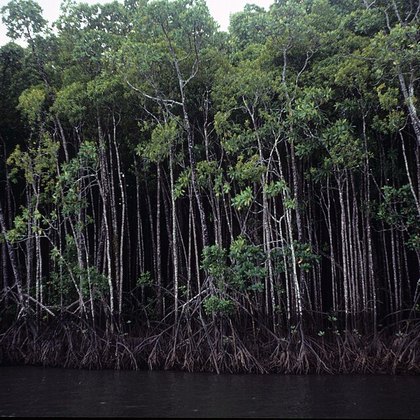
Mangrove above all — the Avicennia and Rhizophora forests along bays, estuaries, creek mouths and coastal islands — and alongside that the coastal woodland immediately adjoining, plus gardens and parks just behind the mangrove where flowering trees stand. The bird takes nectar, chiefly from mangrove blossom, and invertebrates: insects, but also marine snails and crabs picked from the roots and the mud, and occasional fruit. It is monogamous. The nest is a cup of dry grass, seagrass and other plant fibre, slung between half a metre and nearly three metres above the ground or water; there are one to five eggs, usually two, and incubation takes twelve to seventeen days. The breeding season runs from August to December with a peak in September.
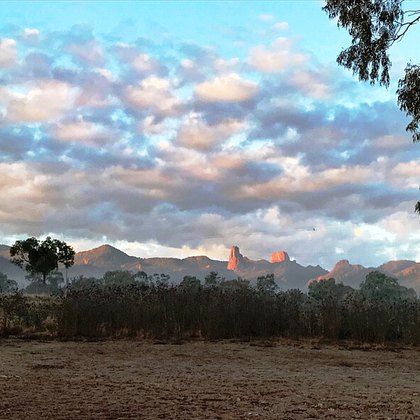
Where the bird is most often found, arranged by main group and formation.


Range and movements
Endemic to Australia and confined to a narrow strip along the east coast, from Townsville in Queensland south to the Clarence River in northern New South Wales, with the highest densities around Moreton Bay and the bays and islands of south-eastern Queensland. The southern limit has been shifting in recent decades: there is evidence that the species is expanding further south along the New South Wales coast. The species is monotypic and sedentary, and does not occur in New Zealand.
- Resident
- dark = core range, pale = thinly spread
Where and when to look
Go at sunrise to a mangrove boardwalk or a jetty on a bay in south-eastern Queensland — Wynnum, Nudgee Beach and the river mouths around Moreton Bay are classics — and let the birds sing towards you; at low tide they also come down to forage low among the roots, and then you get a good view. Do not look at the overall colour but at three things in order: the black eye band, the narrow yellow streak below it and above all the barred grey throat. North of Townsville, bear in mind that you may be dealing with Varied Honeyeater, and in that case note how yellow the face and underside are.
Conservation
Least Concern (LC), with a stable population and a range that even appears to be expanding on its southern side — unusually good news in a family where many species are losing ground. This species' vulnerability lies not in its numbers but in its narrow attachment: it depends almost entirely on coastal mangrove, and that is precisely the vegetation under pressure in south-eastern Queensland and northern New South Wales from port expansion, marinas, coastal development, altered water regimes and estuarine pollution. In the longer term sea-level rise is a factor, because mangrove can only retreat inland where room has been left for it. Where the mangrove stays intact, the species is common in it.
Scientific name
Gavicalis fasciogularis | (Gould, 1854)
John Gould described the species in 1854 as Ptilotis fasciogularis, from a bird taken on Mangrove Island in Moreton Bay — the type locality already points at the habitat. Author and year stand in parentheses, because the species later moved first to Lichenostomus and, in 2011, after molecular work broke up that large genus, to Gavicalis. That genus name is an anagram of Caligavis, another genus from the same split, and so means nothing in itself. The epithet fasciogularis is formed from Latin fascia, 'band', and gula, 'throat', and describes the best field mark precisely: the finely barred throat. The English name, the Dutch mangrovehoningeter and the Spanish mielero de manglar all choose the habitat instead. The species is monotypic: no subspecies are recognised.