All species › Passerines › Honeyeaters › Crimson Chat
Crimson Chat | Epthianura tricolor
Scharlaken schijnpaapje | Eptianuro tricolor
Of all the small birds of dry inland Australia, the Crimson Chat is the most theatrical. The male carries a fire-red crown, breast and rump, a black mask through the eye and a snow-white throat; all of it sits on a brown, mouse-like body of barely twelve centimetres that runs over the red ground rather than hopping. The species follows the rain: a district can be empty for years and then suddenly full of breeding pairs. Old names such as 'saltbush canary' capture well how the bird was known to inland settlers.

Voice
Small and metallic, as in all the chats. The usual contact note is a sharp, high chek-chek passed back and forth by parties spread out on the ground, alongside a thin, soft, repetitive ditty from the male, often from the top of a bush or during a short, slow display flight. Disturbed at the nest, this turns into a hard rasping churr. Over a bare plain it does not carry far; it is a sound you notice only once you are already looking at the right bush.
No freely licensed recording has been found for this species yet; what to listen for is described below.
Identification
A small, round-chested bird of eleven to thirteen centimetres with long thin legs, a short tail and a short, slender, slightly down-curved bill. The breeding male is unmistakable: bright crimson on crown, breast, belly and rump, a black mask around the eye, a pure white throat, dark brown upperparts and blackish wings with pale wing bars. Female and juvenile are much duller: brown above, white on the throat, with a pink to rufous wash over the underparts and a hint of red on the rump. The iris is pale. The most telling feature is behaviour: this bird walks on the ground, it does not hop, and it stays almost always on or just above the soil.
Confusion species
Within the genus, colour separates the species well. Orange Chat (Epthianura aurifrons) is yellow-orange rather than red and has a black throat where Crimson Chat is white; for the dull females the difference lies in the iris, dark red-brown in E. aurifrons and pale in E. tricolor, and in the latter's rufous wash below. Yellow Chat (Epthianura crocea) is yellow with a black breast band and chooses wet ground, while this species keeps to the dry plain. White-fronted Chat (Epthianura albifrons) is white with a black breast and nape band; its female resembles the female Crimson Chat but lacks the pink wash and the red tinge on the rump and usually still shows a trace of the dark band. The closely related Gibberbird (Ashbyia lovensis) is yellow on forehead and belly, has no mask, and is tied to gibber plain. Outside the family the main pitfall is the male Red-capped Robin (Petroica goodenovii), also red and black: that has a black throat, a shorter bill and conspicuous white in the wing, and it perches upright on a twig instead of walking.
Habitat
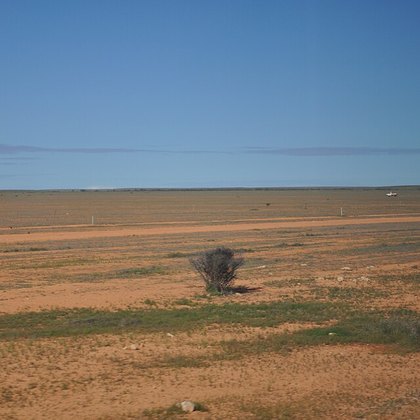
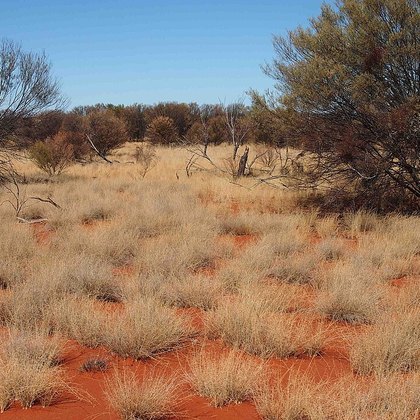
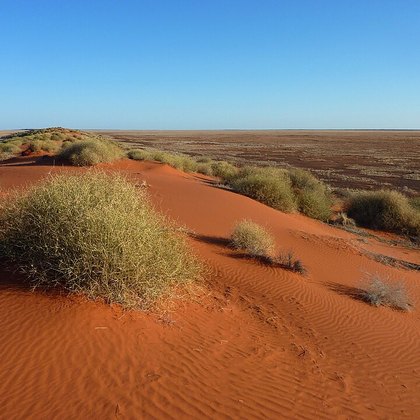
Open arid and semi-arid country with low shrubs: saltbush and bluebush plains, samphire, acacia scrub, dunefields, spinifex with scattered shrubs and grasslands, locally also coastal scrub. The bird forages mainly on foot on the ground and takes almost entirely insects and spiders; with the brush-tipped tongue that marks the family it also takes occasional nectar from flowering shrubs. Outside the breeding season loose parties are the rule, often together with other chats. Breeding runs from July to December, following rain: both parents build the small round grass cup low in a shrub, there are two to four pinkish-white eggs spotted red-brown, and both incubation and the nestling period last about a fortnight. Faced with danger, the parents lead an intruder away by feigning a broken wing.
Where the bird is most often found, arranged by main group and formation.

Range and movements
Endemic to Australia and spread through the dry interior of central and western Australia: from the Western Australian coast east to the western slopes of the Great Dividing Range and south to the mallee of north-western Victoria and the South Australian coast. Because of its strong nomadism the boundary is never fixed: in wet years the species pushes far beyond its core, even to the east coast and the south, only to be absent again for years afterwards. It is absent from Tasmania and does not occur in New Zealand.
- Resident
- dark = core range, pale = thinly spread
Where and when to look
Travel inland shortly after a wet spell, because that is when a breeding colony is most likely; in a dry year the same ground can be completely empty. While driving, watch the tops of low shrubs: the male's red stands out at once. Do not trust a fluttering red speck by the roadside, which may equally be a Red-capped Robin; the chat lands on the ground and walks, the robin stays perched on a twig and flicks. If you approach a nest and a parent goes ahead of you dragging a wing, turn back: that is a distraction display and the nest is just behind you.
Conservation
Least Concern (LC), with a very large range in a part of Australia under little agricultural pressure. The main risk for this species is at the nest: it sits low in a shrub or on the ground, and cats and foxes take young from it. Overgrazing by stock, goats and rabbits also thins the low shrub layer in which the bird builds and feeds. Against that, the species is highly nomadic and responds very fast to rain, with up to three consecutive broods in a good season, so local setbacks are usually made good quickly. The long, deep droughts that belong to the interior are therefore not a threat but a normal swing in this bird's existence.
Scientific name
Epthianura tricolor | Gould, 1841
John Gould described the species in 1841 as Ephthianura tricolor, from a bird from South Australia; author and year stand without parentheses, because it has always remained in this genus. Epthianura, also Gould's, is usually explained from Greek oura, 'tail', with a prefix read as 'refined' or as 'shrunken', and so refers to the short tail. The epithet tricolor is Latin for 'three-coloured' and points at the male's combination of red, black and white. The English name and the Dutch scharlaken schijnpaapje choose the red, while the Spanish eptianuro tricolor follows the scientific epithet. In Australia 'tricoloured chat' and the vernacular 'saltbush canary' were also current. The Dutch 'schijnpaapje' refers to the resemblance to the chats of Eurasia; there is no relationship, for this is a honeyeater.