All species › Passerines › Honeyeaters › Yellow Chat
Yellow Chat | Epthianura crocea
Geel schijnpaapje | Eptianuro amarillo
The Yellow Chat is the scarcest and most retiring member of a small group of brightly coloured honeyeaters that spend their lives on the ground. The male is golden yellow from forehead to tail base, with a crisp black crescent across the breast; the female is the same bird in watercolour, paler and without the band. Unlike its relatives it does not care for dry salt plains but for wet ground: saltmarsh pools, reed fringes, the green margins of artesian bore drains. To see one you head not for the desert but for the mud.
Voice
The voice is small and metallic, as in all the chats: a high, short tsing or tang passed back and forth as a contact call between the birds of a party as they walk through the saltbush. There is also a soft, slightly tumbling warble given by the male from a projecting stem, and a hard rasping churr when the birds are disturbed. Over the rustle of reeds and the hum of insects on a marsh plain it barely carries; it is rather the sound that gives away that more birds are present than the one you can see.
No freely licensed recording has been found for this species yet; what to listen for is described below.
Identification
A tiny, rotund bird of about eleven centimetres with a short tail, notably long legs and toes and a fine, straight, pointed bill. The breeding male is bright golden yellow on forehead, face, throat and the whole underparts, with a narrow, sharply drawn black crescent across the breast; the upperparts are olive-grey to yellowish brown and the black tail is tipped yellow. In flight a yellow rump patch shows. The female has the same pattern in much paler yellow and lacks the breast band altogether; young birds are grey-brown with only a faint yellow wash on the belly. The eye is pale. The bird walks and runs over damp ground and seldom goes higher than the top of a saltbush or a reed stem.
Confusion species
Within the chats, colour decides. Orange Chat (Epthianura aurifrons) is the trickiest: its male is a deeper orange-yellow with black lores and a black throat, whereas the Yellow Chat has a yellow throat and carries its black band lower, across the breast. For the females the eye helps: E. aurifrons has a dark red-brown iris in both sexes, Yellow Chat a pale one. Crimson Chat (Epthianura tricolor) has a red crown, breast and rump and a black eye mask; White-fronted Chat (Epthianura albifrons) is white with a black breast band and shows no yellow at all. The closely related Gibberbird (Ashbyia lovensis) also has a yellow forehead and underparts and a pale eye: it differs in having no breast band at all, a grey crown and above all a different home, bare gibber plain rather than wet saltmarsh. Habitat is in fact the best first filter: no other chat chooses damp, vegetated ground so consistently.
Habitat
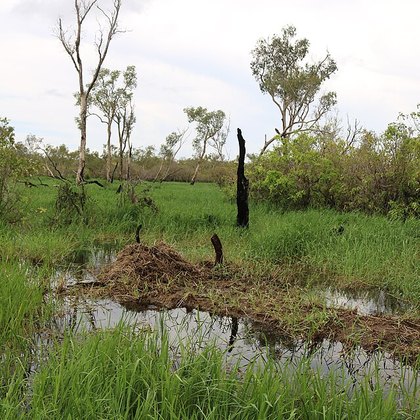
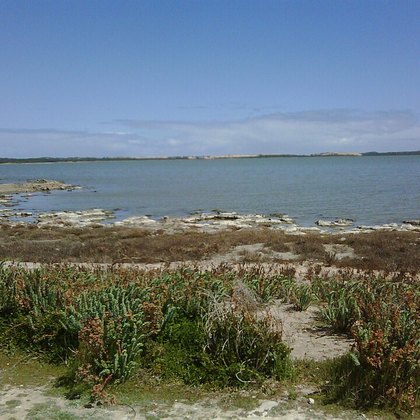
Marshy plains vegetated with saltbush, rank grasses or cumbungi, almost always on saline soil: the hinterland of marine lagoons, the edges of saltmarsh and samphire flats, and inland the green ribbons that form along the drains of artesian bores. The bird forages on foot in damp substrate and shallow water, for which the long legs and toes are suited. The diet is almost entirely insects and other small invertebrates, despite the brush-tipped tongue that marks the family. Parties of two to ten birds are usual. The nest is a small cup close to the ground in a samphire bush or dense grass, holding two or three white to pinkish eggs blotched reddish brown.
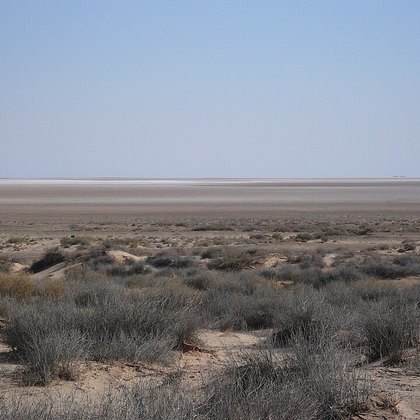
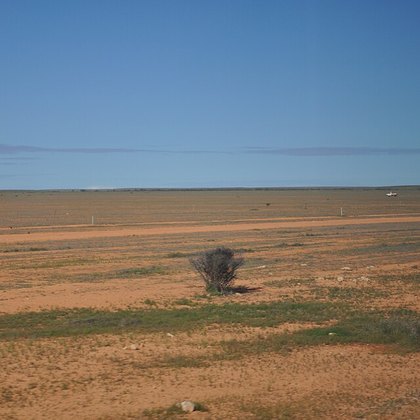
Where the bird is most often found, arranged by main group and formation.
Range and movements
Patchily scattered across northern and inland Australia, with strongholds in the Kimberley, the Top End around the Alligator Rivers, the Gulf of Carpentaria country, parts of western and central Queensland and north-eastern South Australia, plus isolated colonies on the central Queensland coast. Three subspecies are recognised: E. c. crocea from the Kimberley to the Gulf, E. c. tunneyi on the floodplains between the Adelaide River and the East Alligator River, and E. c. macgregori on the coastal plains of central Queensland. The species does not occur in New Zealand.
- Resident
- Winter
- dark = core range, pale = thinly spread
Where and when to look
Search deliberately along the join between open mud and dense low cover: the edge of a samphire flat, a reed fringe by a lagoon, or the green trace below a bore drain in dry inland country. Walk slowly and watch for movement at knee height rather than in the bushes: the birds run off like mice and only climb a stem once you stand still. The high metallic tsing is the most reliable sign that a party is present. Remember that the species is nomadic and may be absent for years from ground that looks perfectly suitable; a blank search says little about the site.
Conservation
Least Concern (LC) at species level, but that rating hides an uncomfortable reality, because the species consists of small, widely separated populations on a habitat under pressure everywhere. The Capricorn subspecies E. c. macgregori of central Queensland was long thought extinct until a small population was rediscovered in 1991; the remaining two to three hundred birds live on Curtis Island, in the Fitzroy delta and around Broad Sound, on marine plains lying largely less than five metres above sea level, and are threatened by altered water regimes, rank growth, weeds, feral pigs, cats and foxes, and by sea-level rise. The Alligator Rivers subspecies E. c. tunneyi is likewise listed as endangered; there the main causes are rooting by feral pigs, buffalo, weeds, changed fire regimes and saltwater pushing ever further inland. Recovery work is under way on both fronts with rangers, Traditional Owners and researchers.
Scientific name
Epthianura crocea | Castelnau & Ramsay, 1877
The genus Epthianura was erected by John Gould in 1838; the species itself was not described until 1877, by François de Castelnau and Edward Pierson Ramsay, from a bird taken on the Norman River at the Gulf of Carpentaria, and authors and year therefore stand without parentheses. The genus name is usually traced to Greek oura, 'tail', preceded by an element read either as 'refined' or as 'wasting away, shrunken' — either way a reference to these birds' conspicuously short tail. The epithet crocea is the Latin word for saffron or golden yellow. The English name, the Dutch geel schijnpaapje and the Spanish eptianuro amarillo all say the same thing: this is the yellow one of the group. The Dutch and Spanish names allude to a resemblance to the chats and wheatears of the northern hemisphere, to which these birds are not related at all.