All species › Passerines › Honeyeaters › Varied Honeyeater
Varied Honeyeater | Gavicalis versicolor
Wielewaalhoningeter | Mielero versicolor
The Varied Honeyeater is the honeyeater of the sea edge in Australia's far north-east: a solid, noisy bird of mangrove, beach forest and seafront esplanade, yellow from chin to belly with fine grey streaking and a black line through the eye that ends in a small white spot below the ear coverts. Anyone walking the Cairns Esplanade has almost certainly seen or heard one, sitting in the trees above the footpath and paying people very little attention.

Voice
An unapologetically loud bird for its size. The usual sound is a series of clear, penetrating whistles that run up and down in pitch and that merge, in a party of birds, into a sustained, clattering chorus; alongside it come rattles and chattering as the birds chase one another. Volume rises sharply at first light, and because the species lives in loose groups the sound is rarely made by one bird alone. Walk the mangrove edge and you will nearly always hear it before you relocate it in the foliage.
No freely licensed recording has been found for this species yet; what to listen for is described below.
Identification
A medium-large honeyeater of about twenty centimetres, brownish grey to olive-green on back and wings. The underparts are the mark: yellow from chin to lower belly, fairly bright on fresh birds, with fine grey-brown streaking heaviest across the breast. A black line runs through the eye, broadening behind it and ending in a small, sharply defined white spot below the ear coverts. The bill is black, rather long and slightly decurved, the legs grey. Male and female look alike; young birds are duller, with a paler, more buff ground colour.
Confusion species
The difficulty lies with its two nearest relatives. Mangrove Honeyeater (Gavicalis fasciogularis) shows no yellow but a finely barred grey-brown and dull yellow throat and is far duller across the belly; the two meet around Townsville, where they also hybridise, so birds at the southern limit cannot always be placed. Singing Honeyeater (Gavicalis virescens) is a bird of the dry interior and the west coast, paler and sandier below, with a yellow stripe behind the eye rather than yellow underparts. From Yellow Honeyeater (Stomiopera flava) and White-gaped Honeyeater (Stomiopera unicolor), the other two genera out of the same old Lichenostomus assemblage, the streaking separates it: those two are entirely plain, the first clear yellow without a single streak, the second monotone olive-grey with a conspicuously pale bill base. The Meliphaga honeyeaters of the same country are smaller, browner and carry a yellow ear patch instead of yellow underparts.
Habitat
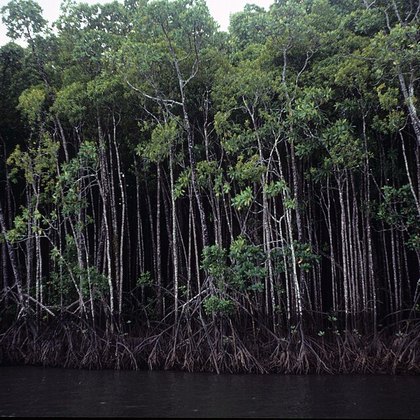
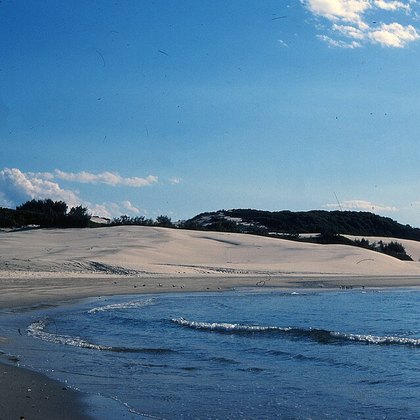
Mangrove is its core country, along with beach forest and the scrub immediately behind the tideline, gardens and parks in coastal towns, and the vegetation of the Torres Strait islands. It almost never moves more than a few hundred metres from salt water. Food is nectar from mangroves and shore trees, supplemented with insects and other invertebrates gleaned from foliage and trunks; spider eggs and soft fruit are also taken. It forages in small parties, often high in the canopy, constantly moving and constantly calling. The nest is a cup of bark and spider web in a fork, usually low in the mangroves.
Where the bird is most often found, arranged by main group and formation.

Range and movements
The centre of gravity lies in New Guinea: the coast and north of the island, Yapen, the Raja Ampat islands, the D'Entrecasteaux Archipelago and the islands of Milne Bay, plus the southern New Guinea coast. In Australia it is confined to the coast of Cape York and north Queensland, with the Torres Strait islands between, reaching south to about Townsville, where Mangrove Honeyeater takes over. Cairns lies in the middle of that Australian range and is where the species is most easily found. It is sedentary and moves very little. It does not occur in New Zealand.
- Resident
- dark = core range, pale = thinly spread
Where and when to look
Walk the Cairns Esplanade on a rising tide, when the waders come closer in and the honeyeaters above the path are at their noisiest. Look at the belly rather than the back: yellow well down onto the underparts, finely streaked, is enough to clinch the species in north Queensland. If you are in doubt south of Cairns, check the throat — barred grey and dull yellow means Mangrove Honeyeater, plain yellow means this bird. Around Townsville a little caution is in order, because there the two species grade into one another.
Conservation
Least Concern (LC) and common throughout its range; in Australian coastal towns it is among the commonest birds of the seafront. What pressure exists comes almost entirely from habitat: clearing and infilling of mangrove for ports, marinas and housing removes its core country, and along the built-up north Queensland coast that loss is locally substantial. Because the species also holds on in gardens and parks wherever flowering trees remain, it has so far largely absorbed it.
Scientific name
Gavicalis versicolor | (Gould, 1843)
John Gould described the bird in 1843 as Ptilotis versicolor; the parentheses around his name show that the species has since changed genus. For a long time it stood in Lichenostomus, but a molecular study in 2011 showed that genus to contain several unrelated branches, and the species ended up in Gavicalis, a name Richard Schodde and Ian Mason coined in 1999 as an anagram of Caligavis, the genus Tom Iredale had introduced earlier. The epithet versicolor is Latin for 'of changing colour' and survives in the English name Varied Honeyeater and the Spanish mielero versicolor. The Dutch name wielewaalhoningeter draws the comparison with the Eurasian Golden Oriole, which carries the same combination of yellow underparts and dark eye-stripe.