All species › Passerines › Honeyeaters › Singing Honeyeater
Singing Honeyeater | Gavicalis virescens
Fluithoningeter | Mielero cantarín
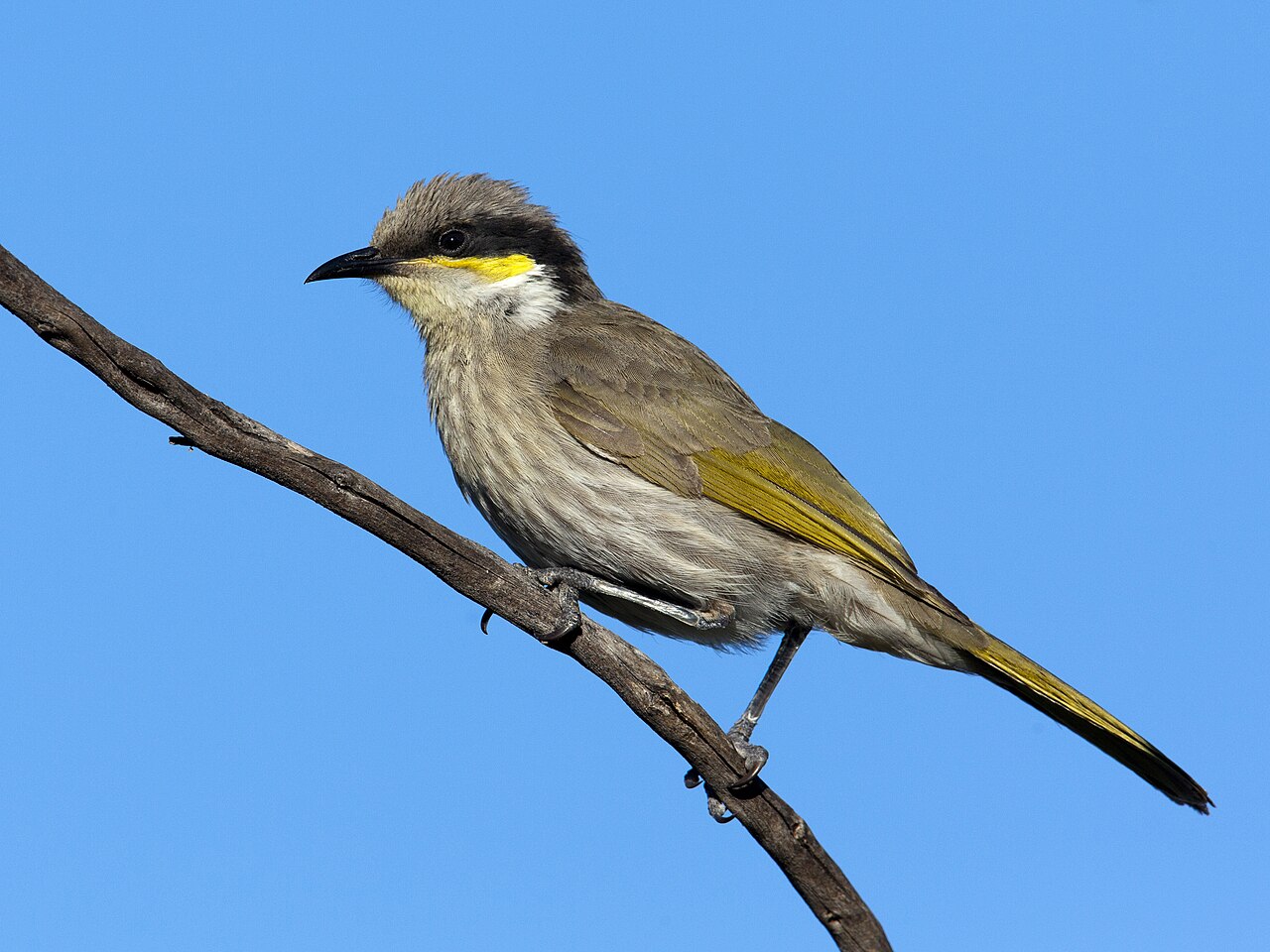
The Singing Honeyeater is the honeyeater you meet everywhere in dry Australia, and it never keeps quiet. It does not look like much — grey-brown, with a black streak through the eye and a yellow smudge beneath it — but its voice fills the landscape: a loud, clear and surprisingly melodious repertoire that at dawn can run for the best part of an hour. It is also a hothead that mobs any intruder in family parties, from another honeyeater to a snake. From the mulga to the front gardens of Perth it is one of the most familiar sounds of western Australia.
Voice
The name is thoroughly earned. The repertoire is large and consists of clear, loud and generally lively, melodious notes: rolling whistled runs, short crisply struck motifs and a strong, repeated prreet-prreet. At dawn it sings early and long — choruses lasting nearly an hour have been described — and it does not fall silent at midday either. There is also a hard chattering scold with which a family party sets on an intruder together. That sheer quantity and carrying power is the best field mark: in dry shrubland this is usually the loudest voice present.
No freely licensed recording has been found for this species yet; what to listen for is described below.
Identification
A medium-sized honeyeater of seventeen to twenty-four centimetres, with a fairly long tail and a stout, slightly curved bill. The upperparts are plain grey-brown, with olive-green to yellowish edges on the wing and tail feathers that give a greenish sheen in sunlight. The face carries the mark: a broad black streak running from the base of the bill through the eye and well back onto the neck, with a bright, narrow yellow smudge immediately below it. Throat and upper breast are white to off-white, the remaining underparts pale grey with distinct fine dark streaking. The bird rarely sits still for long, flies low and direct from bush to bush, and is usually seen in pairs or small family parties.
Confusion species
Singing Honeyeater belongs to the large complex of species once all called Lichenostomus, and resemblance within that group is the main difficulty. Its closest relative is Mangrove Honeyeater (Gavicalis fasciogularis), whose throat is not white but grey with fine white bars and which sits in east-coast mangrove, outside this species' range; Varied Honeyeater (Gavicalis versicolor) is yellower and occurs on Cape York and in New Guinea. On the dry mainland the real pitfalls are Purple-gaped Honeyeater (Lichenostomus cratitius) and Grey-headed Honeyeater (Ptilotula keartlandi): in both the black face streak is shorter and runs back less far, the clear streaking on the underparts is missing, and the throat is not so emphatically white. White-plumed Honeyeater (Ptilotula penicillata) has a white rather than yellow neck smudge and wholly unstreaked underparts. When in doubt, use the voice: none of these species has the Singing Honeyeater's loud, extensive, melodious repertoire.
Habitat
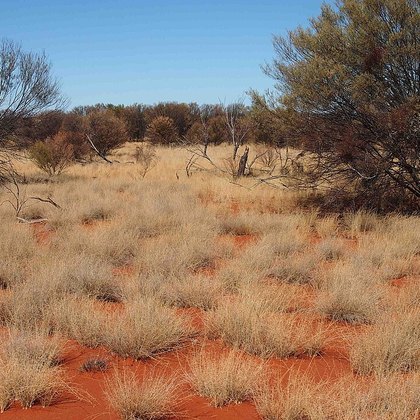
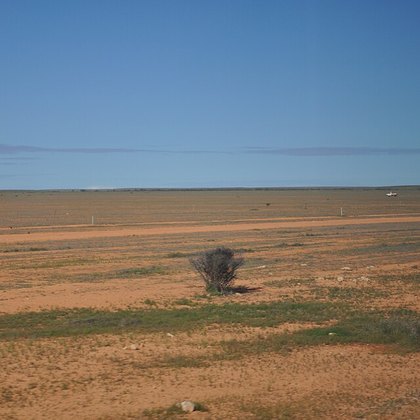
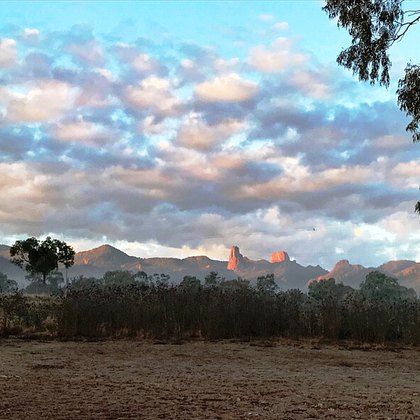
Open shrubland and low woodland, with a preference for acacia and mulga, plus mallee, saltbush and bluebush plain, coastal and dune scrub, riverine woodland along inland creeks, the landward side of mangrove, and partly cleared country with remnant trees. In the south-west it is a common garden bird into the heart of Perth and on islands such as Rottnest. It takes nectar, insects and fruit and is opportunistic with it: raiding the nests of smaller birds has been recorded. It is monogamous, keeps to its partner and builds a cup of grass and cobweb; the breeding season runs from July to February, near the coast from August to November, with one to three — usually two — cream, dark-spotted eggs and an incubation of about fourteen days.
Where the bird is most often found, arranged by main group and formation.


Range and movements
Almost the whole Australian mainland west of the Great Dividing Range, from western Queensland and western New South Wales across the Victorian mallee and all of South Australia and the Northern Territory to the west coast of Western Australia, including offshore islands such as Rottnest and the Shark Bay islands. It is absent from the east coast and from Tasmania, and does not occur in New Zealand. Within that vast range it is largely sedentary, with local shifts that follow flowering and rain.
- Resident
- dark = core range, pale = thinly spread
Where and when to look
Give the eyes a rest and use the ears: in dry shrubland the Singing Honeyeater is usually the bird that sings loudest and longest, and dawn is its hour. Walk towards a singing bird and it will move to the top of a bush and often stay in view, because it is not shy. When identifying, find the black face streak first and follow it back: if it runs well onto the neck, with a yellow smudge below it and a white throat patch above clearly streaked underparts, you have it. In the south-west you can find it without effort in a city park or a caravan park.
Conservation
Least Concern (LC) and common to numerous over most of dry Australia — it is one of the few species that seem little troubled by the clearing of the interior, because it does well in half-open, partly cleared country with remnant trees and also uses planted gardens and watering points. The species additionally gains from the artificial stock waters of the pastoral industry. Where habitat is removed entirely, as under broadacre cropping with no shrub layer, it does disappear. As an aggressive, territorial visitor to blossom it can locally displace smaller honeyeaters, a role it shares in that respect with the miners.
Scientific name
Gavicalis virescens | (Vieillot, 1817)
Louis Pierre Vieillot described the species in 1817 as Melithreptus virescens; author and year stand in parentheses, because it has since moved several times. For a long time it stood as Lichenostomus virescens, until molecular work in 2011 broke up that large genus and this species landed in Gavicalis. That genus name is not a description but a word game: it is an anagram of Caligavis, another genus from the same split. The epithet virescens is Latin for 'turning greenish' and refers to the olive edges of wing and tail. The English name, the Dutch fluithoningeter and the Spanish mielero cantarín all choose the voice, which is indeed the first thing you notice about this bird.