All species › Passerines › Honeyeaters › Tawny-crowned Honeyeater
Tawny-crowned Honeyeater | Gliciphila melanops
Goudkruinhoningeter | Mielero coronado
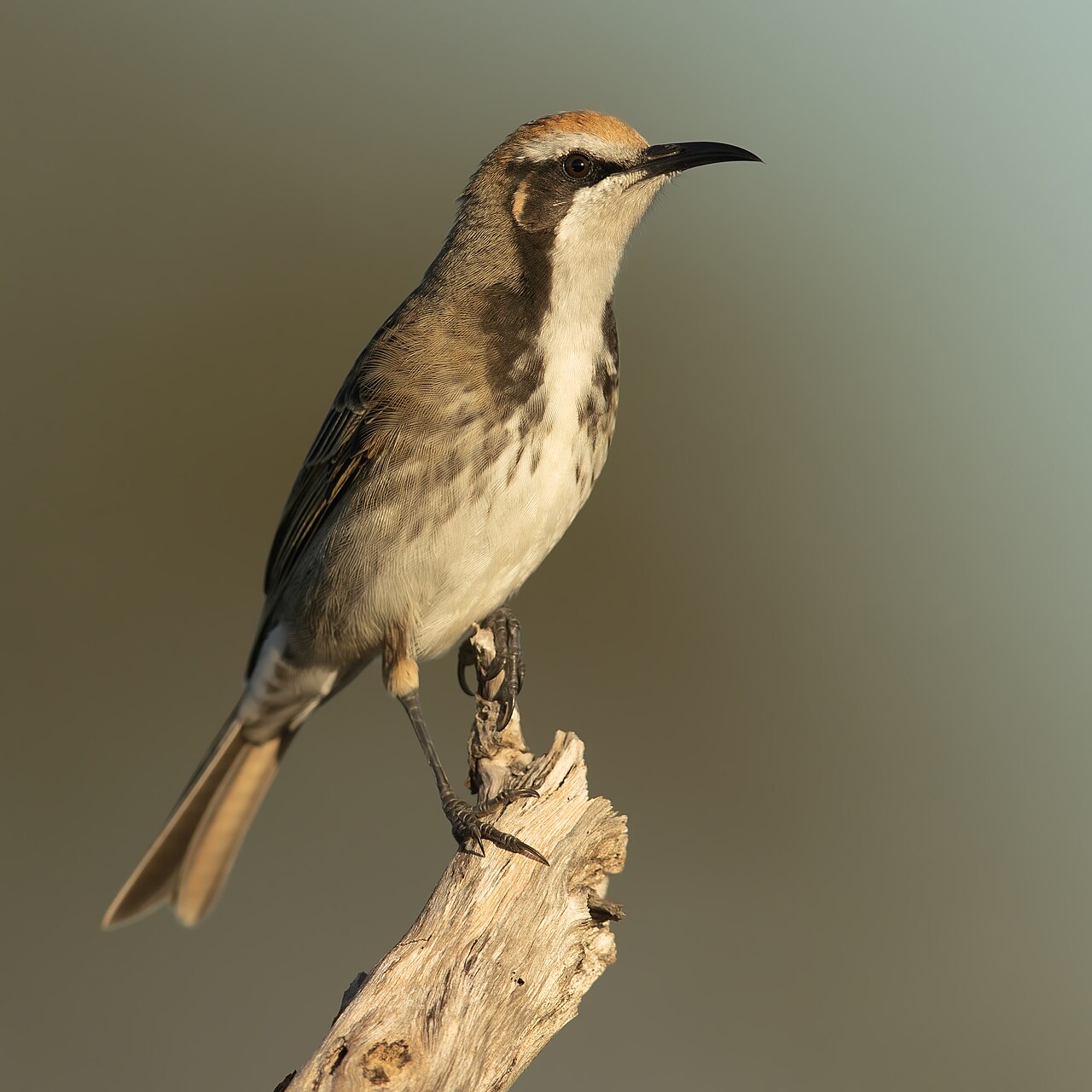
The Tawny-crowned Honeyeater is the honeyeater of the low coastal heaths of southern Australia: a slim, pale bird with a warm tawny crown, a broad white brow and a black wedge running from the eye down the side of the neck onto the breast. It keeps low in the shrubs and on the ground, and usually gives itself away with a mournful, piping whistle that carries far across open heath.
Voice
The voice suits the landscape: empty, distant and faintly sorrowful. The song is a liquid, fluty, plaintive phrase of a few clear notes falling slowly away, in tone recalling Spiny-cheeked Honeyeater but purer and lonelier. It likes to sing from the top of a bush or a bare twig, sometimes during a short song flight in which it climbs at an angle and lets itself drop back. Alongside this come short, sharp contact notes between birds that stay out of sight in the heath.
No freely licensed recording has been found for this species yet; what to listen for is described below.
Identification
A slim honeyeater of fourteen to eighteen centimetres with a long tail and a thin, clearly decurved black bill. The upperparts are pale grey-brown, the underparts white to off-white. The head pattern decides it: a tawny to ochre crown, below it a broad white line that starts at the base of the bill, runs over the eye and curves down behind the ear coverts, and below that a black face descending as two black wedges along the neck to end on either side of the white throat and breast. In flight a yellowish wing panel shows, and a salmon-pink wash on the underwing. Young birds have a browner, white-streaked crown and lack the white head line. Tasmanian birds are slightly more rufous in tone.
Confusion species
Three species with a comparable silhouette share the same heath. Eastern Spinebill (Acanthorhynchus tenuirostris) and Western Spinebill (Acanthorhynchus superciliosus) have a far longer, more strongly curved bill, a rufous nape band and a black-and-white lined head without a tawny crown. Crescent Honeyeater (Phylidonyris pyrrhopterus) is darker and carries black crescents along the breast sides on a grey ground rather than black wedges on white, and its yellow wing panel is brighter than here. New Holland Honeyeater (Phylidonyris novaehollandiae) is heavily streaked black and white over the whole underside and has a white eye. In doubt the crown settles it: none of these species carries the plain tawny cap.
Habitat
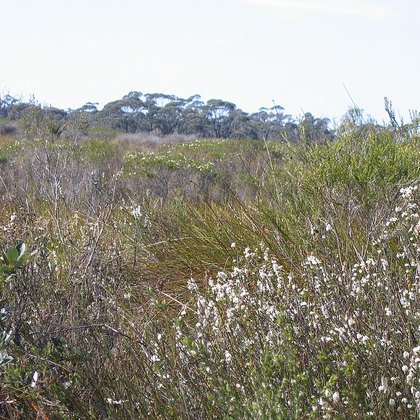
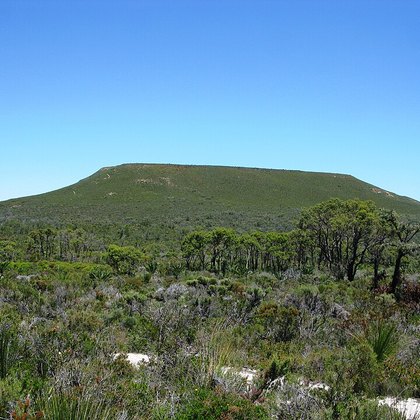
Low, dense heath and shrub heath on poor sands, both the coastal heath of the eastern seaboard and the kwongan of the south-west, together with dune scrub, sandplains carrying heathy vegetation and open sedgeland. It avoids forest and woodland: this is a bird of country where the vegetation reaches waist height and the sky stays open. It eats nectar, drawn with the long curved bill from banksias, heath shrubs and heather-like flowers, plus insects gleaned from the vegetation and sometimes taken while hopping on the ground. The nest is a deep cup of bark, grass, rootlets, leaves and spider web, hidden low in a dense living shrub.
Where the bird is most often found, arranged by main group and formation.


Range and movements
Southern Australia, chiefly along the coast: from the north coast of New South Wales south and west across Victoria and south-eastern South Australia to the western Eyre Peninsula, with a second area in south-western Western Australia from Israelite Bay westwards. The coast of Tasmania belongs to the range as well. Inland it reaches locally well into Victoria and South Australia wherever heath persists. It has been gone from urban Sydney since 1971. It does not occur in New Zealand.
- Resident
- dark = core range, pale = thinly spread
Where and when to look
Find open heath with no trees in it and stand still and listen rather than walk: the mournful whistle betrays the bird long before the eye does. Then follow the sound to the top of a bush, because it likes to sing from a projecting twig. When it flies, watch the wing — the pale yellow panel and the salmon underwing show best in flight and rule out the spinebills at once. A still morning in late winter offers the best chance.
Conservation
Least Concern (LC) and common over most of its range, but the species depends entirely on a habitat that has become badly fragmented across southern Australia. Coastal heath has been given over to housing and farming, and the remaining patches often sit isolated. Fire regime compounds it: the species needs mature, dense heath, and burning too often or on too large a scale leaves ground unsuitable for years. Its local extinction in urban Sydney shows how quickly that can happen once heath is hemmed in by development.
Scientific name
Gliciphila melanops | (Latham, 1801)
John Latham described the species in 1801 as Certhia melanops, that is, initially as a treecreeper; the parentheses around his name record the later move. By way of Phylidonyris it ended up in Gliciphila, a genus William Swainson introduced in 1837 and whose name is built from Greek glykys, 'sweet', and philos, 'lover' — the nectar-lover. The epithet melanops is likewise Greek and means 'black face', for the black mask. Strikingly, all three vernacular names choose the other end of the head: Tawny-crowned Honeyeater, the Dutch goudkruinhoningeter and the Spanish mielero coronado all point at the crown, while the scientific name takes the face. Besides this species the genus holds two more, in New Caledonia and Vanuatu.