All species › Passerines › Honeyeaters › Green-backed Honeyeater
Green-backed Honeyeater | Glycichaera fallax
Brilvogelhoningeter | Mielero dorsiverde
The Green-backed Honeyeater is the honeyeater that looks like no honeyeater: a small, plain olive-green bird of the rainforest canopy of Cape York, yellow below, with a pale iris in a narrow pale eye-ring and blue-grey legs. Seeing it for the first time you think of a white-eye or a gerygone, and precisely that confusion is written into its scientific name. It is the only species in its genus.

Voice
A thin, high sound easily overlooked in the canopy. The best known is a repeated, even series — pee pee pee pee pee — on one pitch, delivered fast and without the rich tone most honeyeaters have. Alongside it come short, wispy contact notes between the birds of a foraging party. Because the species stays high in the leaf cover and the sound carries poorly, in practice the call is often the first and sometimes the only proof that it is present.
No freely licensed recording has been found for this species yet; what to listen for is described below.
Identification
A very small honeyeater of eleven to thirteen centimetres, almost uniformly olive-green to yellow-green on head, back and wings and pale yellow on throat, breast and belly, with no streaking, mask, ear patch or tuft. The head pattern amounts to exactly two things: a pale, grey-white iris and a narrow pale ring around it, which together make a soft pair of spectacles. The bill is short, straight and dark — strikingly little decurved for a honeyeater — and the legs are pale blue-grey, a usable character in good light. Young birds have a dark eye and so lack the very feature the Dutch name refers to.
Confusion species
The main confusion is not with a honeyeater but with a warbler: Fairy Gerygone (Gerygone palpebrosa) is the same size, the same green-yellow colour and forages the same way, but has a dark eye and a shorter, finer black bill, and in the male a dark throat. The white-eyes are the second trap: Silvereye (Zosterops lateralis) shows a broad, sharply defined white eye-ring instead of a vague pale rim, and a grey rather than green back. Large-billed Gerygone (Gerygone magnirostris) is drabber and has a heavier bill. From Dusky Honeyeater (Myzomela obscura) everything separates it: that bird is larger, dark brown-grey and has a long curved bill. Be honest about the limits in the canopy — against the light, a green bird high in the leaves can often only be placed on voice.
Habitat
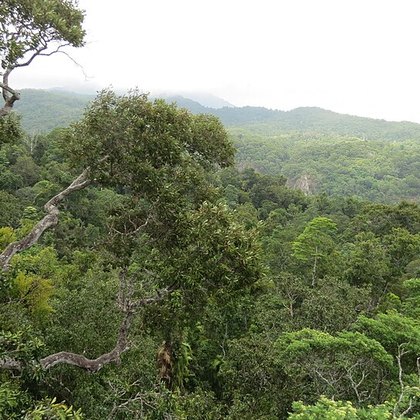
Moist lowland rainforest and the closed forest edges around it, along with monsoon forest and vine thicket; in New Guinea it climbs to about 1800 metres, in Australia it stays in the lowlands. It forages in the canopy and the higher side branches, alone or in small fast-moving parties, and regularly joins mixed flocks of forest birds. Unlike most honeyeaters it lives chiefly on invertebrates, gleaned and hang-picked from leaf and twig; nectar plays a far smaller part than the family name suggests. The clutch averages two to three eggs.
Where the bird is most often found, arranged by main group and formation.

Range and movements
New Guinea, the Aru Islands and the north of Cape York Peninsula in Queensland. In Australia the range is small and confined entirely to the rainforests of the continent's northernmost tip, with the Iron Range and Lockerbie areas the best-known sites; it does not reach south to the wet tropics around Cairns. It is sedentary and hardly wanders. That makes it one of the species Australian birders travel to Cape York specifically to see. It does not occur in New Zealand.
- Resident
- dark = core range, pale = thinly spread
Where and when to look
Expect to hear it first: walk slowly in the Cape York rainforest with an ear turned upward and listen for the flat, repeated series of high notes from the canopy. Then look not for colour but for the eye — a pale iris in a green head is just visible at ten times magnification and separates it at once from the gerygones. A stretch of low forest edge, along a track or a creek, brings canopy birds nearer eye level and is worth seeking out.
Conservation
Least Concern (LC). Across the large New Guinea range the species is common and there is no sign of decline. In Australia it occupies a small range with few observers, so numbers there are poorly known; the Cape York rainforests, however, lie largely within protected areas. Loss of lowland rainforest is the only plausible threat. Other, specific threats cannot be supported from sources for this species and are therefore not stated here.
Scientific name
Glycichaera fallax | Salvadori, 1878
Tommaso Salvadori described the species in 1878 and introduced the genus at the same time; author and year stand without parentheses, because it has always stayed in Glycichaera and is still the only species in it. The epithet fallax is Latin for 'deceptive' or 'misleading' and refers to exactly what the bird does in the field: it looks like something other than a honeyeater. The genus name opens with the same Greek glykys, 'sweet', found in Gliciphila and recurring throughout honeyeater names. The Dutch name brilvogelhoningeter names the deception outright by bringing the white-eyes into it, while the English Green-backed Honeyeater and the Spanish mielero dorsiverde choose the green back.