All species › Passerines › Honeyeaters › Painted Honeyeater
Painted Honeyeater | Grantiella picta
Bonte honingeter | Mielero pintado
The Painted Honeyeater is the mistletoe specialist of inland eastern Australia and, at the same time, one of the family's most sought-after species. The male is black above and white below, with bright yellow panels in wing and tail and a pink bill; the effect is more of a small oriole than of a honeyeater. Where it turns up there is mistletoe, and where mistletoe goes out of the woodland, it goes with it.

Voice
One of the most characteristic sounds of dry summer woodland. The call is a clear, two-syllabled whistle often written as georgie and repeated endlessly from a high branch. The male also sings in a display flight: he climbs steeply from a high perch, then drops fast to another tree, singing the whole way. Because the bird is small and sits high in a thin canopy, that call is usually the first and often the only handle on it.
No freely licensed recording has been found for this species yet; what to listen for is described below.
Identification
A small, compact honeyeater of fourteen to seventeen centimetres with, for the family, a strikingly short bill and short tail. The male is glossy black on head, back and wings, with a broad bright yellow panel along the closed wing and yellow in the tail sides, and white from chin to undertail with a few black streaks on the flanks. The bill is pink with a grey tip — in good light the quickest character of all. The female is duller: greyer above, with less yellow and less sharply drawn flank streaking. Young birds are brownish and have a grey rather than pink bill.
Confusion species
The chief pitfall is Regent Honeyeater (Anthochaera phrygia), which carries the same black and yellow and occurs in the same box-ironbark country: that species is clearly larger at twenty to twenty-four centimetres, has a dark bill and bare warty skin around the eye, and is scaled black on cream below rather than clean white. Both species are rare, and meeting one easily breeds wishful thinking about the other. Females and young birds can at first suggest White-naped Honeyeater (Melithreptus lunatus), but that bird has a white nape band and a black head with no yellow wing panel. From every honeyeater of the dry woodland it is separated by the combination of short pink bill, clean white underparts and yellow wing panels.
Habitat
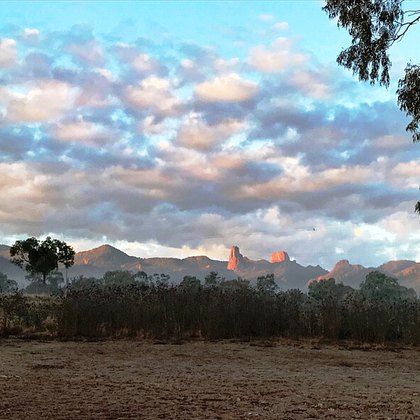
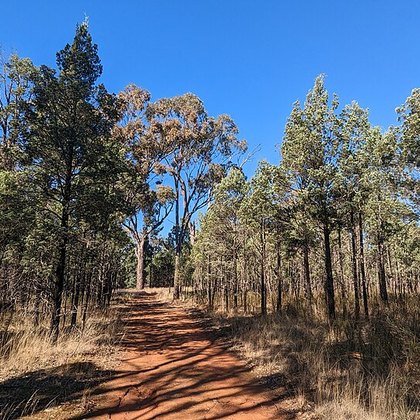
Dry, open eucalypt forest and woodland west of the Great Dividing Range, with brigalow, box woodland, casuarina and cypress-pine woodland and riverine woodland along inland creeks; occasionally it appears in town parks holding large eucalypts. The tie to mistletoe is almost absolute: it lives chiefly on mistletoe berries, particularly of Amyema species, supplementing them with nectar and insects for the protein and amino acids the berries do not supply. It is accordingly also a disperser of mistletoe seed. The nest is a fine, see-through cup of grass, rootlets and spider web, slung three to twenty metres up, often in or beside a mistletoe clump.
Where the bird is most often found, arranged by main group and formation.


Range and movements
Eastern and northern Australia. It breeds from October to March in inland Victoria, New South Wales, the Australian Capital Territory and southern Queensland, mainly on the western slopes and plains behind the ranges. In winter most of the population moves north, into northern Queensland, Cape York and the Northern Territory. The movements are not rigid: the birds follow mistletoe fruiting and can appear locally in numbers in a good year where they have been absent for years. It does not occur in New Zealand.
- Resident
- Breeding (summer)
- dark = core range, pale = thinly spread
Where and when to look
Look for the mistletoe, not the bird. In the summer months walk through dry box woodland or along a creek with riverine timber and scan the canopies for hanging mistletoe clumps carrying ripe berries; stand by such a tree and listen for the repeated two-note whistle. Once the bird shows, the pink bill is the fastest separation from Regent Honeyeater at range. Males sing most in early morning, and that is also when the display flight above the canopy is easiest to see.
Conservation
Globally Least Concern (LC), but within Australia the species is listed as Vulnerable nationally and in New South Wales and Victoria, and a national recovery plan has been written for it. The cause is the loss and fragmentation of dry woodland to clearing and grazing: no old trees, no mistletoe, and no Painted Honeyeater. The picture is not uniform, though, because in some degraded, heavily thinned woodlands mistletoe actually increases. Keeping large, connected tracts of inland woodland with old trees is the core of management.
Scientific name
Grantiella picta | (Gould, 1838)
John Gould described the species in 1838 as Entomophila picta; the parentheses around his name show that it later moved to another genus. That genus, Grantiella, honours a person — the ending says as much — and holds this species alone. The epithet picta is Latin for 'painted' and refers to the crisp black, white and yellow. The English name Painted Honeyeater, the Dutch bonte honingeter and the Spanish mielero pintado all follow that epithet literally, which among honeyeaters is the exception rather than the rule.