All species › Tubenoses › Southern storm petrels › New Zealand Storm-Petrel
New Zealand Storm-Petrel | Fregetta maoriana
Nieuw-Zeelands stormvogeltje | Paíño maorí
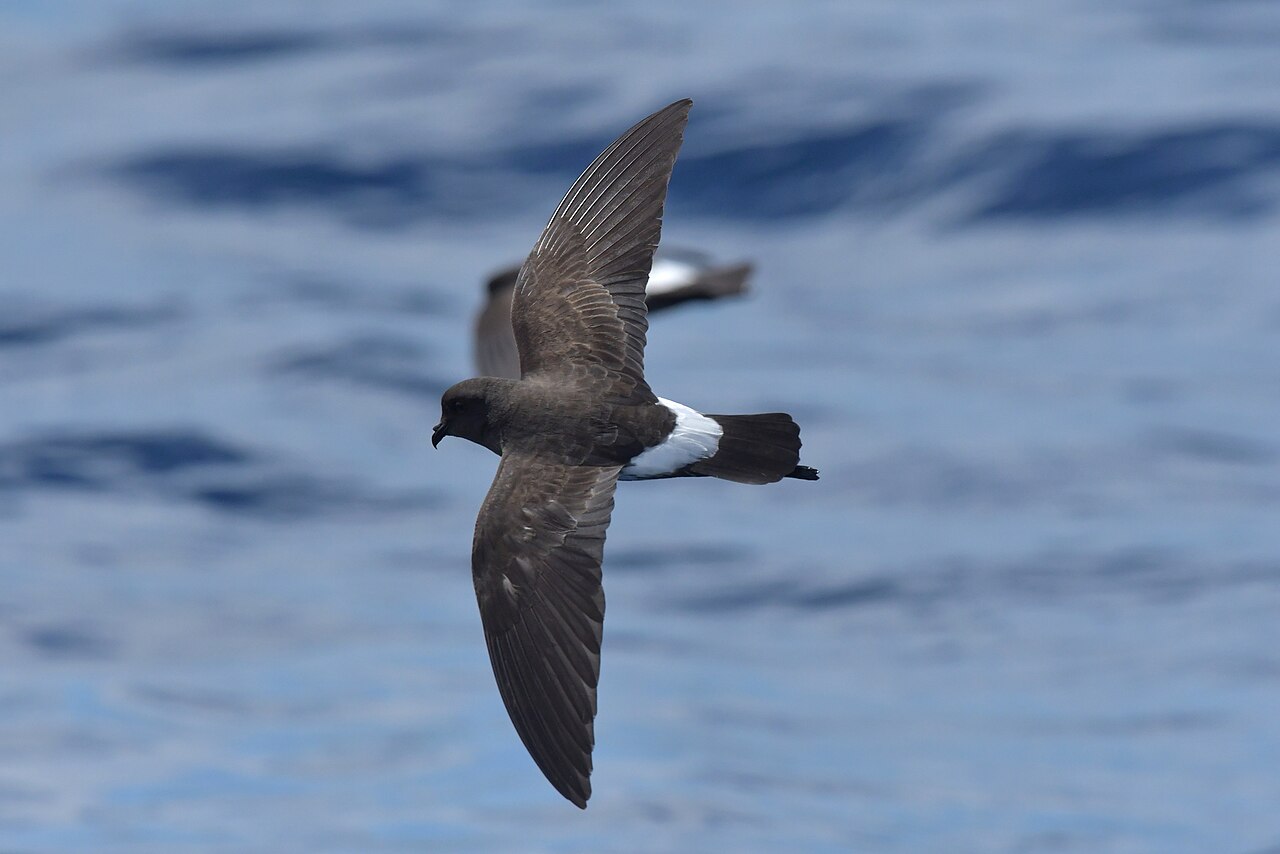
The New Zealand Storm-Petrel was known for a century and a half only from three nineteenth-century skins in European museums, and was taken for extinct. In January 2003 it was found alive off the Coromandel coast, and in 2013 the first nests were located, under the forest of Hauturu-o-Toi. It is a small black-and-white storm petrel with a streaked belly that appears to walk on the water, and as far as is known it breeds on a single island in the world.
Voice
At sea it is all but silent; the birds that appear behind a chum slick in the Hauraki Gulf do so without a sound. At the colony under the forest of Hauturu they come in only in darkness and are not noisy, which is part of why the breeding site took ten years of searching — and transmitters — to find. For the user of this guide, voice is no help here.
No recording with a suitable Creative Commons licence has been found for this species yet; what to listen for is described below.
Identification
Eighteen centimetres and about thirty-five grams: the smallest of the four Fregetta storm petrels here. Head, breast and upperparts are blackish brown, with a sharply defined white rump. The underparts are white but — and this is the feature — marked with bold dark streaking over the flanks and on through the belly, so that the underside looks streaked rather than clean white. A paler bar runs across the inner upperwing; the underwing has a dark leading edge with a white panel inside it. Bill, legs and feet are black, and the feet project beyond the tail. The flight is the image of the genus: swinging left and right low over the water, pushing off with alternate feet so that the bird seems to walk across the surface.
Confusion species
This is the hardest identification group in the guide. New Caledonian Storm-Petrel (Fregetta lineata) has the same streaked belly and is barely separable at sea: it is larger, longer-winged and longer-legged, with denser and bolder streaking and a narrower, less clean white panel on the underwing — the describers themselves leaned mainly on measurements taken from skins. White-bellied Storm-Petrel (Fregetta grallaria) has a clean white belly or at most a few irregular spots, not rows of streaks. Black-bellied Storm-Petrel (Fregetta tropica) shows no streaking but a single broad black stripe down the white belly, and is larger. Wilson's Storm-Petrel (Oceanites oceanicus) is smaller and has an entirely dark belly. Be honest: a streaked Fregetta at range often stays unresolved, and in the Hauraki Gulf the place helps more than the plumage.
Habitat
Outside the breeding season a bird of the open sea over deep water, feeding along current edges and beyond the shelf break. The breeding habitat is unusual for a seabird: it nests under tall closed forest on Hauturu-o-Toi, in crevice-like cavities in crumbly, stony, litter-covered ground, well inland and high on the slopes. That is what makes the colony all but impossible to find without transmitters.
Where the bird is most often found, arranged by main group and formation.

Range and movements
Within this map window it concentrates in summer in the outer Hauraki Gulf and northern New Zealand waters, with the only known breeding site on Hauturu-o-Toi (Little Barrier Island). After breeding the birds move west: there are records off Queensland, New South Wales and Victoria, and off New Caledonia. GBIF holds nearly two thousand records from New Zealand for 2015–2024 against just over fifty from Australia — the ratio between a breeding range and the edge of a wintering range.
- Resident
- dark = core range, pale = thinly spread
Where and when to look
Book a pelagic trip in the outer Hauraki Gulf between November and March, preferably one that uses chum; there the species has gone in twenty years from a ghost to a reasonably reliable sighting. Look for a small storm petrel tapping across the water with alternate feet, then go to the underside: the dark streaking on flanks and belly is what it turns on, and one sharp photograph of the belly is worth ten minutes of watching.
Conservation
Critically Endangered (CR). The species was taken for extinct from about 1850 until 2003 and is known from one breeding island: Hauturu-o-Toi, where the first nests were found with transmitters in February 2013. The population is put at hundreds to perhaps a few thousand birds, and New Zealand lists it nationally as Vulnerable. That it is doing as well as it is comes down to Hauturu being predator-free: the kiore (Pacific rat) was eradicated there in 2004 and the island is a strictly closed nature reserve. That is also exactly where the risk lies — one island, one population, one escaped rat or one fire. Beyond that, fledglings on their first flight are disoriented by artificial light on the water and along the coast.
Scientific name
Fregetta maoriana | (Mathews, 1932)
Mathews described the species in 1932 from the old museum skins, in a genus of its own, Pealeornis; after the rediscovery, genetic work showed it belongs in Fregetta, and because it has therefore changed genus, author and year stand in parentheses. For a time it was carried as Oceanites maorianus. The epithet maoriana simply means 'New Zealand' or 'of the Maori', and the type locality is New Zealand with no closer detail — the old skins carry no precise site. In Maori the bird is takahikare-raro.