All species › Tubenoses › Southern storm petrels › New Caledonian Storm Petrel
New Caledonian Storm Petrel | Fregetta lineata
Nieuw-caledonisch stormvogeltje | Paíño de Nueva Caledonia
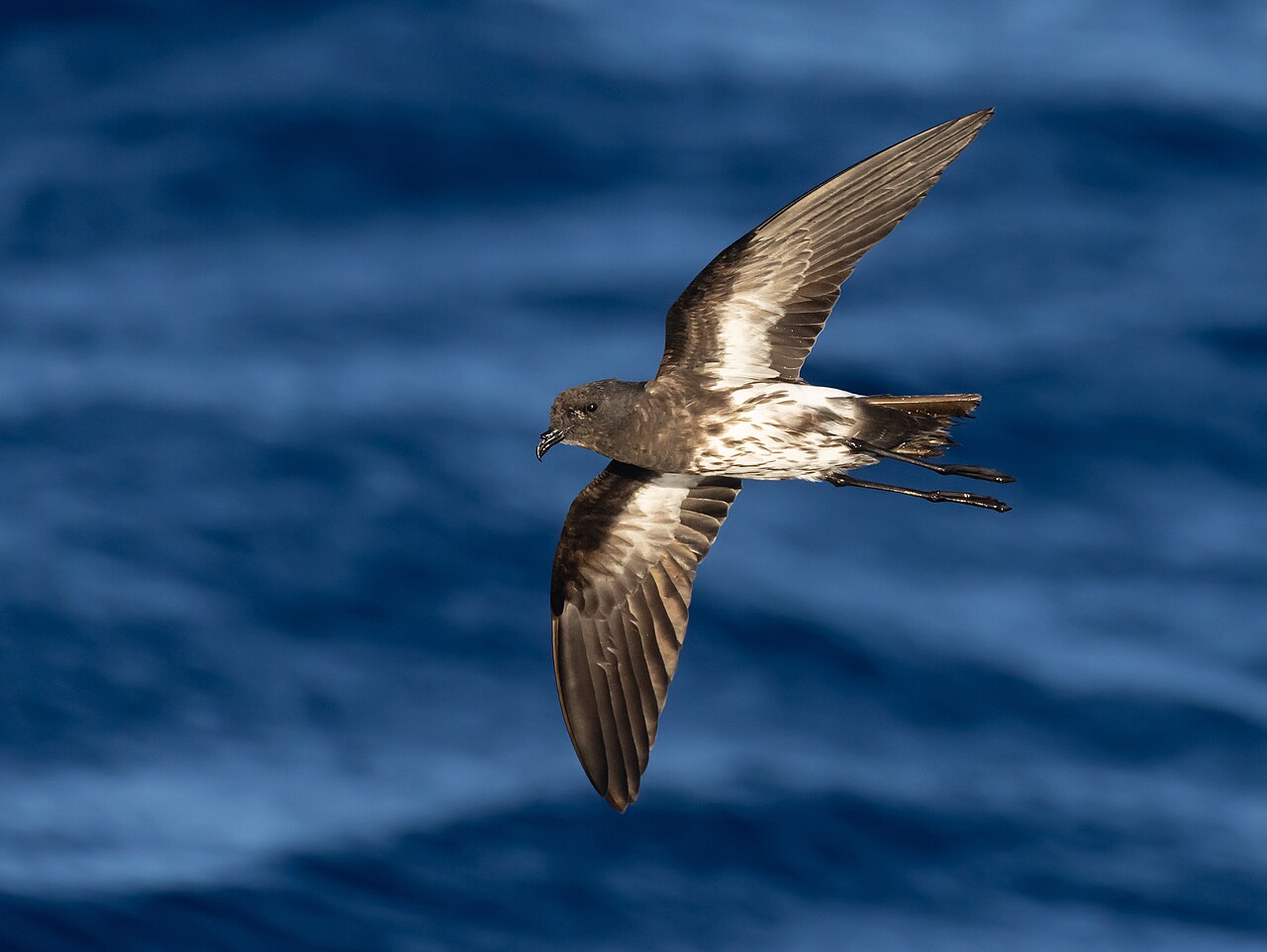
New Caledonian Storm Petrel is the youngest species in this guide: restored as a valid species only in 2022, on the strength of five museum skins and photographs of birds at sea. It is a small black-and-white storm petrel with a conspicuously streaked white belly, and one of the very few seabirds in the world whose breeding grounds have still never been found. In Australian waters it is a rare vagrant.
Voice
Unknown. No call has ever been described for this species, because every record comes from the sea, where the birds are silent, and the colony has never been found. By analogy with the other Fregetta species one might expect soft purring and a persistent piping from burrows at the colony, but that is a guess and not an observation — this is one of the few species in this guide for which voice simply does not exist in the literature.
No freely licensed recording has been found for this species yet; what to listen for is described below.
Identification
A Fregetta storm petrel of an estimated nineteen to twenty-one centimetres, larger than New Zealand Storm Petrel. Head, neck, throat and upper breast are blackish brown, the upperparts blackish brown with a greenish or greyish sheen, and the uppertail coverts form a white U. Lower breast, belly and flanks are white with a distinctive oval blackish-brown streaking set in rows, densest on the flanks — hence the epithet lineata, 'lined'. The underwing has a broad blackish-brown leading edge and, inside it, a fairly narrow and not very clean white panel. The flight is that of the genus: low and swinging, pushing off with alternate feet so the bird appears to walk across the swell.
Confusion species
This is a confusion that science itself failed to resolve for a century and a half, and the user should know it. New Zealand Storm Petrel (Fregetta maoriana) is the near double: smaller, shorter in wing and leg, with finer streaking and a broader, cleaner white underwing panel. White-bellied Storm Petrel (Fregetta grallaria) has a clean white belly, or at most scattered irregular marks — never the consistent rows of streaks of this species. Black-bellied Storm Petrel (Fregetta tropica) shows no streaking but a single broad black stripe down the belly. In practice: only a sharp photograph of the underside settles it, and even the describers relied for the separation from maoriana chiefly on six measurements taken from skins rather than on field characters.
Habitat
Open sea over deep water. The birds are seen in the Coral Sea and the surrounding tropical and subtropical waters, foraging low over the surface. The breeding habitat is unknown: the colony has never been found. The one clue is a juvenile picked up on the New Caledonian mainland on 26 September 2014, which points strongly to a breeding site in the mountains of that island.
Where the bird is most often found, arranged by main group and formation.

Range and movements
Within this guide's map window a vagrant to Australia's eastern waters. The measurement made for this guide (GBIF, 2015–2024) yields thirty-two records, all in Australia and spread over three of the ten years; nothing is known from New Zealand. The first sightings at sea date from 2008, off southern New Caledonia, and since then the species has been seen repeatedly there and off the Australian east coast. One of the five known skins was collected off Brisbane in 1973; the others come from Samoa (1839) and the Marquesas (1922), and the holotype from the Pacific.
Where and when to look
Realistically expect it only on a pelagic trip in the Coral Sea or well off the coast of Queensland and northern New South Wales. Treat every streaked Fregetta as a photographic case: take as many images of the underside and the underwing as you can, because that is where everything sits. Record the position accurately; the most useful contribution an observer can make to this species is a run of well-dated, well-positioned records, because those help to find the breeding grounds.
Conservation
Data Deficient (DD) with the IUCN — which here is not reassurance but an admission. The describers put the world population at one hundred to a thousand pairs and call the species themselves 'potentially already critically endangered'. It is not extinct: birds have been seen at sea with some regularity since 2008. But as long as the breeding site is unknown, literally nothing can be protected: there is no rat to eradicate, no cat to trap, no fence to build. That makes finding the colony — presumably high in the interior of New Caledonia — the most urgent conservation question for this bird, and the authors of the description say so in as many words.
Scientific name
Fregetta lineata | (Peale, 1849)
Titian Peale described the bird in 1848 as Thalassidroma lineata, from material of the United States Exploring Expedition; because the species now stands in Fregetta, author and year go in parentheses. The epithet lineata means 'lined' and refers to the rows of streaks on the belly. For more than a century and a half the type was dismissed as an aberrant individual of another species — a separate genus Pealea was even coined for such 'Pealea forms' — and doubt about where the type had been collected did the rest. Only in 2022 did Bretagnolle, Flood, Gaba and Shirihai restore the species, in the Bulletin of the British Ornithologists' Club, by tying the skins to photographs of the birds off New Caledonia. All three guide names point to that island, although breeding there has not yet been proved.