All species › Tubenoses › Southern storm petrels › White-bellied Storm Petrel
White-bellied Storm Petrel | Fregetta grallaria
Witbuikstormvogeltje | Paíño ventriblanco
White-bellied Storm Petrel is the black-and-white storm petrel with the cleanest underside: jet-black head and breast, a white rump and an unmarked white belly with neither stripe nor streaking. It swings over the swell with wings held high and legs down, as if stepping across the water. In this region it breeds on the islets off Lord Howe and on the Kermadecs — never on an island with rats.

Voice
At sea it is silent. At the colonies, which it visits only at night, a soft, high, repeated piping comes from the rock crevices, alternating with a purring murmur between partners; these are not loud colonies, and the sound is easily lost in the surf around these small, steep islets. For field identification, voice plays no part in this species.
No freely licensed recording has been found for this species yet; what to listen for is described below.
Identification
Eighteen to twenty centimetres with a wingspan of about forty-seven. Head, neck, breast and upperparts are black to blackish brown, with a broad, sharply bounded white rump band. The whole underside from the breast back is clean white, flanks included, and the underwing is white with dark leading and trailing edges. The tail is square, the bill fine and black. The legs are long, but in flight the toes just fail to project, or barely project, beyond the tail tip — a difference that is obvious in flight once you look for it. The flight is springy and swinging: it hangs over the water with wings raised and pushes off with its feet each time, so that it seems to walk from wave to wave.
Confusion species
Black-bellied Storm Petrel (Fregetta tropica) is the standard pitfall: slightly larger, with a broad black stripe down the white belly and with feet that clearly project beyond the tail in flight. Be honest about the limits of that character: in some Black-bellied the belly stripe is narrow or broken, and some White-bellied of the Kermadec population do show dark marks on the belly, so foot projection and flight action are often more reliable than the belly pattern. New Zealand Storm Petrel (Fregetta maoriana) and New Caledonian Storm Petrel (Fregetta lineata) both carry rows of dark streaks over belly and flanks, never an unmarked white belly. White-faced Storm Petrel (Pelagodroma marina) has a white face with a black mask and a grey rather than white rump.
Habitat
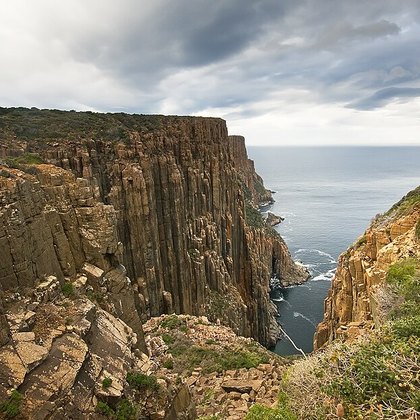
Subtropical and warm temperate open sea over deep water, where it shears over the surface as it feeds. It breeds on predator-free islets, mostly small and steep, off a larger coast: in crevices and cavities among boulders, under overhanging rock and in grass-lined holes, always within walking distance of a place from which it can take off.
Where the bird is most often found, arranged by main group and formation.

Range and movements
Within this map window the subspecies grallaria breeds on the islets of the Lord Howe group — Roach Island and the surrounding rocks near Ball's Pyramid — and on the Kermadec Islands north-east of New Zealand. On the main island of Lord Howe it has been gone since black rats arrived in 1918. At sea it occurs in the Tasman Sea and the subtropical waters off eastern Australia, concentrated between Lord Howe, Norfolk and the New South Wales coast; in New Zealand waters it is considerably scarcer than Black-bellied Storm Petrel.
- Resident
- dark = core range, pale = thinly spread
Where and when to look
Look for it on a pelagic trip in the warm half-year out of Wollongong, Sydney or Port Stephens, or — far better — on the crossing to Lord Howe and Norfolk. With every Fregetta take the belly first (unmarked white?) and the tail tip immediately after: do the feet stick out or not? Those two questions together do more than any other character, and it pays to settle the answer with a photograph.
Conservation
Least Concern worldwide (LC), with a population of the order of three hundred thousand birds across all oceans. The picture in this region is far bleaker: the Tasman Sea subspecies grallaria is estimated at some two and a half thousand pairs in total and is listed as Vulnerable in Australia, both nationally and in New South Wales. The cause is known and nearly always the same: the black rat, which reached the main island of Lord Howe in 1918 and wiped out the colony there, leaving only the rat-free rock stacks. Against that stands one concrete bright spot: after a large-scale eradication campaign, Lord Howe Island was declared rodent-free in 2023, which opens the way for a return to the main island. Light pollution at fledging and plastic in the diet add to the pressure.
Scientific name
Fregetta grallaria | (Vieillot, 1818)
Vieillot described the species in 1818 as Procellaria grallaria; because it has since stood in another genus, author and year go in parentheses. Bonaparte placed it in Fregetta in 1855, a name formed from Fregata, the frigatebird. The epithet grallaria is modern Latin for 'stilt-walker', after the strikingly long legs on which the bird appears to step across the water. The type locality is given vaguely as 'the southern seas'. All three guide names point at the same thing: the white belly.