All species › Passerines › Scrubbirds › Noisy Scrubbird
Noisy Scrubbird | Atrichornis clamosus
Grote doornkruiper | Corredor chillón
The Noisy Scrubbird is a plain brown ground bird of the dense coastal heath east of Albany, held to be extinct for seventy years until it was found again at Two Peoples Bay in 1961. It hardly flies, stays in cover, and in the field can be established almost only by sound. The scrubbirds and the lyrebirds stand at the foot of the songbird tree, which is rooted in Australasia.
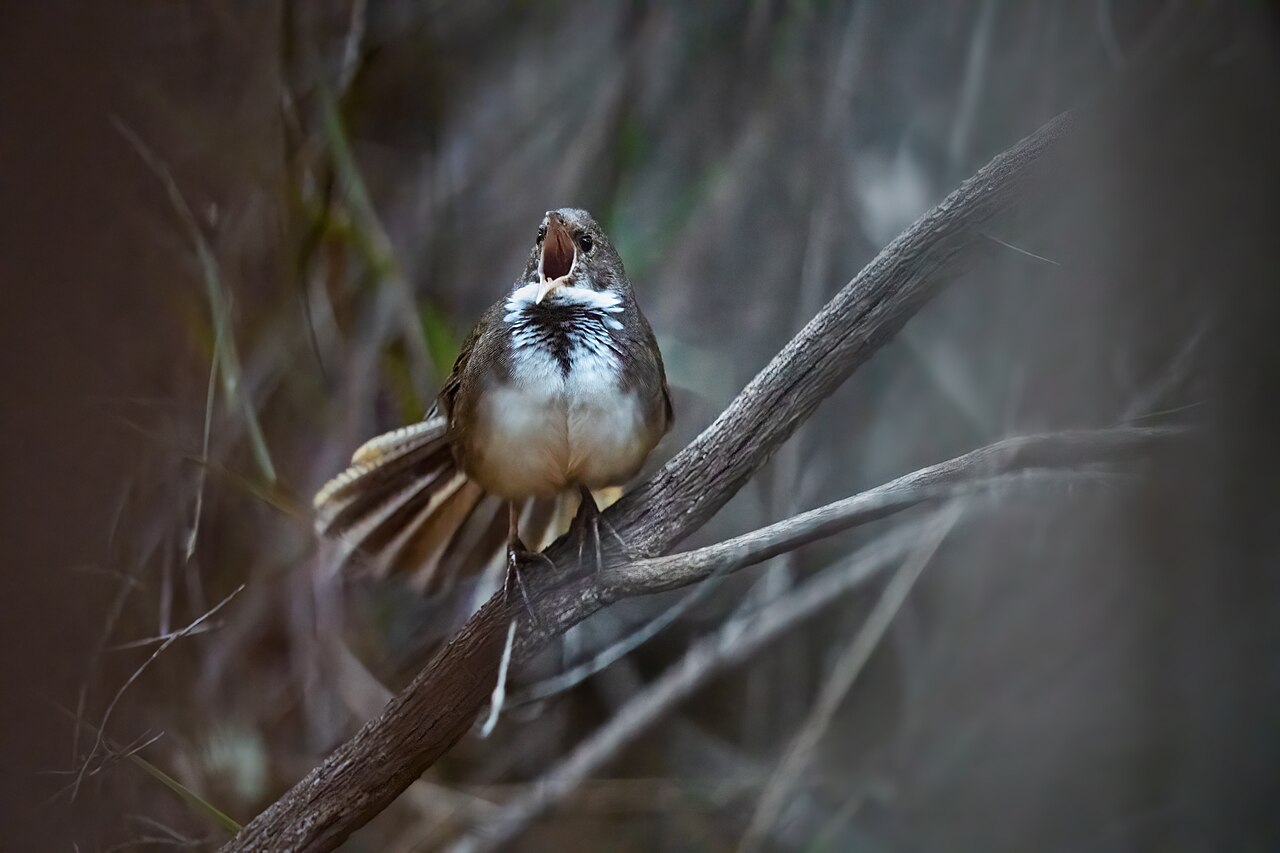
Voice
The male's song is a series of clear, metallic notes rising quickly in strength; loud at a hundred metres, near painful close to, and still audible at a kilometre. It is ventriloquial: the direction deceives, and the bird often sits tens of metres from where it is sought. Between phrases come short, hard tchak notes and mimicry of other heath birds. Males sing all year, most in winter and early spring, from June to October; females are all but silent.
No freely licensed recording has been found for this species yet; what to listen for is described below.
Identification
Nineteen to twenty-three centimetres, a good part of it the long, graduated tail, usually carried cocked. The upperparts are dark red-brown with fine dark vermiculation, the belly rusty and the flanks greyish. The male has a black throat and breast with a white line below it; the female lacks this and is distinctly smaller. The wings are short and rounded and the flight is feeble: it would rather run, low and with the tail up, and rarely crosses open ground. Young birds are duller and lack the throat pattern.
Confusion species
Western Bristlebird (Dasyornis longirostris) lives in the same heath and is as brown, but has scalloped underparts, a short broad tail with dark bars, and a more musical song that is nothing like as loud. Scrubwrens of the genus Sericornis are smaller and move higher in the bush. Rufous Scrubbird (Atrichornis rufescens) is the only related species and lives four thousand kilometres away, in the border ranges of New South Wales and Queensland; confusion in the field is impossible.
Habitat
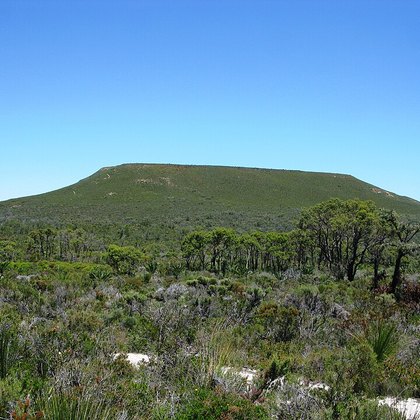
Dense low vegetation in damp hollows and along drainage lines within coastal heath, with sedge, shrubby heath and a closed roof from knee to eye height. It needs cover that has not burnt for ten years or more; it is absent from recently burnt heath and returns only years later. The dense understorey of moist eucalypt forest on the slopes of Mount Manypeaks is occupied as well. Open, low-cropped heath and bare ground it avoids entirely.
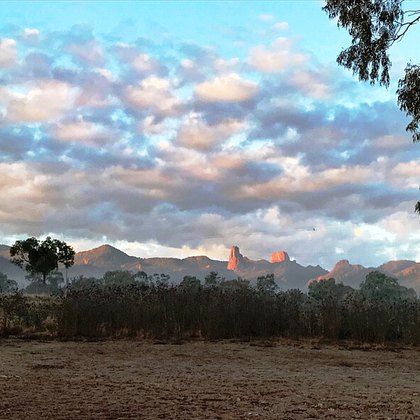
Where the bird is most often found, arranged by main group and formation.
Range and movements
The whole range lies in the far south-west of Australia, in a handful of reserves east of Albany: Two Peoples Bay with Mount Gardner, Mount Manypeaks and Waychinicup. In the nineteenth century the species occurred much further west — the type locality lies between Perth and Augusta — and after 1889 it went unreported and was taken for extinct. In 1961 a small population was found again at Two Peoples Bay; the town planned there was shelved and the area became a reserve. Birds have since been moved to Bald Island, the Porongurup and Waychinicup, with mixed success.
- Resident
- dark = core range, pale = thinly spread
Where and when to look
Count on hearing, not on seeing. Go in winter or early spring, June to October, at first light to the tracks at Two Peoples Bay and stand still; the song carries far, but the direction misleads and walking does not help. To see the bird itself takes luck with one that crosses a path, and that lasts a second. Playing recordings to draw it out has no place here: this is an endangered species with a small number of territories.
Conservation
Endangered (EN). Estimates come to about fifteen hundred birds, spread over a few subpopulations within an area of less than fifty square kilometres. Fire is the heaviest threat: one summer fire can empty a whole subpopulation, as happened at Mount Manypeaks, and the heath then needs ten years before it is habitable again. Foxes, feral cats and black rats take birds that cannot fly clear.
Scientific name
Atrichornis clamosus | (Gould, 1844)
Gould described the species in 1844 as Atrichia clamosa; because it was later moved to another genus, author and year stand in parentheses. The name Atrichia proved to be taken already, and Stejneger replaced it in 1885 with Atrichornis, from Greek a- (without), thrix (hair or bristle) and ornis (bird): the bird lacks the stiff bristles that related families carry around the base of the bill. clamosus is Latin for 'noisy'. The type locality reads 'between Perth and Augusta, Western Australia'.