All species › Passerines › Lyrebirds › Superb Lyrebird
Superb Lyrebird | Menura novaehollandiae
Liervogel | Ave lira soberbia
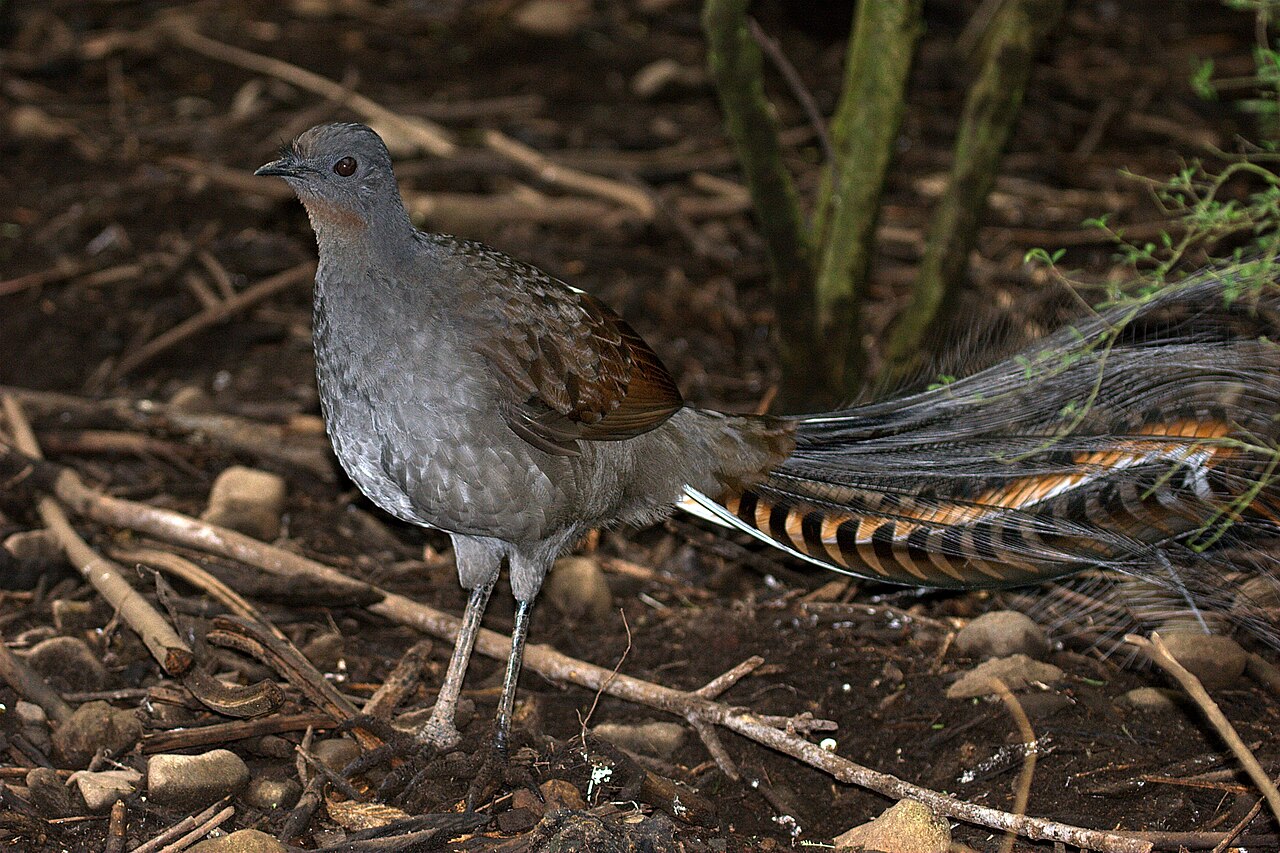
The Superb Lyrebird is a large brown ground bird of moist forest in the south-east, known for the male's lyre-shaped tail and for its mimicry. It sings in midwinter, in June and July, when the rest of the forest is silent.
Voice
The song is loud, sustained and built almost entirely out of mimicry: an estimated seventy to eighty per cent of what a male sings is the sound of another bird. In the field the models are species of its own forest — Eastern Whipbird (Psophodes olivaceus), kookaburra and Pilotbird (Pycnoptilus floccosus) — copied so accurately that the imitated species often cannot hear the difference. It has its own song as well: blowing whistles, a rattling klik-klak and a shrill alarm that carries down a whole valley. In display the male imitates no single species but a whole alarming flock at once, and does so at two moments: when the female makes to leave, and during copulation. The mimicry is a tradition — in Sherbrooke Forest the birds went on imitating Pilotbird for decades after it had gone. Chainsaws and camera shutters belong to the story but not to the field: those recordings come from captive birds.
Recording: JJ Harrison — CC BY-SA 4.0 · Royal National Park, Sutherland Shire Council, New South Wales, Australia · xeno-canto
Identification
A large, long-bodied ground bird of 80 to 100 cm, of which more than half is tail in the male. The plumage is unremarkable: grey-brown above, paler grey below, with rufous wings and heavy black legs. The male's tail carries two broad curved lyrates and twelve fine filamentaries, and thrown over the head makes a silver-white fan. The female is shorter, around 86 cm, with an ordinary brown tail; young males look like this for years. It flies rarely and roosts high in a tree.
Confusion species
The only other lyrebird is Albert's Lyrebird (Menura alberti), smaller, warmer rufous and confined to the Queensland–New South Wales border; overlap is negligible. Females and young are confused on the forest floor with Australian Brushturkey (Alectura lathami), which is black with a bare red head. Anyone going by song alone must be careful: a lyrebird imitating a whipbird sounds like a whipbird, and the difference lies in the sequence.
Habitat
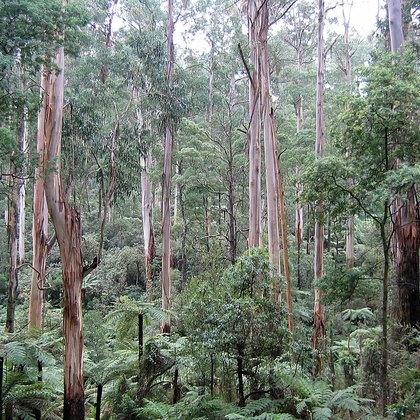
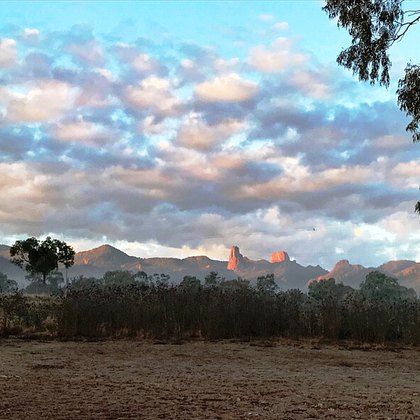
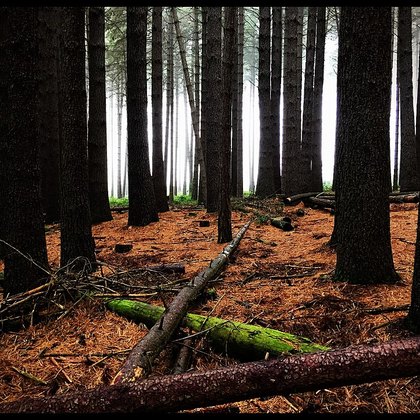
Wet sclerophyll forest with a dense fern layer and deep moist litter in sheltered gullies, and cool temperate forest with southern beech. Drier eucalypt forest and mature plantations are used as well, as long as the soil stays damp and there is cover. It is tied to the ground: it rakes the litter with heavy feet and shifts so much material that it measurably changes the forest. It avoids open, dry and bare country.
Where the bird is most often found, arranged by main group and formation.

Range and movements
From southern Victoria north along the Great Dividing Range into south-eastern Queensland, in a narrow band of moist forest. Birds were released in southern Tasmania between 1934 and 1954; that population persists and is expanding. The species is extremely sedentary — a bird stays in the same gully for life — so that areas burnt out, as in the summer of 2019 and 2020, are only repopulated from unburnt ground nearby.
- Resident
- dark = core range, pale = thinly spread
Where and when to look
Go into a moist gully at first light in winter, in June and July, and stand still: the male then sings for hours from one of his raked earth mounds and is easier to find by ear than by eye. Follow the sound slowly and stay on the track; the bird walks off as soon as it sees movement. In Sherbrooke Forest near Melbourne and in the Blue Mountains near Sydney that is an ordinary winter morning.
Conservation
Not threatened; still common across its range and increasing in Tasmania. Foxes and feral cats take birds on the ground, and the severe fires of 2019 and 2020 struck a considerable part of the range. Because the bird is so sedentary and matures so late, a burnt-out gully recovers slowly.
Scientific name
Menura novaehollandiae | Latham, 1801
Latham described the species in 1801 as Menura novaehollandiae, introducing the genus Menura in the same work; author and year stand without parentheses. Menura is formed from Greek mene (moon) and oura (tail), after the pale crescent marks on the tail feathers. novaehollandiae means 'of New Holland', the name by which Australia was then known. The type locality is New South Wales. The Dutch name follows the English: superb became 'pracht'.