All species › Passerines › Lyrebirds › Albert's Lyrebird
Albert's Lyrebird | Menura alberti
Alberts liervogel | Ave-lira de alberto
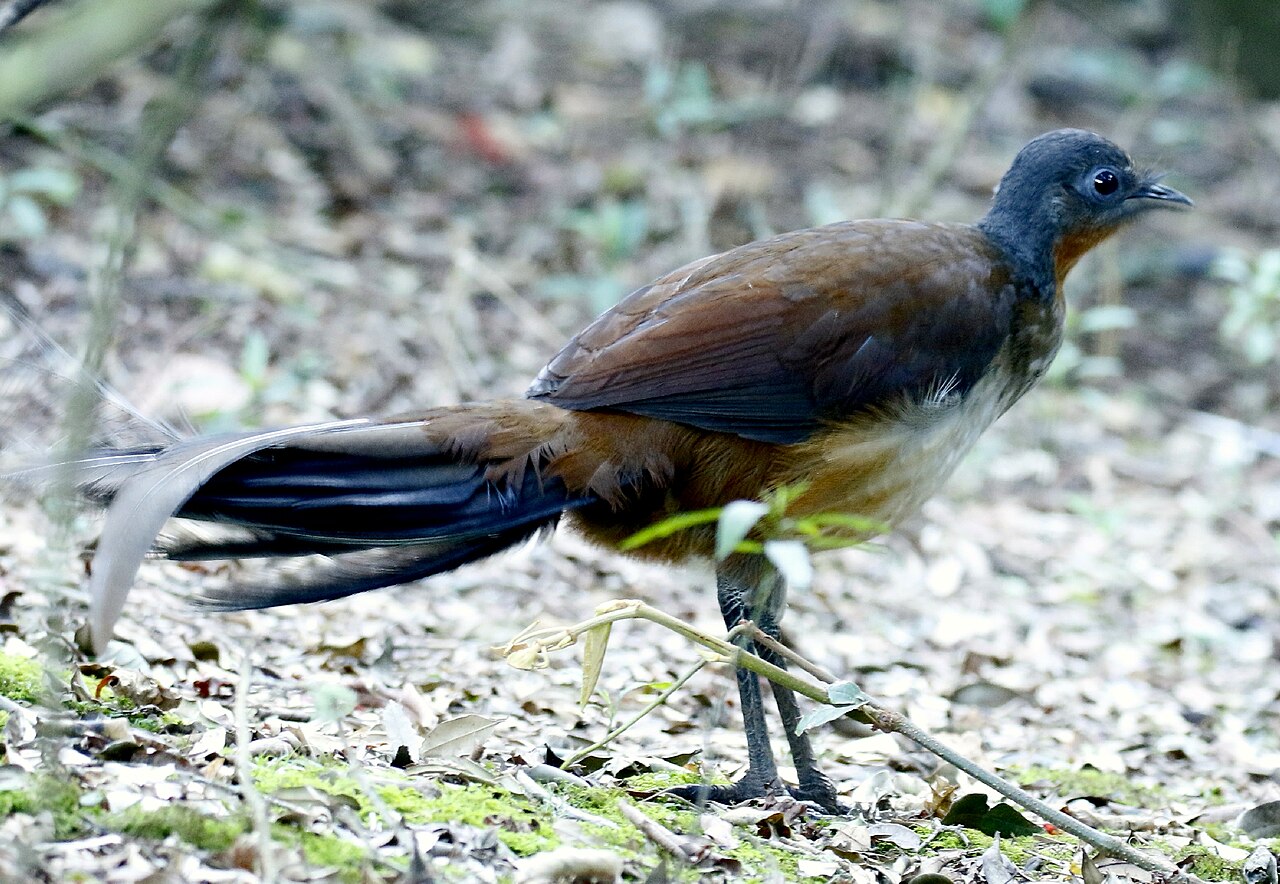
A large, rufous-brown forest bird that lives on the ground and is the smaller of the two lyrebirds, with by far the smaller range: only the border ranges of south-eastern Queensland and north-eastern New South Wales. Its fame rests on its voice, for it builds its song almost entirely out of imitations of other forest birds, so convincingly that an observer is easily misled by it.
Voice
The territorial song is one of the most remarkable sounds in Australia: a long, loud sequence consisting almost wholly of mimicked voices of other forest birds, strung into one sustained recital and audible over hundreds of metres. Regular components are the voices of the Satin Bowerbird, the Australian King-Parrot and the Eastern Whipbird. Between them come a cracking gronk of its own and a rhythmic mechanical rattle. Song peaks in the southern winter, from June to August, in the first hour after sunrise.
No freely licensed recording has been found for this species yet; what to listen for is described below.
Identification
A large, almost fowl-like forest bird with powerful legs and heavy feet, warm rufous-brown on back and wings and grey-brown on head and underparts, with a rusty throat. The male has a long tail, but it lacks the two broad, curved lyre feathers of the Superb Lyrebird (Menura novaehollandiae): the outer tail feathers here are narrow and dark with rufous webs, and the rest of the tail consists of fine, hair-like filaments. In display the tail is thrown forward over back and head and then forms a quivering, translucent curtain rather than a lyre. The female is smaller, with a shorter and simpler tail. The display site is a platform of trampled vines and sticks in the understorey, not the scraped earth mound the other lyrebird uses; the male makes the platform vibrate with his feet while singing.
Confusion species
Confusable only with the other lyrebird, the Superb Lyrebird (Menura novaehollandiae), which is larger and greyer-brown, carries the two broad lyre feathers in the male and holds its display on a scraped earth mound instead of a platform of vines. The ranges adjoin without overlapping: Albert's Lyrebird holds the border ranges, the other species the country south of them. On sound the pitfall lies elsewhere: because the song consists of imitations, species that are not present are regularly recorded from it.
Habitat
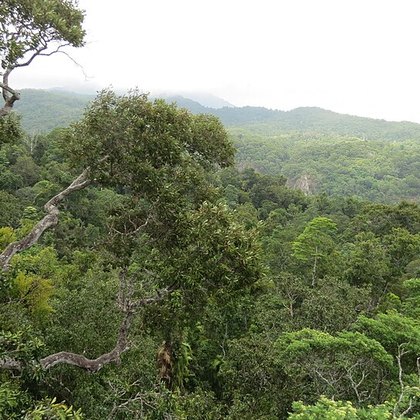
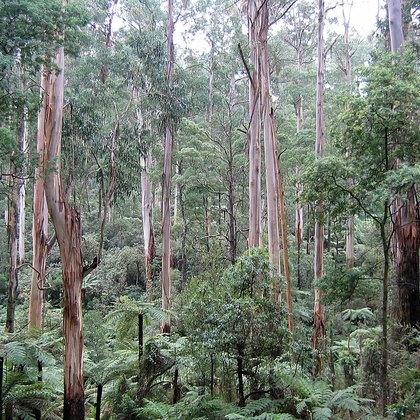
Subtropical rainforest and Antarctic beech forest on the highest ridges, with a dense, moist litter layer in which the bird turns over the ground, and besides this adjoining wet sclerophyll forest with a rainforest-like understorey. Usually between about three hundred and eleven hundred metres. For food the bird depends entirely on that deep, moist litter with soil life beneath it.
Where the bird is most often found, arranged by main group and formation.

Range and movements
The smallest range of any lyrebird: the mountain chains of the border country between south-eastern Queensland and north-eastern New South Wales, roughly from the Main Range and the Lamington plateau south to the Nightcap and Richmond ranges. The total range amounts to only a few thousand square kilometres across a handful of mountain blocks. Resident, staying within the same forest all year, with at most altitudinal shifts in severe cold.
- Resident
- dark = core range, pale = thinly spread
Where and when to look
Go into the mountain rainforest before sunrise in the southern winter, from June to August, and stand and listen: the long mimicry sequence carries far and gives the direction. Then walk very slowly and listen for the sound of raked leaves, for the bird gives itself away more often by raking than by sight. The platforms of trampled vines are recognisable and stay in use for years, so a site found once is worth returning to the next morning.
Conservation
Near Threatened. The range is exceptionally small and fragmented, and the historical logging of mountain rainforest narrowed it further. Current threats are feral cats, foxes and dogs, which hit a ground-nesting bird with a single egg hard, and increasing bushfires pushing into rainforest — a forest type that does not normally burn. Most of the range lies within protected World Heritage rainforest reserves.
Scientific name
Menura alberti | Bonaparte, 1850
Bonaparte described the species in 1850 and named it after Prince Albert, the consort of Queen Victoria; the Dutch and English names follow that dedication. The genus Menura was introduced by Latham in 1801, from Greek mene (moon) and oura (tail), after the moon-shaped pale spots on the tail feathers of the Superb Lyrebird. The genus holds only two species, which together make up the family Menuridae; the other, the Superb Lyrebird (Menura novaehollandiae), is described elsewhere in this guide.