All species › Gamebirds › Megapodes › Orange-footed Scrubfowl
Orange-footed Scrubfowl | Megapodius reinwardt
Rood boshoen | Talégala de reinwardt
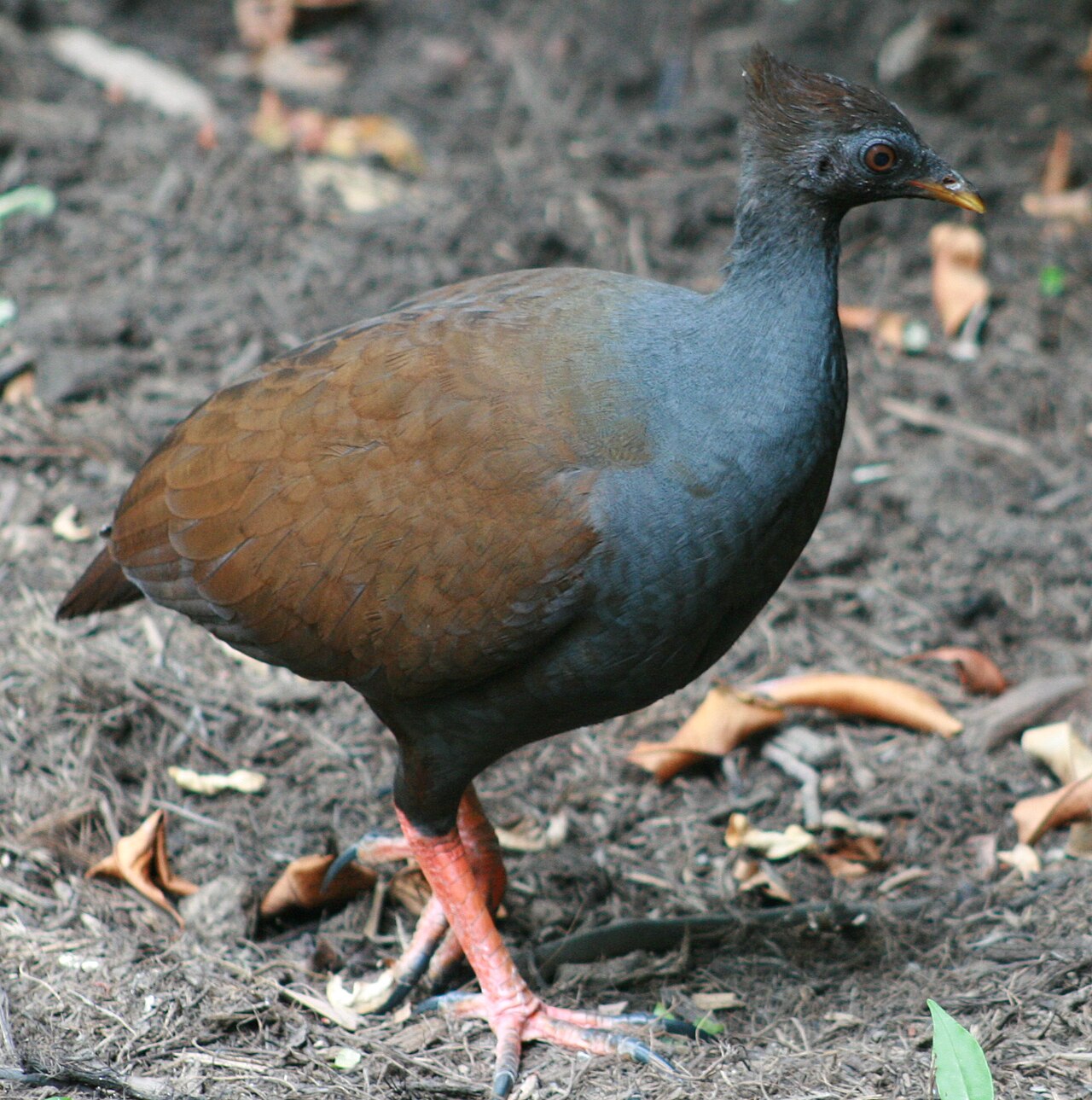
Orange-footed Scrubfowl is the megapode of the Australian tropics: a dark, chicken-sized forest bird with stout orange legs and a pointed crest at the back of the head. Like its relatives it does not brood, but lays into a heap of sand and rotting leaves that supplies the heat. In Darwin it walks between the gardens and everyone knows it as the bush chook.
Voice
One of the noisiest forest birds of the north, above all after dark and at first light. The pair calls in duet: a run of chuckling, accelerating notes that breaks into a shrill, near-hysterical scream — okok-ok-ok-owwwwk owwwwk. The sound carries a long way through dense rainforest and suggests a gamebird raising the alarm rather than a songbird. Around the mound the screaming can go on for hours.
No freely licensed recording has been found for this species yet; what to listen for is described below.
Identification
A dark, thickset ground bird of forty-two to forty-seven centimetres with a small head and a heavy rear end. Head and neck are dark brown to dark grey, the upperparts chestnut, the wings dark brown and the underparts greyish. A small pointed crest sits at the back of the crown and fixes the shape. The legs are the striking feature: heavy, coarsely scaled and bright orange, with big powerful toes for raking litter. The sexes look alike. It flies rarely and clumsily, legs dangling and trailing.
Confusion species
Australian Brushturkey (Alectura lathami) is the only other megapode sharing ground with it in Queensland: far larger at 60–75 cm, glossy black, with a bare red head, a yellow throat wattle and a laterally flattened tail, and no orange legs or crest. Malleefowl (Leipoa ocellata) of the southern mallee comes nowhere near it. Red Junglefowl (Gallus gallus), feral on a few islands, has a red comb and wattles and a sickle-shaped tail. Beyond those, a dark forest bird on bright orange legs in the northern tropics is hardly anything else.
Habitat
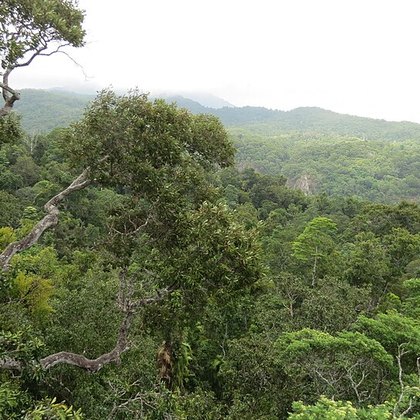
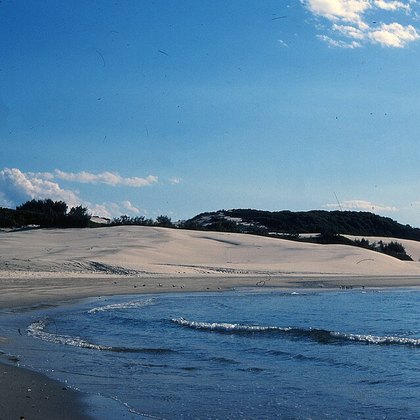
Rainforest with a closed canopy that holds shade and moisture, monsoon forest and vine thicket, and beyond that dense patches of eucalypt forest, mangrove edge and swamp forest. It is particularly attached to coastal forest and the scrub strip behind the beach, where it builds its mound on sand above the tideline so that the sun does the work. In Darwin and on Cape York it also uses gardens, park edges and the shaded strips along roads at the fringe of towns.
Where the bird is most often found, arranged by main group and formation.


Range and movements
Tropical northern Australia: the Top End of the Northern Territory including Darwin, Kakadu and Arnhem Land, the Tiwi Islands, the Kimberley, the upper half of Cape York and the islands of Torres Strait, and down the Queensland coast to about Yeppoon. Several races divide that ground. Outside the guide the range runs on through New Guinea and the Lesser Sundas. It does not occur in New Zealand.
- Resident
- dark = core range, pale = thinly spread
Where and when to look
Walk a rainforest track at East Point or the Darwin Botanic Gardens at sunrise and let the screaming lead you; you will nearly always hear it before you see it. Then look on the forest floor for turned-over litter and follow the line of big triangular footprints. A huge, low-spread heap of sand against a tree base or behind the beach is usually his, and successive pairs keep using it for years.
Conservation
Least Concern (LC), with a stable population and common to locally numerous right across the north. Adaptability helps: it holds on in the gardens and parks of Darwin and Cairns, and the mound it reuses for years makes it less dependent on undisturbed forest than many rainforest birds. The risks lie in the loss of coastal rainforest and vine thicket to development and fire, and in pigs and dogs digging out mounds; on the Torres Strait islands some egg-collecting continues. None of these currently threatens the species as a whole.
Scientific name
Megapodius reinwardt | Dumont, 1823
Dumont described the species in 1823 as Megapodius reinwardt, in the Dictionnaire des sciences naturelles, and it has stayed in that genus, so author and year carry no parentheses. Megapodius is built from Greek megas, 'large', and pous, podos, 'foot': the big foot with which the whole family rakes its mound together. The epithet reinwardt honours Caspar Georg Carl Reinwardt, the German-Dutch naturalist who founded the botanic garden at Buitenzorg on Java and sent material from the archipelago to Europe; it stands as a noun in apposition, hence the unusual form without -i or -ii. Amboina was given as the type locality, but that rests on an error: the type came from Lombok.