All species › Gamebirds › Guineafowl › Helmeted Guineafowl
Helmeted Guineafowl | Numida meleagris
Helmparelhoen | Gallina de Guinea
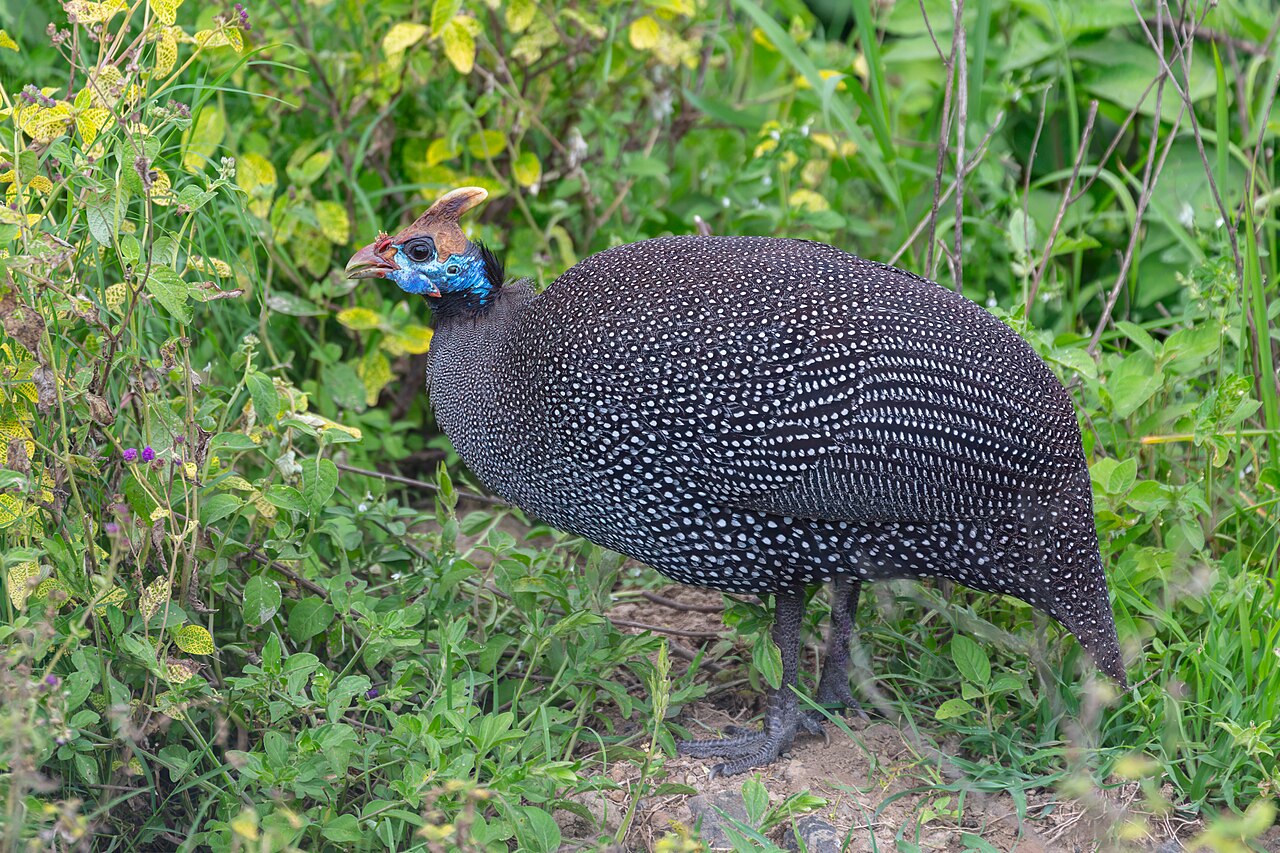
The Helmeted Guineafowl is an African savanna bird that has walked off the farmyard in Australia and New Zealand. The slate plumage with its thousands of white pearls is unmistakable, and so is the bare blue-and-red head with its bony casque. Self-supporting flocks exist, but almost always within walking distance of a farm.
Voice
Loud and hard to miss. The female calls a penetrating two-syllable buck-wheat that carries across whole paddocks; the male keeps to a single repeated chek. At any alarm the whole flock breaks into a harsh rattling kek-kek-kek-kek-krrrrr that stops only once the birds have run clear. They call most at dusk, going up to the roost.
Recording: Kileo Jumah — CC0 · Ngorongoro Conservation Area (crater floor), Arusha, Tanzania · xeno-canto
Identification
Fifty-six centimetres, a rounded bird with a humped back, small head and short neck, so that in profile it reads as an upturned drop. The plumage is slate to black and spangled from head to tail with round white pearls; at a distance the bird simply looks grey. The head is bare and blue-white with red wattles and carries a bony, horn-coloured casque, taller in the male. Legs and bill are dark. Young birds are browner, with a short casque and downy feathering on head and neck. It walks a great deal and flies short, low and noisily.
Confusion species
There is no second grey, white-spotted gamebird in the region, so confusion comes mainly at range. Wild Turkey (Meleagris gallopavo) is twice the size, dark brown-black and without pearls. Australian Brushturkey (Alectura lathami) also has a bare red head, but no casque, no spots and a tall, laterally flattened tail. A party of guineafowl crossing a paddock is sometimes taken for young turkeys; the stocky build, the short neck and the calling settle it.
Habitat
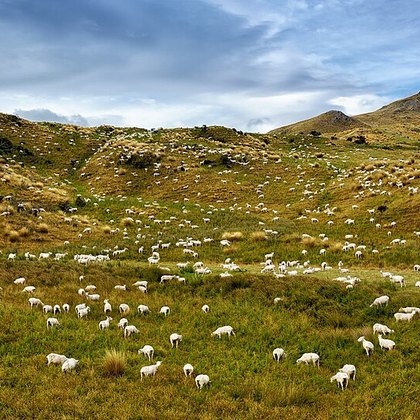
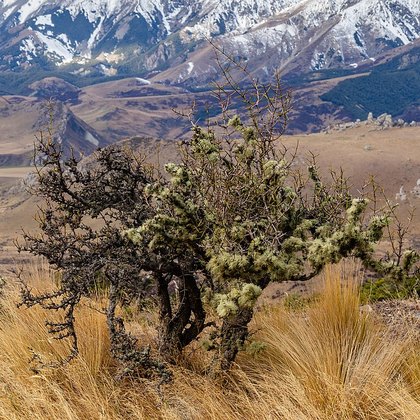
Grazed grassland with regrowth, crop edges, farmyards and orchards, and in New Zealand also manuka and gorse scrub on abandoned pasture. It needs a mosaic: open ground to forage on, dense cover to slip into and trees to roost in. Uniform short pasture without shrubs it leaves alone, and where pesticides are used heavily it disappears, because much of its diet is insects. In Africa this is the same bird of the open savanna.
Where the bird is most often found, arranged by main group and formation.


Range and movements
At home across Africa south of the Sahara, from the Sahel to the Cape. In New Zealand it was released from the 1860s; those attempts failed, and what runs wild now descends from later escapes from farmyards. Between 1999 and 2004 it was found in less than one per cent of the country, almost entirely on farmland around Auckland and the Kaipara. In Australia the picture is the same: scattered flocks around farms and townships in the east and southwest, with no continuous range. Nowhere in the region is the species independent of human holdings.
- Resident
- dark = core range, pale = thinly spread
Where and when to look
Do not look for it in reserves but along the road through farmland: yards, stock grids, maize stubble and the verges of country roads at first light. A party walking in single file across a paddock that runs off rather than flies when approached is almost certainly this bird. Watch the roost trees at dusk, when the racket of birds going up gives the flock away.
Conservation
Not threatened globally (LC) and common in Africa. In New Zealand the wild population is small and probably cannot maintain itself unaided; it is topped up continually by birds escaping from farmyards. The same holds in Australia. In neither country is it treated as a harmful introduction: it damages young crops but eats large numbers of insects, and it has never been shown to establish in natural habitat.
Scientific name
Numida meleagris | (Linnaeus, 1758)
Linnaeus described the bird in 1758 as Phasianus Meleagris, among the pheasants; because it later moved to another genus, author and year stand in parentheses. Linnaeus introduced Numida himself, in 1764, after Numidia, the Roman name for northern Africa. meleagris is the classical Greek name for the guineafowl: the sisters of Meleager were said to have been changed into these birds, and their tears became the white pearls of the plumage. The type locality is Nubia on the upper Nile, from Hasselquist's specimen.