All species › Gamebirds › New World quail › California Quail
California Quail | Callipepla californica
Californische kuifkwartel | Codorniz
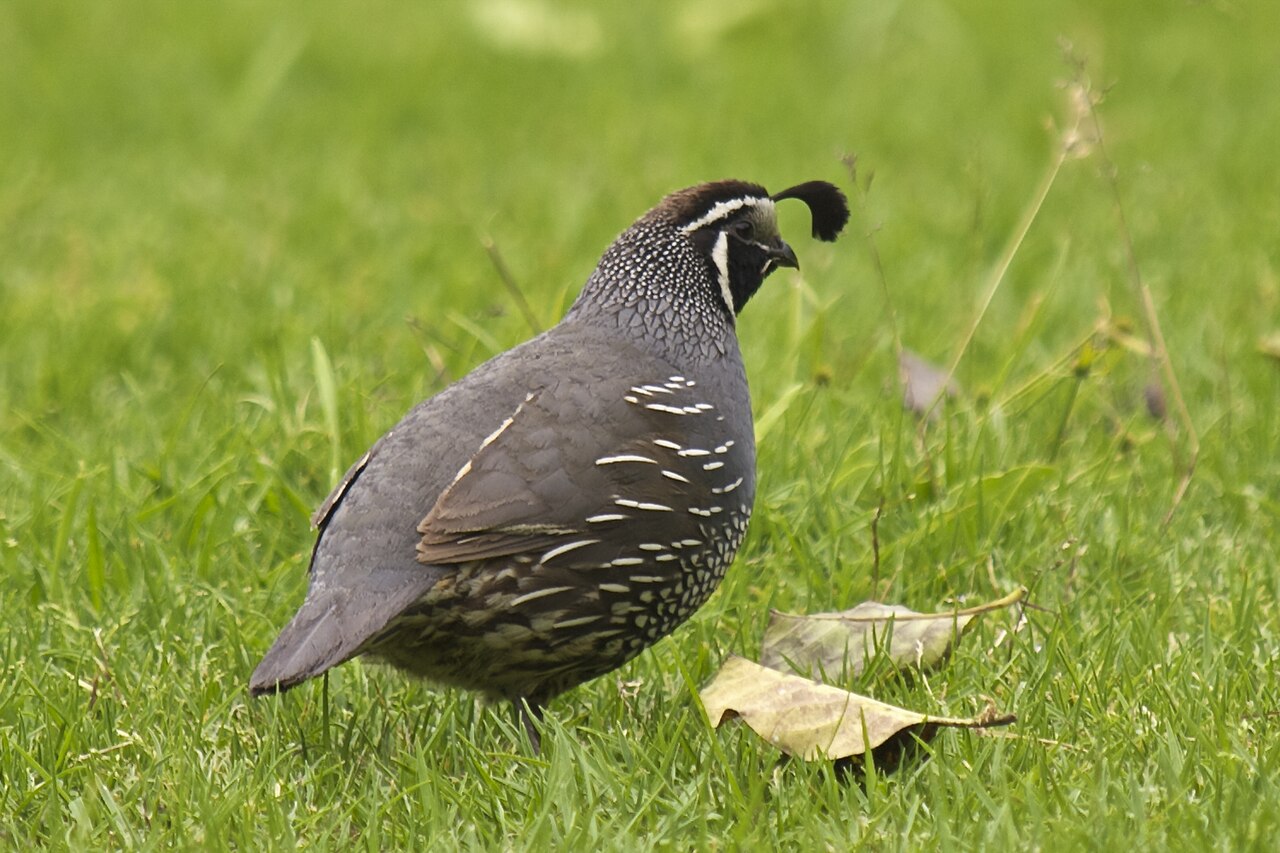
California Quail is the commonest gamebird of New Zealand farmland and no less common on Norfolk. It comes from western North America and was released here in 1862. The black, forward-curving topknot and the black scaling on the belly identify it at once.
Voice
The male's call is a three-part, hollow and emphatic qua-quer-go, with the stress on the middle syllable; he calls from a post, a fence or a bush and the sound carries far across open country. There is also a sharp, short pit-pit as a contact and alarm note. A flushed covey erupts in a confused cackle of short high notes, and that, with the loud clatter of wings, is usually the first sign.
Recording: Jonathon Jongsma — CC BY-SA 3.0 · Fremont Older Open Space Preserve, Santa Clara, California, United States · xeno-canto
Identification
Twenty-five centimetres, stocky and short-tailed, with a black topknot of a few feathers hanging forward over the crown. The male has a black chin and cheek framed in white, and a white eyebrow that meets on the forehead; breast and neck are blue-grey, the crown brown, and the belly cream to rust with sharp black scaling. The female is duller and browner, without the head pattern and with a smaller plume, but shows the same scaled belly. Young birds are streaked and as yet plumeless. It moves in coveys of ten to a hundred and flies off short and fast.
Confusion species
Brown Quail (Coturnix ypsilophora) shares the same country but is smaller, more evenly brown-mottled and has no plume; it sits tight until almost trodden on and then flies low away. Chukar (Alectoris chukar) of the dry eastern highlands is much larger, with red bill and legs and crisp black bars on the flank, and it too lacks the plume. No other quail in the region carries a crest.
Habitat
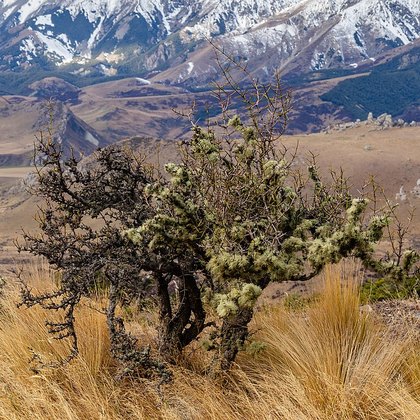
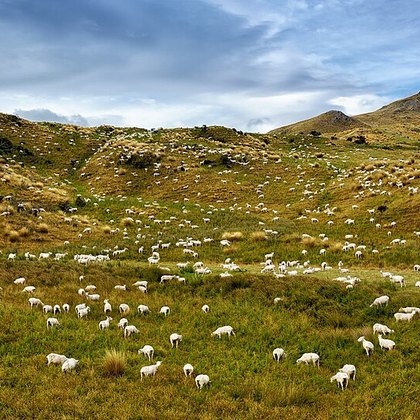
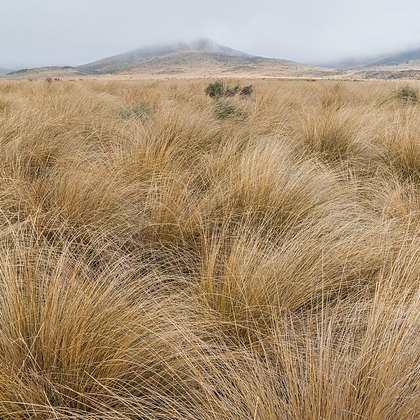
Uncultivated open shrubland: bracken, matagouri, gorse, blackberry, tutu and lupin on abandoned pasture and dry terraces, with bare ground to run on between. Also crop edges, road verges, gardens and golf courses, provided cover lies within walking distance. It avoids closed forest, and mown uniform pasture without shrubs just as much; it wants an edge, not a field. On Norfolk it holds the same kind of rank ground around the paddocks.
Where the bird is most often found, arranged by main group and formation.


Range and movements
At home in western North America, from southern Oregon to Baja California. The first birds were released at Papakura in 1862, followed by releases at Nelson, Auckland, Wellington, Canterbury and Otago. It is now commonest from Northland through the Waikato, inland Bay of Plenty, coastal Wairarapa, Nelson and Marlborough, North Canterbury and Banks Peninsula; it is more or less absent from Southland, the West Coast, the Southern Alps and the Chathams. On Norfolk it is established. In Australia the releases did not hold, and records there are now scarce.
- Resident
- dark = core range, pale = thinly spread
Where and when to look
Drive or walk a country road with gorse hedges or blackberry margins at first light and watch the silhouettes on the fence posts: that is nearly always a calling male, and the plume stands out against the sky. In summer, from December to February, a covey with ten or more downy chicks crosses the track behind the parents; stand still and let them pass, because pursued they scatter into cover.
Conservation
Not threatened (LC) and firmly established in New Zealand, with locally high densities on farmland. It is a game bird and is shot in autumn without that affecting the population. It does no damage of any consequence and does not penetrate native forest; densities do swing sharply with winters and with scrub management, because rank growth cleared away means fewer birds.
Scientific name
Callipepla californica | (Shaw, 1798)
Shaw described the species in 1798 as Tetrao californicus, among the grouse; because it later moved to another genus, author and year stand in parentheses. Wagler introduced Callipepla in 1832, from Greek kalli-, 'beautiful', and peplos, 'robe': the finely dressed one. californica means 'of California'. The type locality is California, later fixed on Monterey, where the bird was collected on one of the voyages of exploration along the west coast.