All species › Gamebirds › Partridges, pheasants, grouse and allies › Chukar Partridge
Chukar Partridge | Alectoris chukar
Aziatische steenpatrijs | Perdiz chucar
The Chukar Partridge is a solid grey partridge of the dry stony high country of the South Island, brought in from Asia in the 1920s as a gamebird. The black necklace enclosing a cream-white throat, the boldly barred flanks and the coral-red bill and legs make it unmistakable. Despite eighty years of releases it has never become numerous, and its range is contracting.

Voice
The sound gave the bird its name: a loud, strident, accelerating cackle written chuck-er-chuck-er-chukar-chukar, speeding up and rising in pitch, delivered from a boulder or a bluff edge and audible the length of a valley. It calls most in the early morning and towards evening, and most fiercely in spring. Alarm brings a sharp repeated chuck, and a flushed covey rattles away on hard-beating wings.
No freely licensed recording has been found for this species yet; what to listen for is described below.
Identification
A stocky, round-built partridge of thirty-one centimetres and half to three-fifths of a kilogram — far larger and heavier than any quail in the region. The upperparts are ash grey with rufous on crown and shoulders, the breast plain grey, the belly buff. The head pattern decides it: a crisp black band runs across the forehead, through the eye and down the side of the neck, closing as an unbroken necklace around a cream-white chin and throat. The flanks carry broad, sharp bars of black, white and chestnut. The bill is bright red, the legs pinkish red, and a bare red ring surrounds the dark eye. The sexes look alike; the female is a little smaller and lacks the spur.
Confusion species
In New Zealand it is most often confused with California Quail (Callipepla californica), which at twenty-five centimetres is smaller, carries a black forward-curving plume, has a scaled belly instead of barred flanks, and has no black necklace. Red-legged Partridge (Alectoris rufa), released in small numbers in the country, is the real trap: browner on the back, with more chestnut in the flank bars, a white eyebrow, and above all a necklace that breaks up into loose streaks below instead of forming a closed black band. Common Pheasant (Phasianus colchicus) is much larger and long-tailed and keeps to lower, greener country. The species does not occur in Australia.
Habitat
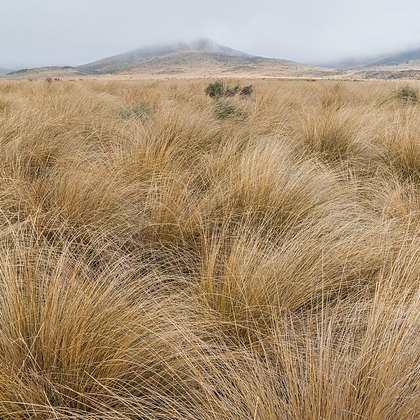
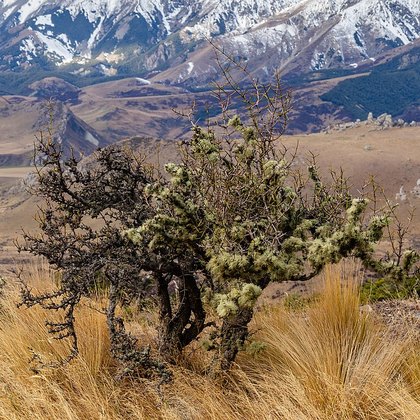
Dry stony hill and high country east of the Southern Alps: shale and scree slopes, rock outcrops, short tussock and open scrub of matagouri and broom, up to about two thousand metres. It needs rock to call from and shelter under and bare ground to run on, and avoids wet, misty and densely vegetated country. In winter it drops lower down the slopes.
Where the bird is most often found, arranged by main group and formation.

Range and movements
Only the high country of New Zealand's South Island, from Marlborough through Canterbury to Otago. The largest populations are around Nelson Lakes, in the Seaward Kaikoura Range, in the Mackenzie basin and in the ranges of Central Otago; near Cape Campbell it sometimes appears at low altitude. The North Island releases, in Hawke's Bay and the Bay of Plenty, did not hold. Occupancy is fragmented and shrinking in many places.
- Resident
- Passage
- dark = core range, pale = thinly spread
Where and when to look
In spring drive into a high dry side valley in Central Otago or the Mackenzie country and stop at sunrise beside a bluff edge with boulders; the cackled chukar carries for kilometres and places the bird. Look for the silhouette on top of a boulder, because it likes to call from a lookout. If a covey runs off across a scree slope, watch the flank: broad black, white and chestnut bars are all you need at that range.
Conservation
Least Concern (LC) worldwide, with a very large Asian range, but in New Zealand this is a small, fragmented and declining population despite more than eighty years of captive breeding and supplementation. Hard winter weather and predation by introduced mustelids and by native raptors keep numbers down. It is a gamebird and may be hunted from May to August, except in Hawke's Bay, where the birds released after 1987 are fully protected. It is not regarded as harmful to native ecosystems, though it is an introduced grazer of native high-country grassland.
Scientific name
Alectoris chukar | (Gray, 1830)
John Edward Gray described the species in 1830 as Perdix chukar, in Hardwicke's Illustrations of Indian Zoology; the later move to Alectoris puts author and year in parentheses. The epithet is onomatopoeic and comes, by way of Hindi chakor, straight from the call. The genus Alectoris was introduced by Kaup in 1829, from Greek alektoris, 'hen'. The type locality is taken as Srinagar in Kumaon, in northern India.