All species › Gamebirds › Partridges, pheasants, grouse and allies › Stubble Quail
Stubble Quail | Coturnix pectoralis
Stoppelveldkwartel | Codorniz pectoral
The Stubble Quail is the quail of open country: grain stubble, wheatfields and dry grassland across southern Australia. It is paler and more sharply streaked than the other quails of the region, and once flushed it goes high and far on loudly whirring wings. Its numbers swing with the rain: after wet years it is everywhere, after dry ones nowhere.
Voice
The best-known call is a clear, carrying three-note two-to-weep, the stress on the drawn-up final note, repeated for hours from the ground on moonlit nights and at first and last light. There is also a shorter two-note to-weep. When flushed it gives a burst of sharp chirps, and above all the loud hard whirr of the wings — a sound that startles more people than the bird itself.
No freely licensed recording has been found for this species yet; what to listen for is described below.
Identification
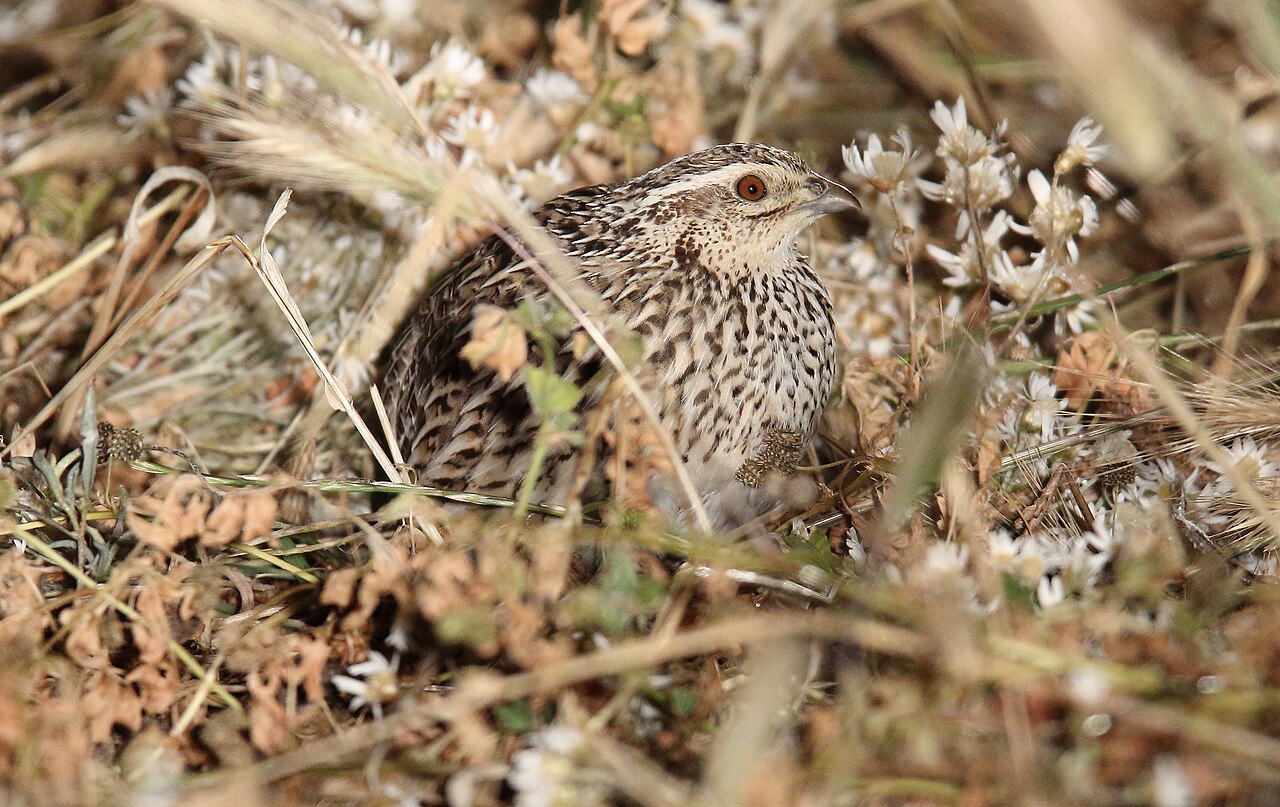
A compact quail of sixteen to twenty centimetres and a little over a hundred grams, grey-brown above with broad cream streaks down the centre of each feather, so the back reads as sharply striped. The underparts are creamy white with black streaks on breast and flanks, and a clear pale eyebrow runs over the eye. The male has an orange-buff to rusty cheek and throat with a dark patch below; on the female that area is cream and flecked, and she is the larger of the two. The bill is dark grey, the legs pale pink. In flight the wings are longer and more pointed than on the other quails and the bird looks strikingly pale.
Confusion species
Brown Quail (Synoicus ypsilophorus) is the first to rule out: darker and plainer, without the cream streaking and without an eyebrow, with orange-yellow rather than pale pink legs, and it flies low and briefly before dropping straight back in. It also keeps to damper, denser grass, while Stubble Quail chooses dry open crop. King Quail (Synoicus chinensis) is much smaller, darker and unstreaked, with barred underparts. Little Button-quail (Turnix velox) shares the dry grassland but is smaller and sandier, has a white eye and a bold white flank line, and lacks a hind toe. Farmed Japanese Quail (Coturnix japonica) is the trickiest: escaped aviary birds are streaked in much the same way, but usually show a dark anchor-shaped throat mark and look heavier and clumsier. A lone 'Stubble Quail' in a garden or around a farmyard is more often an escaped Japanese Quail than a wild bird.
Habitat
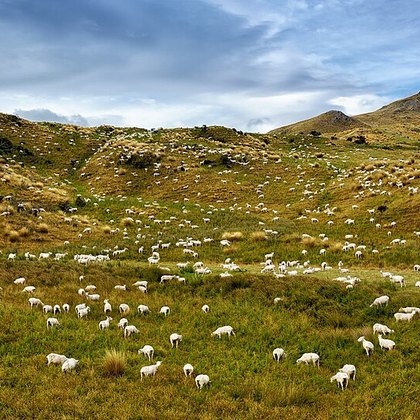
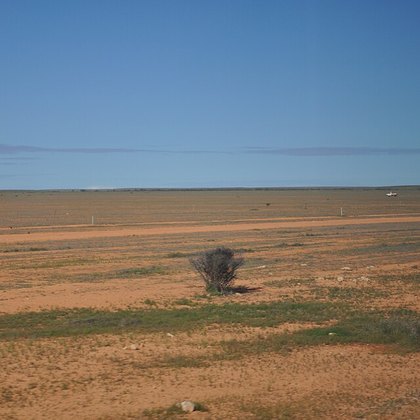
Open herbaceous grassland and cropland with enough height to disappear into: wheat and barley stubble, lucerne, fallow, native tussock and Mitchell grass, and saltbush plains. It needs no shrubs or trees but does need a dense standing sward; mown or heavily grazed ground it ignores. After good rain it pushes far into the dry interior, into spinifex country and even up into alpine herbfield.
Where the bird is most often found, arranged by main group and formation.


Range and movements
Mainland Australia, centred on the south-east — Victoria, New South Wales, southern Queensland and South Australia — and on the wheatbelt of south-western Western Australia. In the Northern Territory and most of Western Australia it is scarce and present only after rain. On Tasmania it disappeared between the 1940s and the 1960s. It does not reach New Zealand: the quail that lived there was the closely related and now extinct New Zealand Quail.
- Resident
- Breeding (summer)
- dark = core range, pale = thinly spread
Where and when to look
The bird is almost never seen and almost always heard: stand at the edge of a grain paddock or a patch of tussock grassland on a full-moon night in spring and wait for the three-note two-to-weep, which runs on for hours. To see one, walk slowly through the stubble at harvest time and stop for every bird that lifts, to catch the pale upperparts with their cream streaks; it flies far enough to give you time. Watch too for footprints and dust bowls along the verges of farm tracks.
Conservation
Least Concern (LC) and secure nationally, with numbers that track rainfall and the grain harvest closely — stubble has on balance been a gain rather than a loss for this species. It is the only native gamebird in Australia that may still be legally hunted, under strict seasons and bag limits. Regionally the picture is poorer: it is extinct in Tasmania and rated rare in the Northern Territory and Western Australia. Conversion of native grassland to closely grazed pasture and too-frequent burning of rank cover are the main pressures.
Scientific name
Coturnix pectoralis | Gould, 1837
Gould described the species in 1837 in his Synopsis of the Birds of Australia and placed it straight into Coturnix, where it still stands, so author and year carry no parentheses. coturnix is simply the Latin word for a quail; Garsault introduced it as a genus name in 1764. The epithet pectoralis means 'of the breast', after the black streaking on breast and flanks. The type locality is New South Wales.