All species › Pelicans, herons and ibises › Herons, egrets and bitterns › Pacific Reef Heron
Pacific Reef Heron | Egretta sacra
Oostelijke rifreiger | Garceta de arrecife
The reef heron is the heron of the rocky shore: a stocky bird on short thick yellow-green legs, walking over weed-covered platforms and coral rubble and pressing itself low among the boulders. It comes in two colour morphs — a slate-grey dark morph and an all-white morph — and these are not two species but one and the same bird.

Voice
Usually silent. When disturbed and at the nest it gives a harsh, raw croak, craak or orrk, a single note bouncing off the rocks. In greeting a partner there is a softer, short growl, and the young beg with hoarse peeping. It has little more than that.
No freely licensed recording has been found for this species yet; what to listen for is described below.
Identification
A medium-sized heron of fifty-seven to sixty-six centimetres, but made to look far stockier than that by its short legs and heavy build. The bill is long, heavy and dull yellow to brownish; the legs are short, thick and yellow-green. The dark morph is uniform charcoal grey with a narrow white stripe down chin and throat, the white morph entirely white. Both share the same bill, the same legs and the same outline, and intermediates occur. In breeding dress both carry long plumes on back and breast. In flight the beat is quick and low over the water, and the feet barely project past the tail.
Confusion species
The trouble is mostly with the white morph. It suggests Little Egret (Egretta garzetta), which has a thin black bill and long black legs, and Plumed Egret (Ardea plumifera), which is slimmer, longer-legged and has a shorter, clean yellow bill. Great Egret (Ardea alba) is far larger and holds its neck in a sharp kink. On a reef heron in flight the feet scarcely pass the tail, on every other white egret they do — that is the quickest mark of all. The dark morph at range recalls White-faced Heron (Egretta novaehollandiae), but that bird is slimmer, longer-legged, paler blue-grey and has a sharply marked white face rather than a thin throat stripe. Both morphs can come from the same nest.
Habitat
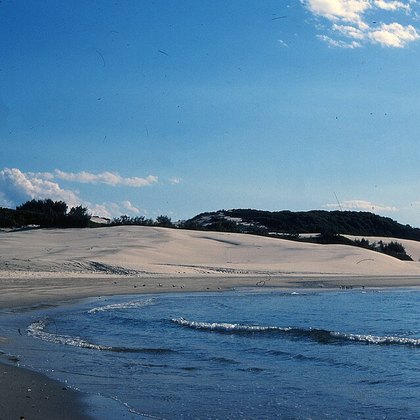
Rocky shore, weed platforms, coral reef and reef flats exposed at low tide, coral cays, and the stone of jetties and breakwaters; also sandy beach along the tideline and mangrove edge where it meets rock. It takes small fish, crabs and prawns from reef pools, working the tide. The nest is a stick platform in a rock crevice, under overhanging vegetation or in a low tree just above the sea.
Where the bird is most often found, arranged by main group and formation.


Range and movements
Along almost the whole Australian coast where there is rock and reef, from the south-west around the north to New South Wales, in greatest numbers on the Great Barrier Reef and along the Top End and Kimberley coasts; there the white morph predominates, while in the south and in New Zealand virtually only the dark morph occurs. In New Zealand it keeps mainly to the northern coasts and numbers an estimated three to five hundred birds only; measured over forty years that figure appears stable. It is present on Norfolk Island as well.
- Resident
- dark = core range, pale = thinly spread
Where and when to look
Walk a rock platform or a breakwater at low tide and read the outlines between the blocks: a dark reef heron only shows when it moves, because its grey is exactly the grey of wet rock. On the Great Barrier Reef any white heron on a cay or an exposed reef is almost certainly this species and not an egret. In flight, check the feet: if they barely project, it is the reef heron.
Conservation
Least Concern (LC) globally: across the Indian and Pacific oceans it is widespread and numerous. New Zealand is another matter — at three to five hundred birds it counts as nationally threatened there, under pressure from coastal building, disturbance of nest sites by recreation and the killing of nestlings by roaming dogs. Elsewhere along busy coasts disturbance weighs on breeding pairs too; on reefs far from settlement it is untroubled.
Scientific name
Egretta sacra | (Gmelin, 1789)
Gmelin described the species in 1789 as Ardea sacra, from a bird on Tahiti; as it was later moved to another genus, author and year stand in parentheses. The genus Egretta was introduced by Johann Reinhold Forster in 1817, from Provencal French aigrette. The epithet sacra is Latin for 'sacred': on Tahiti and elsewhere in Polynesia the bird was held sacred, and the first European collectors took the name over. In Maori it is matuku moana, 'heron of the sea'.