All species › Pelicans, herons and ibises › Herons, egrets and bitterns › Pied Heron
Pied Heron | Egretta picata
Bonte reiger | Garceta pía
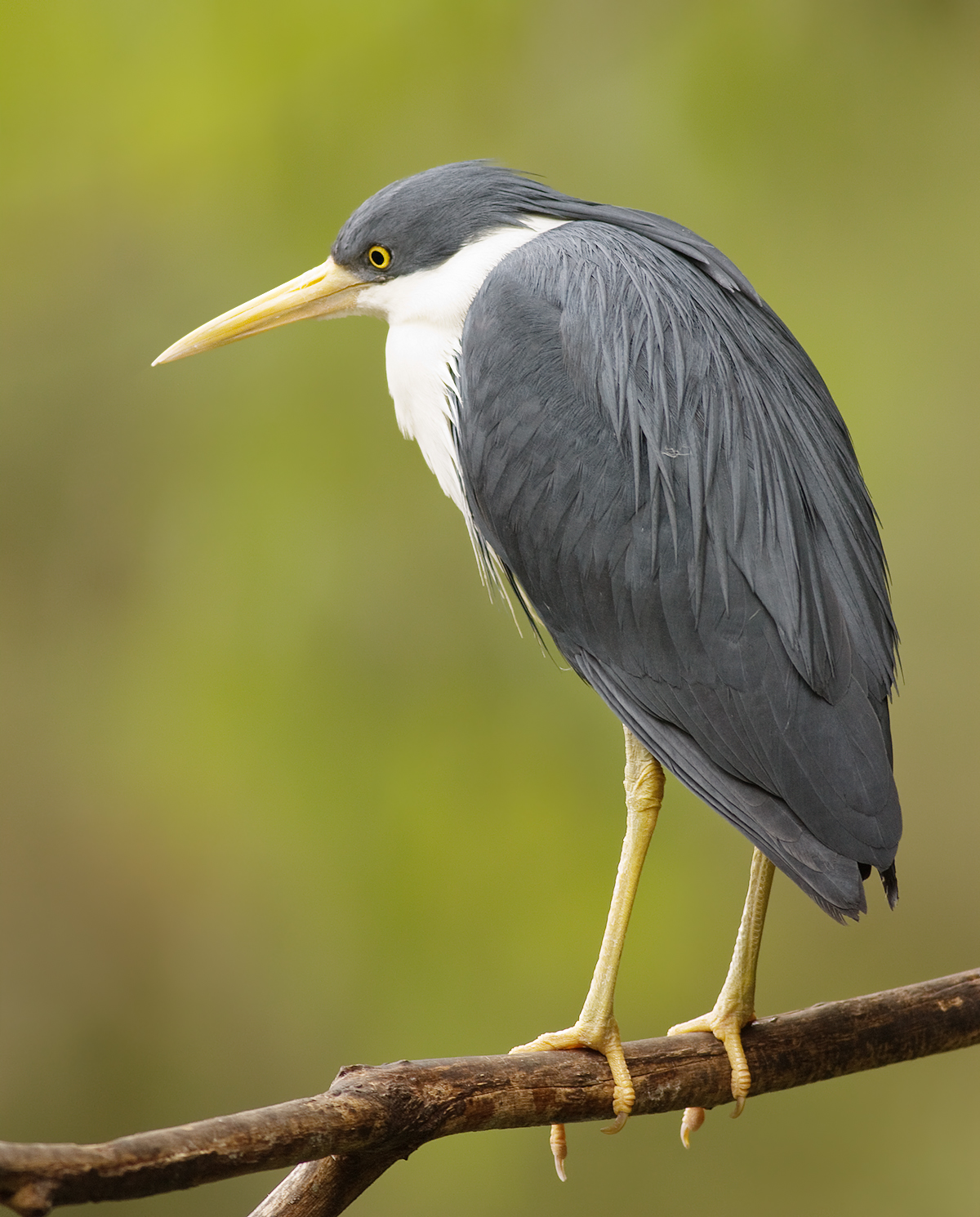
The Pied Heron is the small, brisk heron of the monsoon swamps of northern Australia: slate-grey in body and wing, with a black crested head and a sharply marked white neck, on yellow legs. It is seldom alone — usually there are dozens at once, packed along the edge of a drying pool.
Voice
The usual note is a loud barking ohrk or awk, given in flight when a party lifts; with hundreds of birds together it becomes a steady barking over the pool. At the nest it turns to a soft cooing mutter and a run of short clicks between partners. The young hiss and rattle.
No freely licensed recording has been found for this species yet; what to listen for is described below.
Identification
A small heron of forty-three to fifty-five centimetres, dark slate-grey on wings, back and underparts, with a glossy black head carrying a short drooping crest, and a clean white chin, throat and neck standing out against the dark like a collar. Bill and legs are yellow to orange-yellow. Young birds look quite different: they have a wholly white head and neck and lack the black crown and crest, so that at first glance they suggest another species. Males are slightly heavier than females but look the same. In flight it is compact and dark, quick-beating, with the pale neck catching the light.
Confusion species
White-faced Heron (Egretta novaehollandiae) shares the swamp but is larger, paler blue-grey, white on the face only and not the whole neck, with dull yellow legs and no black crest. The dark morph of the Pacific Reef Heron (Egretta sacra) is larger, uniform charcoal, and keeps to rocky shore rather than inland pools. White-necked Heron (Ardea pacifica) also has a white neck but is nearly twice the size, with a wholly white head. The hardest bird is the young Pied Heron with its white head and neck: go by the small size, the yellow legs and the company of adults.
Habitat
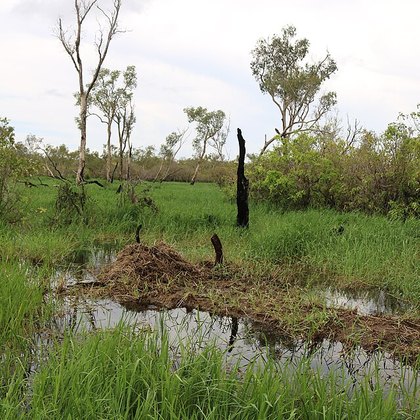
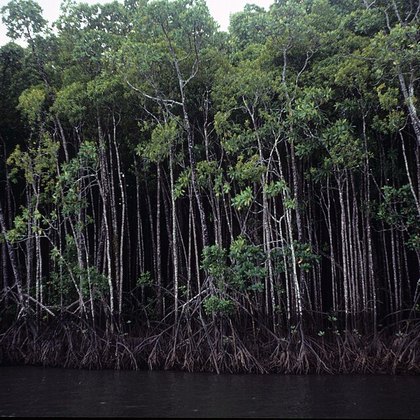
Shallow freshwater swamp, flooded grassland and drying billabongs of the monsoon country, with mangrove and tidal flat as a second ground. It feeds readily on sewage ponds and at the margins of tip ponds near the northern towns, where it gathers in numbers. It breeds colonially in trees over water, mangrove among them, usually with other herons.
Where the bird is most often found, arranged by main group and formation.


Range and movements
Coast and near-inland of monsoonal northern Australia: from the north-eastern Kimberley in Western Australia east across the Top End and the Gulf of Carpentaria to north-eastern Queensland. Inland it is scarce, and further south a vagrant. Outside Australia it occurs on Sulawesi and in southern New Guinea. It is absent from New Zealand and Norfolk Island. Within its range it moves with the water: in the dry season it concentrates at the last remaining pools.
- Resident
- dark = core range, pale = thinly spread
Where and when to look
The Darwin sewage ponds and the pools of Fogg Dam and the Adelaide River floodplain are the classic places, and the dry season from June to October is the best time, when the water shrinks and the birds draw together. Look for a band of dark birds with white necks along the waterline; the white neck lets you count them even against the light. Then look among them for the birds with wholly white heads — those are the year's young.
Conservation
Least Concern (LC), and locally numerous in the monsoon north. It benefits from built water — sewage ponds, farm dams and irrigation — where it feeds in large parties. The pressure lies in the changing swamp: saltwater intrusion into the coastal plains as sea level rises, trampling of margins by feral buffalo and pigs, and the advance of exotic wetland plants such as mimosa in the Top End swamps. On a world scale none of this yet weighs heavily.
Scientific name
Egretta picata | (Gould, 1845)
Gould described the species in 1845 as Ardea (Herodias) picata, from a bird at Port Essington in the Northern Territory; as it was later moved to another genus, author and year stand in parentheses. The genus Egretta was introduced by Johann Reinhold Forster in 1817, after Provencal French aigrette. The epithet picata comes from Latin picatus, 'smeared with pitch', from pix, 'pitch' — used in bird names for deep black and for pied plumage, which is also what the Dutch and English names record. The species has no subspecies.