All species › Pelicans, herons and ibises › Herons, egrets and bitterns › White-faced Heron
White-faced Heron | Egretta novaehollandiae
Witwangreiger | Garceta cariblanca
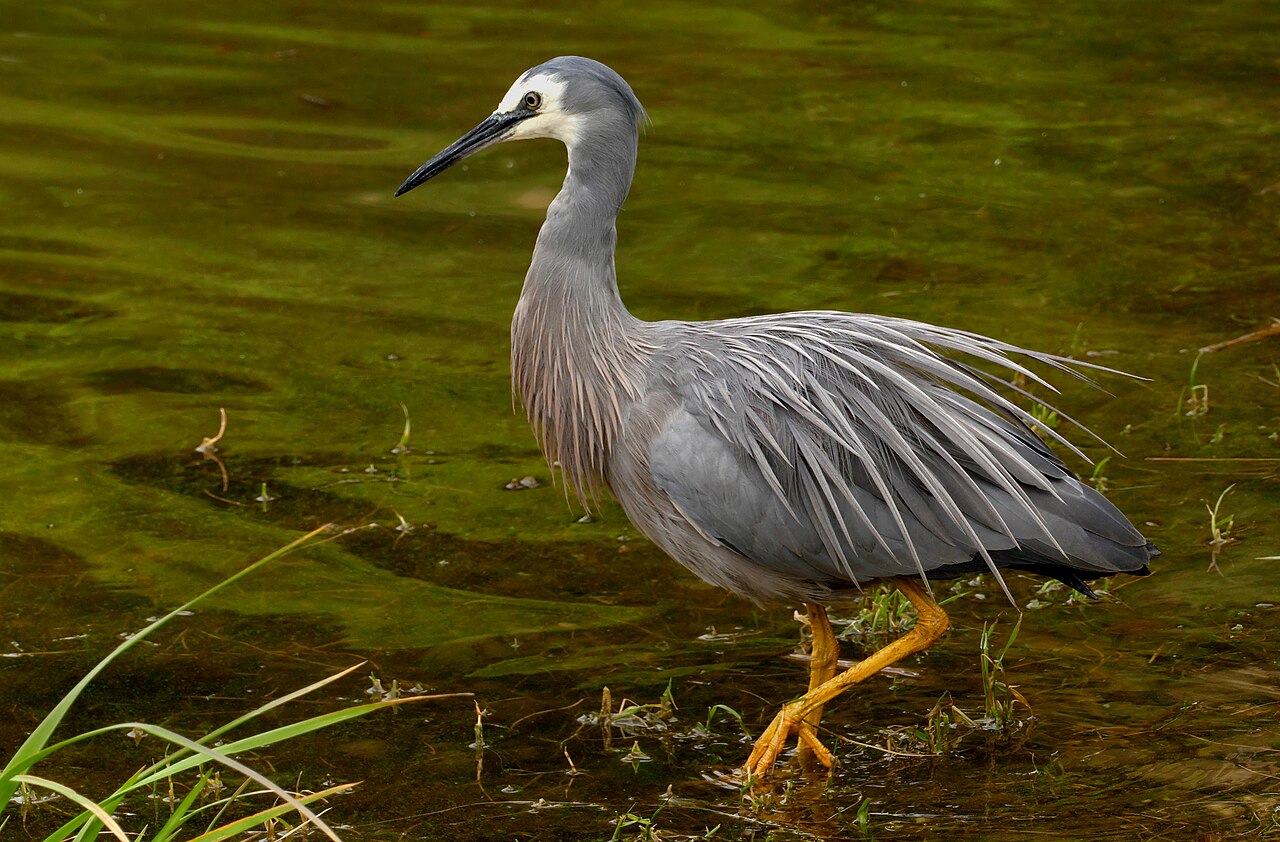
The White-faced Heron is the commonest heron of Australasia: a slim blue-grey bird with a sharply marked white face, standing wherever there is water — from estuary mud to a puddle on a playing field. It colonised New Zealand under its own power in the 1940s and is now one of the commonest large birds there.
Voice
A hoarse, gravelly croak given almost always in flight: graak or graaw, a single note, and the sound a startled bird leaves behind as it lifts off a drain bank. In a dispute over a fishing spot the same croak comes louder and repeated. At the nest it shifts to a softer three-syllable gow-gow-gow in greeting. Otherwise it is a quiet bird.
No freely licensed recording has been found for this species yet; what to listen for is described below.
Identification
A slim heron of just over sixty centimetres, pale blue-grey, with a long thin neck, a pointed grey-black bill and long dull yellow legs. What fixes it is the white face: forehead, chin and throat are sharply white against the grey, and it keeps that marking all year. The flight feathers are darker than the rest and make a clearly dark wing in flight. When breeding it grows long reddish-brown to bronze plumes on the foreneck, breast and back. Young birds lack these and have a less clean white face. In flight it draws the neck in and beats slowly.
Confusion species
White-necked Heron (Ardea pacifica) is larger and darker, with an entirely white neck rather than only a white face, and prefers shallow inland waters. Pacific Reef Heron (Egretta sacra) in its dark morph is more compact, shorter-legged and slate-coloured with no white face, and stands on rocky shores and reefs. Little Egret (Egretta garzetta) and Great Egret (Ardea alba) are all white. A young White-faced Heron with a vague face is the bird that holds up an observer longest; go by the yellow legs and the slim build.
Habitat
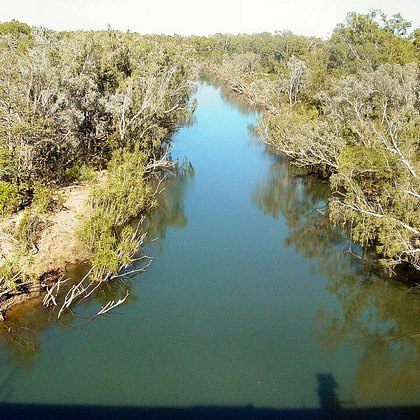
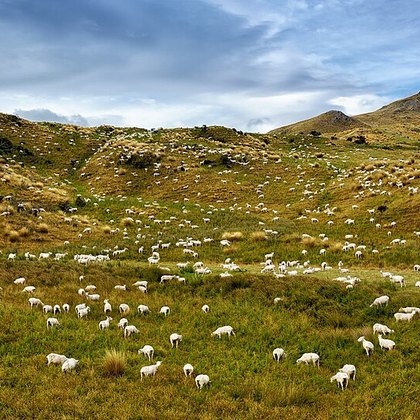
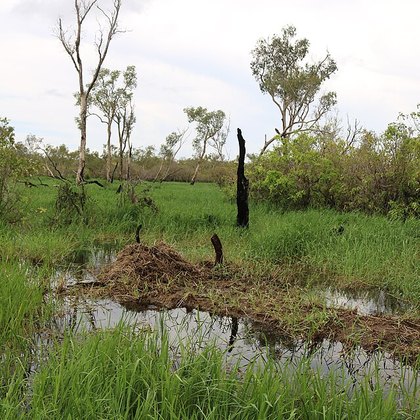
Anywhere water stands, up to five hundred metres: mudflats and estuaries, rocky shores, reefs, shallow lake margins, creeks, drains, rice fields, stock dams, sewage ponds. After rain it also walks damp pasture and city playing fields, hunting worms and insects. It nests singly or in small groups, in a loose stick basket high in a tree, usually near water but sometimes in a street tree.
Where the bird is most often found, arranged by main group and formation.


Range and movements
Across nearly all of Australia except the driest desert, and on Tasmania and most coastal islands. Beyond that New Guinea, the Torres Strait islands, Indonesia, New Caledonia and Norfolk. New Zealand is the newest chapter: it crossed under its own power in the 1940s, spread rapidly from the 1950s and now occupies both islands and the Chathams. It does not migrate but wanders with the water, and in dry years the inland birds shift to the coast.
- Resident
- dark = core range, pale = thinly spread
Where and when to look
Do not watch only the water: in winter, June to August, it stands on pasture, golf course and playing field after rain, well away from any shore, and that is where it is most easily seen close to. On a mudflat it pays to watch how it hunts — it walks fast, stirs the mud with a foot and then stabs, where the egrets stand still. Against the light the white face is the first thing to show.
Conservation
Least Concern (LC), numerous and stable or increasing across its range. It has profited from human land use as few herons have: stock dams, irrigation channels, rice fields, sewage ponds and watered lawns have given it food and room, and the colonisation of New Zealand followed from that. Locally it loses nests to the clearing of riverside trees and to disturbance, and inland drought years push the numbers down for a time, but none of that has a grip on the species as a whole.
Scientific name
Egretta novaehollandiae | (Latham, 1790)
Latham described the species in 1790 as Ardea novaehollandiae; because it was later moved to another genus, author and year stand in parentheses. The genus Egretta was introduced by Johann Reinhold Forster in 1817 and comes from the Provençal French aigrette, 'little egret', itself a diminutive of aigron, 'heron'. novaehollandiae means 'of New Holland', the old name for Australia, where the described bird came from. The placement in Egretta rather than Ardea rests on skeletal anatomy and on DNA work.