All species › Pelicans, herons and ibises › Herons, egrets and bitterns › Little Egret
Little Egret | Egretta garzetta
Australaziatische kleine zilverreiger | Garceta común
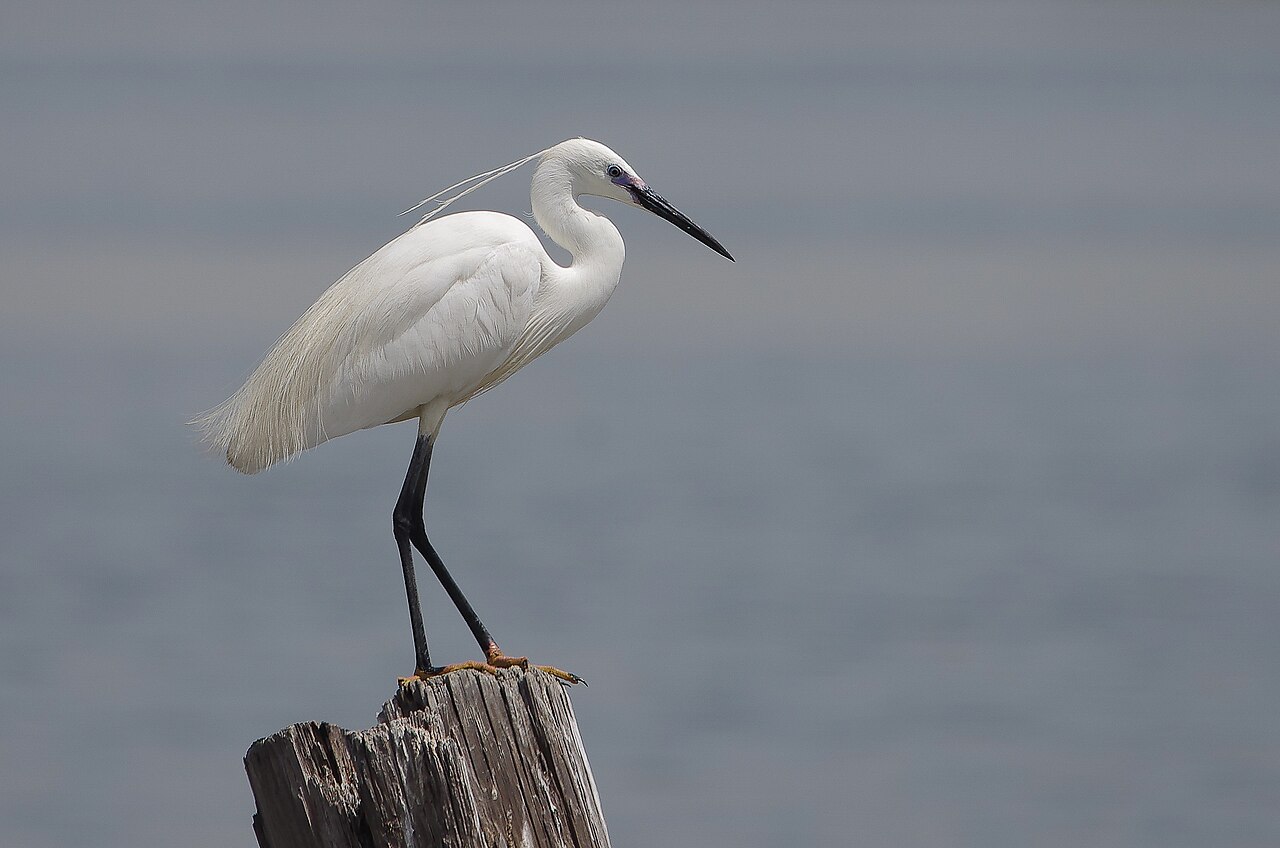
The smallest and liveliest of the three white egrets: a slim, wholly white bird with a thin jet-black dagger of a bill and black legs, which does not stand and wait but runs through the shallows, stirs the mud with a foot and dashes after the fish it flushes. In breeding dress two long narrow plumes trail from the nape.
Voice
On the mudflat it is almost always silent. Disturbed, it gives a hoarse, short kgarrk. At the colony it is a good deal noisier: a bubbling, croaking rasp at nest changeovers and in disputes over sticks, and a drawn-out raw aaah between birds. The young make a rattled peeping.
Recording: MERCIER Christophe — CC BY-NC-SA 4.0 · Panazol, Haute-Vienne, Nouvelle-Aquitaine, France · xeno-canto
Identification
A slim white heron of fifty-five to sixty-five centimetres, with a narrow, wholly black bill kept all year — that, with the size, is the first thing seen. The legs are black; in the Australasian subspecies nigripes the toes are black too, where European birds have strikingly yellow feet, and the lores are yellow to grey. In breeding dress it grows two long narrow nape plumes, filmy plumes over back and breast, and briefly red lores. The gape line reaches to below the eye and no further. In flight it is lighter and more agile than the larger egrets, with a quicker beat.
Confusion species
Plumed Egret (Ardea plumifera) is larger and has a short blunt yellow bill instead of a thin black one; Great Egret (Ardea alba) is much larger, with a heavy yellow bill and a gape line running behind the eye. In doubt, bill colour is the quickest mark on this species: black, and black all year. Eastern Cattle Egret (Ardea coromanda) is smaller, stocky and short-necked with a yellow bill. The white morph of the Pacific Reef Heron (Egretta sacra) has short thick yellow-green legs and a heavy dull-yellow bill and stands on rocky shore. With Australasian birds, note that the black feet are not an error but the mark of the subspecies.
Habitat
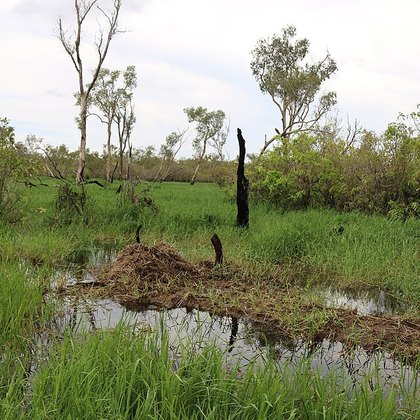
Shallow water over open bottom: mudflats and estuaries, saltmarsh, mangrove edge, lake and billabong (cut-off river channel that flows only at high water) margins, flooded grassland, rice fields, fish ponds and sewage works. It searches rather than waits, walking actively through the water. It breeds colonially in trees or mangrove over water, among other herons, ibises and cormorants.
Where the bird is most often found, arranged by main group and formation.



Range and movements
In Australia widespread along the northern and eastern coasts and the inland waters behind them, from the Kimberley and the Top End to Queensland and New South Wales, in smaller numbers in the south and south-west; in Victoria it is listed as threatened under the Flora and Fauna Guarantee Act. In New Zealand it is an annual non-breeding visitor in small numbers, chiefly from autumn to early spring on the northern harbours and estuaries; it does not breed there. On Norfolk Island it is a scarce visitor.
- Resident
- dark = core range, pale = thinly spread
Where and when to look
Take the behaviour before the bill: where Great and Plumed Egrets stand motionless, this bird runs, shuffles a foot through the mud and keeps changing direction. A northern harbour flat on a rising tide gives the best chance. On a settled bird, check the feet: black on Australasian birds, which is exactly what rules out a stray from Europe.
Conservation
Least Concern (LC) globally, with a large and largely stable range across Europe, Africa, Asia and Australasia. In Australia it comes less easily: it is scarce in the south-east and listed as threatened in Victoria, mainly through drainage of wetland and loss of the trees over water that hold the colonies. That does not weigh on the species as a whole, but it leaves the Australian edge populations exposed.
Scientific name
Egretta garzetta | (Linnaeus, 1766)
Linnaeus described the species in 1766 as Ardea garzetta; as it was later moved to another genus, author and year stand in parentheses. The genus Egretta was introduced by Johann Reinhold Forster in 1817, from Provencal French aigrette, 'little egret'. The epithet garzetta is taken from the Italian folk name garzetta or sgarzetta. The type locality is vaguely given as 'the Orient', after Brisson. Australasian birds belong to the subspecies nigripes, 'black-footed'; the guide's Dutch name sets them apart from the European Little Egret on that basis.