All species › Pelicans, herons and ibises › Herons, egrets and bitterns › Little Heron
Little Heron | Butorides atricapilla
Mangrovereiger | Garcilla estriada
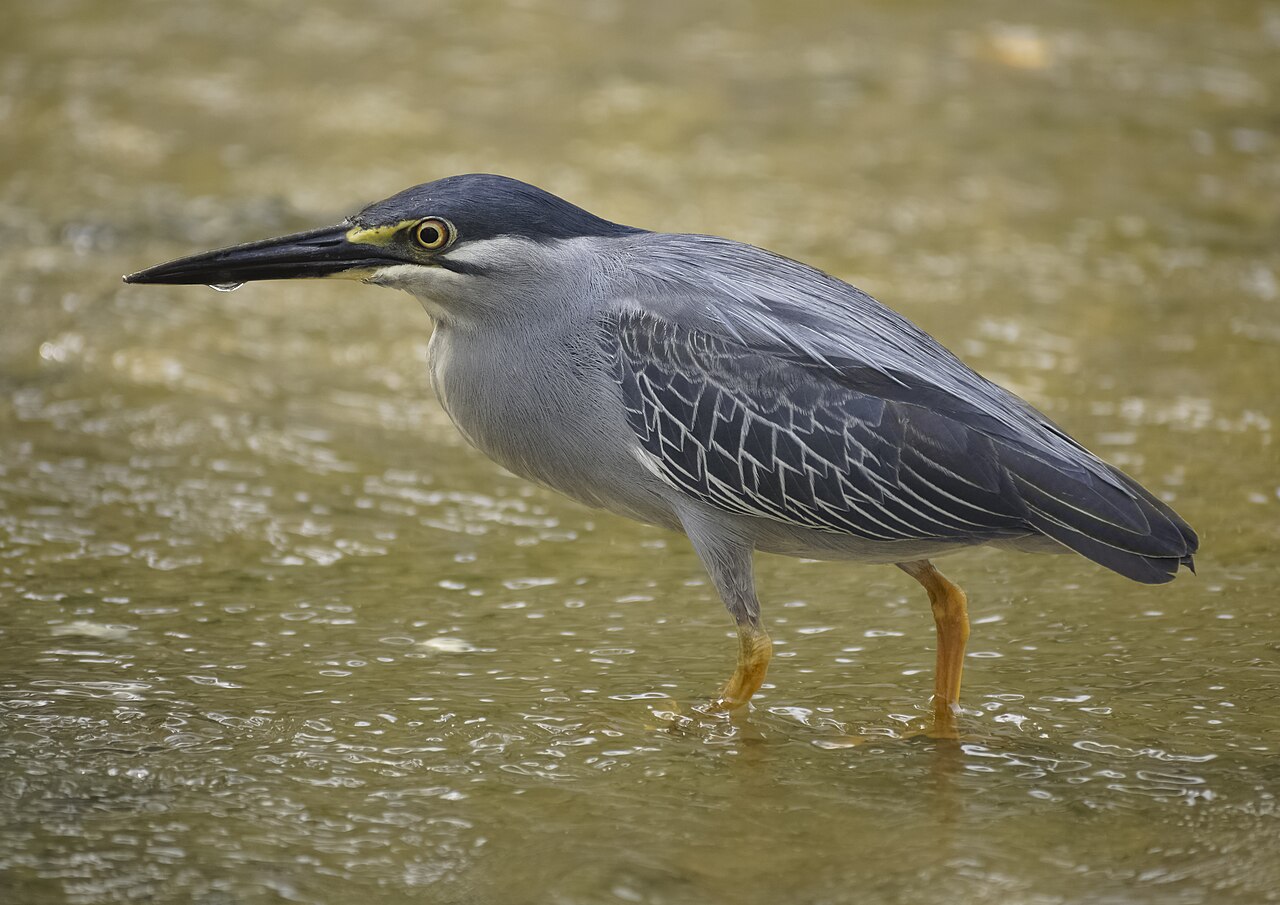
The Little Heron is the smallest heron of the Australian coast: a squat, short-legged bird with a heavy dagger of a bill and a black cap, sitting hunched on a mangrove root or a boat ramp just above the water. It never stands tall and upright the way the egrets do; it crouches, waits and strikes.
Voice
The sound you hear most often is alarm: a sharp, explosive kyow or skeow as the bird bursts out from under a mangrove root, one hard note skimming across the water. At the nest and between partners come soft wooden clicks, kek-kek-kek, and young birds beg with a running rattled peeping. Otherwise it is silent.
No recording with a suitable Creative Commons licence has been found for this species yet; what to listen for is described below.
Identification
A small, compact heron of just over forty centimetres, on strikingly short yellow legs — orange-red when breeding — and with a long, heavy, dagger-shaped bill that looks almost too big for it. The crown is glossy black, drawn back into a short crest raised in excitement, and a dark line runs from the bill to below the eye. Upperparts are slaty grey with a green sheen, the wing feathers pale-edged. Two colour forms occur in Australia: the usual grey form and a rufous form with cinnamon underparts. Young birds are brown and heavily streaked on neck and breast. In flight it is compact, with quick beats and feet barely projecting past the tail.
Confusion species
The region's night heron, the Nankeen Night-Heron (Nycticorax caledonicus), uses the same mangrove but is larger, rufous on back and wings, with a white crown stripe and two long white nape plumes. The Black-backed Bittern (Botaurus dubius) is smaller again and shows a pale wing patch that flares in flight. A young White-faced Heron (Egretta novaehollandiae) is far longer-legged and slimmer, with a blue-grey rather than black crown. The dark morph of the Pacific Reef Heron (Egretta sacra) shares the rocky shore but is a size larger and uniformly slate, without the black cap and without yellow legs.
Habitat
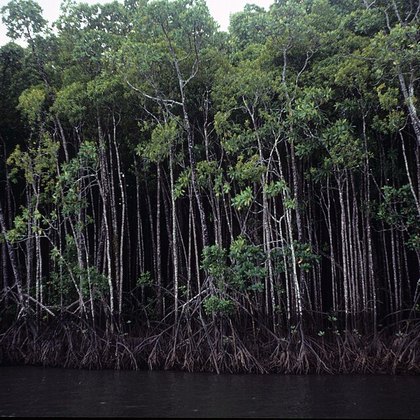
Mangrove forest and the creeks that thread it are its world: it hunts on exposed roots, on the mud of the creek bed and on the boulders at the edge. It also uses built shorelines — marinas, boat ramps, jetty piles and rock walls — where it grows used to people and allows approach to a few metres. It nests in the mangrove itself, on a rough stick platform three to nine metres above water.
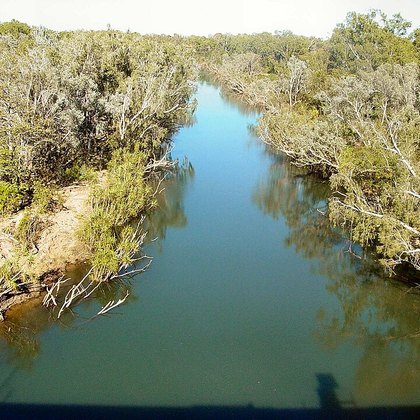
Where the bird is most often found, arranged by main group and formation.

Range and movements
The whole tropical and subtropical coast of Australia: from Shark Bay in Western Australia north along the Kimberley and the Top End to Cape York, then south down the east coast to Mallacoota in Victoria. South of Sydney it thins out quickly. It does not move inland, and it is absent from New Zealand and Norfolk Island altogether; this is a bird of the tidal zone, not of the river.
- Resident
- dark = core range, pale = thinly spread
Where and when to look
Go to a mangrove creek on a falling tide and look low, not high: it is almost always within half a metre of the water, on a root or a fallen trunk, hunched so that the neck disappears. Standing still and waiting finds it sooner than walking on — a moving observer flushes it and gets only the departing bird and the call. Boat ramps and jetties in northern marinas are the easiest places of all.
Conservation
Least Concern (LC): the species is numerous across its range and not declining, and Australia holds only a part of it. Locally, clearing of mangrove for harbours, aquaculture and coastal building reduces nest sites, and disturbance at busy landings adds to that. Because the bird takes readily to built shorelines as well, none of this weighs on the whole.
Scientific name
Butorides atricapilla | (Afzelius, 1804)
Afzelius described the species in 1804 as Ardea atricapilla, from a bird near Freetown in Sierra Leone; as it was later moved to another genus, author and year stand in parentheses. Blyth introduced the genus Butorides in 1852, a contraction of Middle English butor, 'bittern', and Greek -oides, 'resembling'. atricapilla is Latin for 'black-capped', from ater, 'black', and capillus, 'hair of the head'. For a long time the mangrove herons of America, Africa, Asia and Australia counted as one species; the Australian bird belongs to the Old World species Butorides atricapilla, while the American birds are now Butorides virescens and Butorides striata.