All species › Pelicans, herons and ibises › Herons, egrets and bitterns › Australasian Bittern
Australasian Bittern | Botaurus poiciloptilus
Australische roerdomp | Avetoro australiano
The Australasian Bittern is a vulnerable marsh heron that is almost never seen and almost only heard: the male booms from the reeds after dark, and that sound is at the same time the only means of counting the species. In New Zealand it ranks among the most threatened birds in the country.
Voice
In the breeding season the male produces a deep boom from dense cover, a sequence of one to ten notes — three on average — at even intervals: woom ... woom ... woom, each note low enough to be taken in through the chest rather than the ear. He calls mainly at dusk and through the night, from late spring into midsummer, that is from September to January, and on a still evening it carries across a whole swamp. The female is largely silent, but gives a bubbling call on returning to the nest and a nasal kau in alarm. Birds flushed into flight give a resonant kau kau, and that is often all an observer ever gets of the species. Because booming males are the only workable unit, the population is expressed in calling males rather than in birds.
No freely licensed recording has been found for this species yet; what to listen for is described below.
Identification
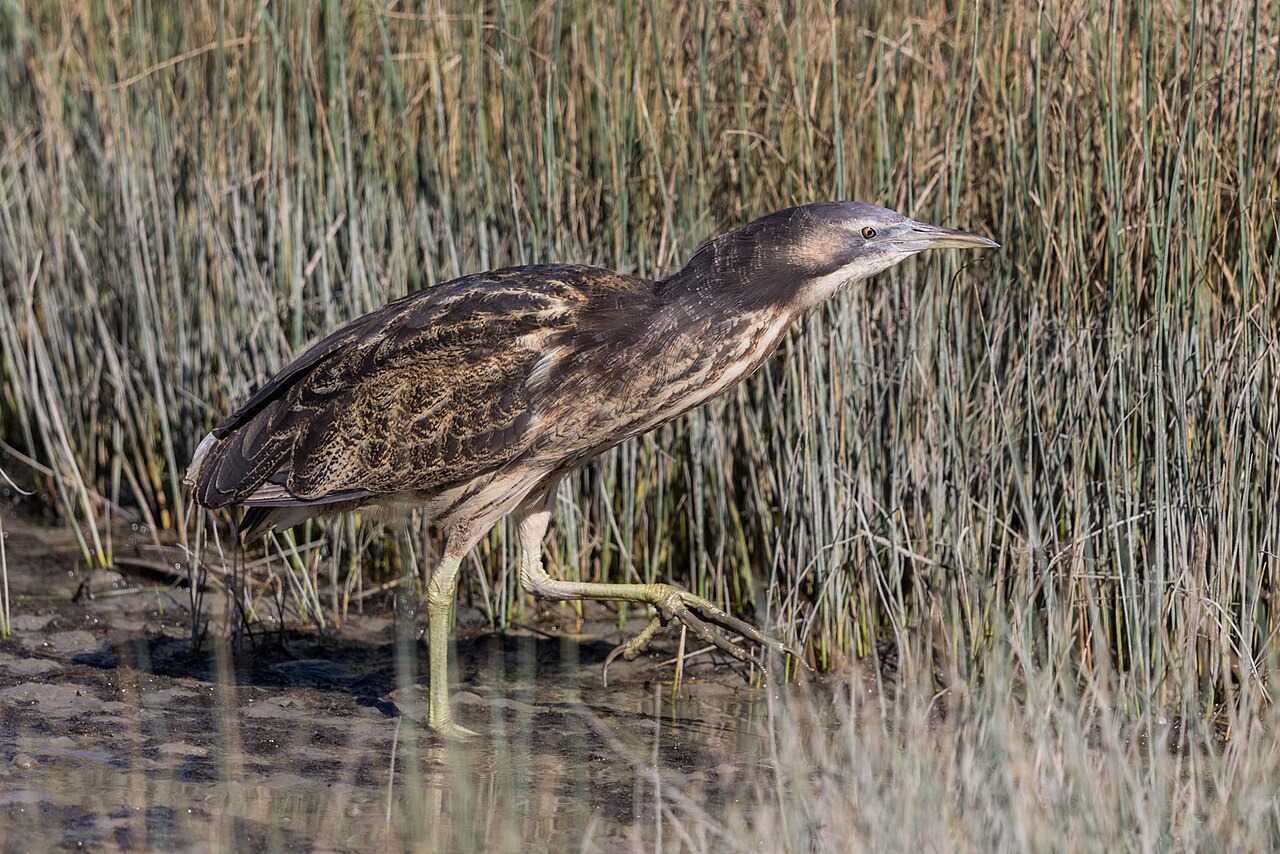
A bulky, thickset heron of seventy-four centimetres with a heavy neck, a stout yellowish bill and relatively short yellow legs. The plumage is beige with dark brown streaking and mottling, the head largely dark with a pale stripe above the eye, and the whole pattern dissolves completely in dead reed. The male, at about fourteen hundred grams, is markedly heavier than the female at around nine hundred. Juveniles have buff-mottled primaries and a yellow iris; only by about the third year are the primaries dark brown and the iris copper-red. In danger it points neck and bill straight up and stands motionless, after which it cannot be found again among the reed stems.
Confusion species
Nankeen Night Heron (Nycticorax caledonicus) is the mistake most often made: it is cinnamon and plain above, white to cream below and red-eyed, but its juvenile is streaked and in poor light looks much like a bittern. Australian Little Bittern (Ixobrychus dubius) is less than half the size and has a far paler, more contrasted wing. A bittern flying low over the reeds with dangling legs and slow beats is also taken for a young night heron or even a harrier; the heavy bill and the short thick neck rule that out.
Habitat
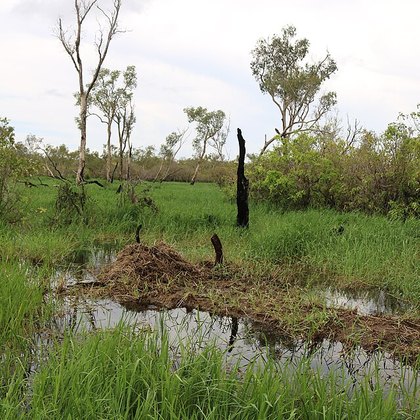
Dense freshwater wetland with a lasting water level: reedbeds, rushes and raupo along lakes, spring-fed creeks, sedge swamp and bog with open channels running through. In the Riverina of New South Wales it also uses rice crops, which now hold a substantial share of the Australian breeding birds. Edges of rank, neglected pasture and swamp woodland are taken in as well, but open shorelines, fast water and drying pools are not.
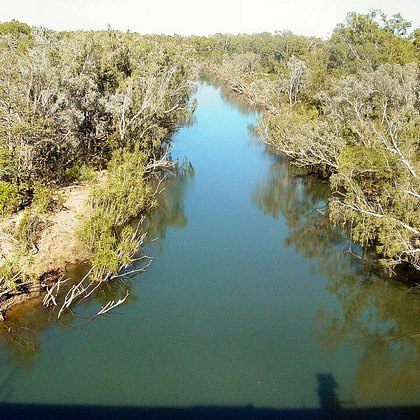
Where the bird is most often found, arranged by main group and formation.


Range and movements
In Australia the far southwest of Western Australia and a broad band from southeastern Queensland to southeastern South Australia, Tasmania included; on New Caledonia it is rare. In New Zealand it occurs scattered across the North Island, the South Island and Stewart Island. Radio-tracking shows New Zealand birds use smaller home ranges and move at most a hundred and forty kilometres, while Australian birds cover up to five hundred and fifty — a difference that explains why the Australian population shifts with water levels from year to year and the New Zealand one does not.
- Resident
- dark = core range, pale = thinly spread
Where and when to look
From September to December stand at the edge of a large reed swamp at sunset and listen for half an hour without moving; that is far and away the most reliable way to establish the species. By day it pays to scan the narrow channels and the reed edge where reed gives way to open water, especially on a falling level. Do not go into the reeds: a disturbed bittern leaves its place, and the nests are on the ground.
Conservation
Vulnerable (VU) on the global list and classed as Nationally Critical in New Zealand, where the estimate stood at some nine hundred birds in the 1980s and the decline has been steeper since. The Whangamarino wetland held about a hundred and forty-five birds in the 1980s and now fewer than fifteen booming males, a fall of eighty-nine per cent in thirty-five years. New Zealand has lost ninety per cent of its wetlands, and to that come predators, poor water quality, reduced food and winter starvation; nests and females are the weak link.
Scientific name
Botaurus poiciloptilus | (Wagler, 1827)
Wagler described the bird in 1827 as Ardea poiciloptila, among the herons; because it was later moved to another genus, author and year stand in parentheses. The genus Botaurus was introduced by Stephens in 1819, from medieval Latin butio, 'bittern', and taurus, 'bull', after the booming. poiciloptilus is built from Greek poikilos, 'variegated', and ptilon, 'feather'. The type locality is New South Wales.