All species › Pelicans, herons and ibises › Herons, egrets and bitterns › Black Bittern
Black Bittern | Botaurus flavicollis
Zwarte woudaap | Avetorillo negro
The Black Bittern is Australia's darkest heron: a sooty black, long-necked bird with a striking yellow stripe down the side of the neck. Unlike most bitterns it lives in trees — it roosts and nests on branches over the water — and that is exactly why it is so seldom seen, because in the shade of an overhanging tree it all but disappears.

Voice
The most distinctive sound is a deep, muffled, repeated cooing that comes out of wooded banks mainly at dusk and at night, spaced a few seconds apart and so low in pitch that it is easily taken for a dove or a frog. When flushed it gives a hard, short croak as it slips away through the branches. Outside the breeding season it is largely silent.
No freely licensed recording has been found for this species yet; what to listen for is described below.
Identification
A medium-sized, slender heron of about sixty centimetres that looks entirely black at range. Close up the male is sooty black with a large, sharply defined ochre-yellow patch on the side of the neck, running from the throat to the bend of the wing; the underparts are dark with pale streaking down the foreneck. The female is dark brown rather than black, the juvenile paler with rusty feather edges. The crown and lower neck feathers are lengthened into a kind of plume. The bill is long, straight and dark, the legs dark. In flight the whole upperside including the wing is uniformly black — no pale wing panel, which separates it at once from Black-backed Bittern.
Confusion species
Black-backed Bittern (Botaurus dubius) is the species it is most often confused with, and the distinction is easy once you look for it: that bird is less than half the size (25–36 cm against 54–66 cm), has a yellow bill with a black ridge instead of a dark bill, and shows a large buff panel on the wing coverts against a black back in flight — in Black Bittern the upperwing is uniformly black. Black-backed Bittern also stays in low reed and sedge, while Black Bittern perches in trees. Little Heron (Butorides atricapilla) shares the mangroves but is smaller, paler grey with a black cap, and lacks the yellow neck stripe. Australasian Bittern (Botaurus poiciloptilus) is far larger, brown and heavily streaked.
Habitat
Wooded fresh water: rivers and creeks with a closed gallery of trees, paperbark swamp forest, tree-lined swamps and pools, and mangroves on the coast. What it wants is overhanging branches above water — it roosts there, hunts from there and builds its loose stick platform there. It feeds by day as well as in the dark, usually from a branch, but also walks through low marsh vegetation along a creek.
Where the bird is most often found, arranged by main group and formation.
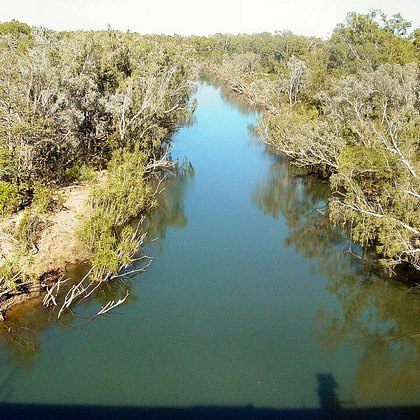

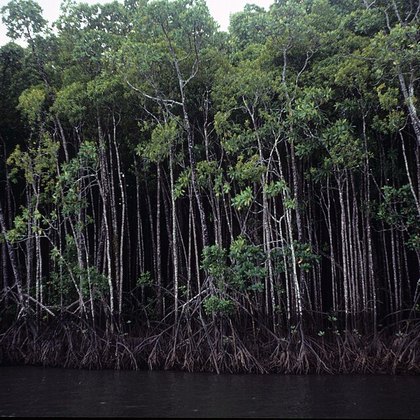
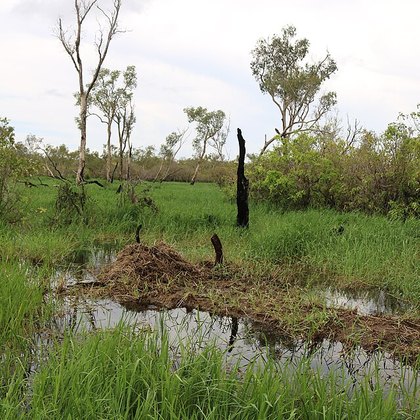
Range and movements
The coastal belt and near hinterland of Australia in a broad arc: the south-west of Western Australia, the whole tropical north coast, and the east coast south to far eastern Victoria. The dry interior is absent from its picture, and it does not occur in Tasmania. It is sedentary and stays year-round in the same stretch of riverside timber. Beyond Australia this is a widespread Asian species, from India and Sri Lanka to China, Indonesia and New Guinea. It does not occur in New Zealand.
- Resident
- dark = core range, pale = thinly spread
Where and when to look
Sit at dawn or sunset along a creek with dense riverside timber and watch the low overhanging branches above the water, not the reeds. A canoe helps, because from the water you see in under the canopy. Listen first and search afterwards: the muffled cooing at dusk points out the tree. When it flushes, check the completely uniform black upperwing.
Conservation
Least Concern (LC) globally, since the species is spread across tropical Asia. In Australia it is nowhere numerous and is listed as vulnerable or threatened in several states: it depends on continuous riverside forest, and that is exactly what has been cleared, fragmented or degraded by grazing and river regulation over much of the east coast. Because it lives so secretively, numbers are poorly known.
Scientific name
Botaurus flavicollis | (Latham, 1790)
Latham described the bird in 1790 as Ardea flavicollis; because it was later moved to another genus, author and year stand in parentheses. flavicollis is formed from Latin flavidus, 'yellowish', and -collis, '-necked', after the yellow neck stripe. The type locality is India. The species stood for a long time in Ixobrychus or Dupetor, but molecular work moved it into Botaurus in 2023 — that genus was introduced by Stephens in 1819, from Medieval Latin butaurus, built from butio, 'bittern', and taurus, 'bull', after the bull-like booming of the Eurasian Bittern.