All species › Pelicans, herons and ibises › Herons, egrets and bitterns › Black-backed Bittern
Black-backed Bittern | Botaurus dubius
Zwartrugwoudaap | Avetorillo australiano
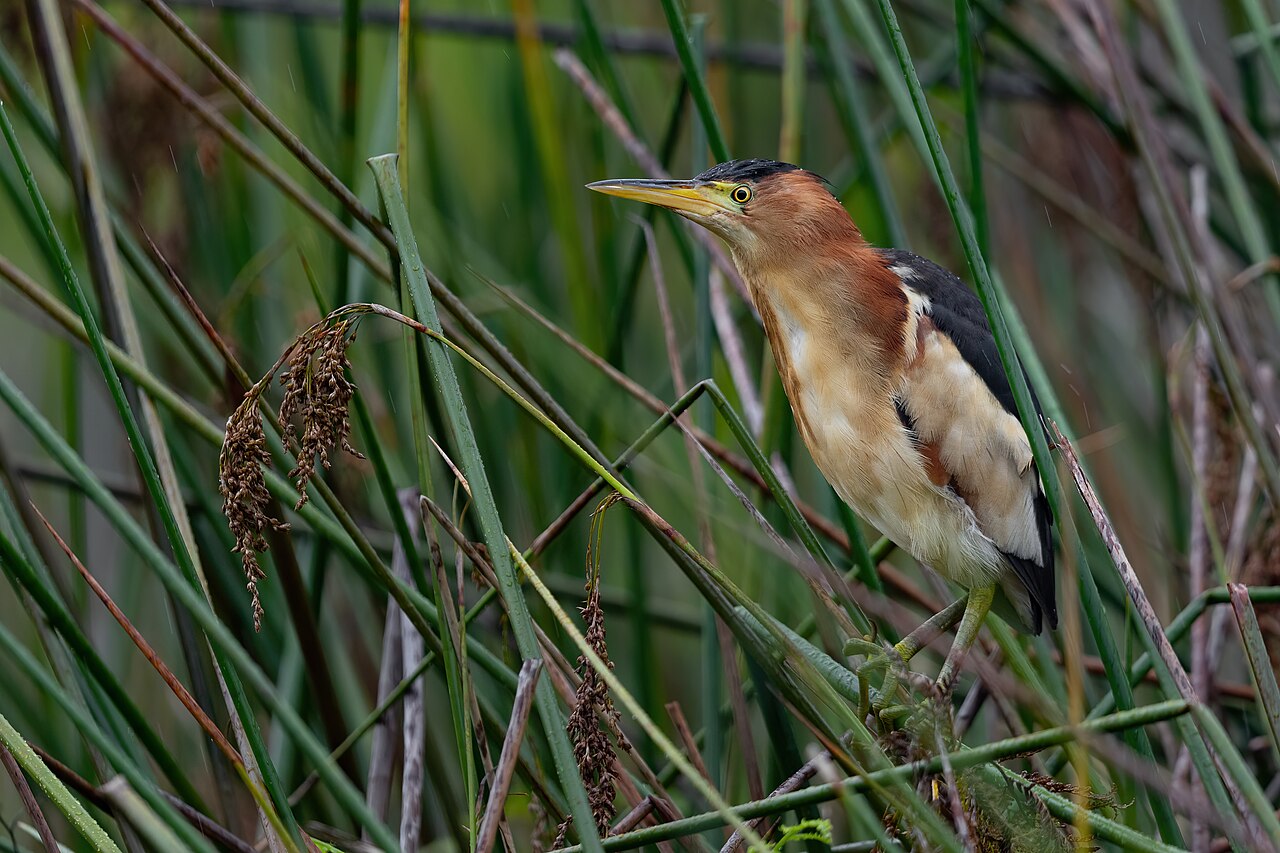
The Black-backed Bittern is Australia's smallest heron: a little bittern of barely thirty centimetres that spends its whole life in dense reed and sedge and that most birdwatchers hear rather than see. Only when it crosses a reedbed does it give itself away, with a large buff patch on the wing against a black back.
Voice
The male calls in the breeding season at dusk and at night: a low, short, muffled note repeated about every half second in a series of some ten seconds, woof-woof-woof-woof, monotonous and unstressed. Observers liken it to wood being slowly sawn, or to a frog, and on a still evening it carries at least a hundred metres. Outside the breeding season it is almost entirely silent, with at most a low croak when disturbed.
No freely licensed recording has been found for this species yet; what to listen for is described below.
Identification
A tiny, compact heron of twenty-five to thirty-six centimetres, usually seen only in silhouette as it shoots low and fast from one reedbed to the next. The male has a black back, crown and tail contrasting sharply with a buff neck and buff wing coverts; in flight those coverts make a large, conspicuous pale panel on an otherwise dark wing. The female has a brown rather than black back and is duller, with dark streaking on the pale underparts; juveniles resemble the female but are more heavily streaked. The eye is yellow, the bill yellow with a black ridge, the legs greenish-yellow. Alarmed, it freezes bolt upright with the bill pointed at the sky and melts into the reed stems.
Confusion species
Black Bittern (Botaurus flavicollis) is the only real risk and one look settles it: that bird is more than twice the size (54–66 cm against 25–36 cm), is entirely sooty black with a yellow stripe on the side of the neck, has a dark bill, and shows a uniformly black upperwing in flight with no pale panel; it also perches in trees over water rather than in low reed. Australasian Bittern (Botaurus poiciloptilus) shares the reed swamp but at 74 cm is a giant beside it, brown and heavily streaked. A small dark bird flushing from reeds may equally be a reed-warbler or a rail; look then for the drawn-in neck and the feet projecting behind.
Habitat
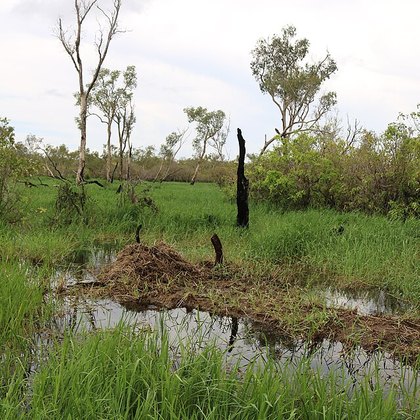
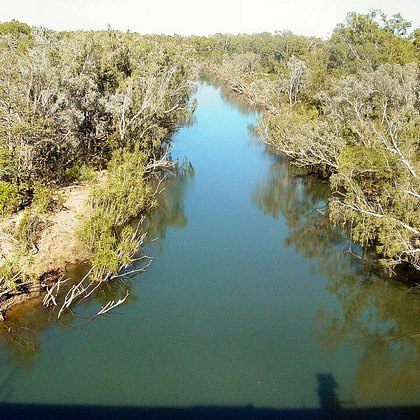
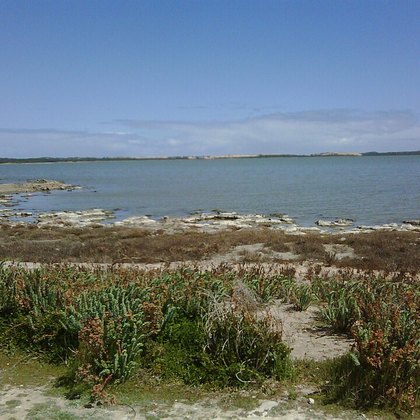
Freshwater swamps with dense standing vegetation: reed, cumbungi, sedge and rush, and inundated shrub thickets, with at least half a metre of water beneath. It does not need a large swamp — a drain, a small reedbed on a town edge or a drainage channel can serve, as long as the cover is thick enough. Sometimes also in brackish or saline water, including saltmarsh and the fringe of mangrove.
Where the bird is most often found, arranged by main group and formation.

Range and movements
Local across south-eastern and south-western Australia, centred on the Murray-Darling Basin and the Swan Coastal Plain near Perth; along the east coast it is patchy and irregular, and there are scattered records from the Kimberley, the Top End and the Torres Strait islands. In the south it is mainly a summer bird, breeding from October to January and then gone; part of the population winters in New Guinea, while at some artificial waters, for instance on the Ord River, birds appear to be present year-round. It is absent from Tasmania, and in New Zealand and on Lord Howe it is an extremely rare vagrant.
- Resident
- Breeding (summer)
- dark = core range, pale = thinly spread
Where and when to look
Find it with your ears. Stand by a reed swamp at sunset in November or December, wait for the quiet, and listen for the monotonous sawing call from the reeds; that is the only reliable way to know it is there. To see it takes patience: watch the open water along the reed edge in the last light, when it sometimes shifts briefly between beds — and then only one mark counts, the pale wing panel against the black back.
Conservation
Least Concern (LC) globally, but that figure misleads for this guide: the world population is estimated at some five thousand mature birds and lies almost entirely in Australia, where it is rated near threatened nationally and endangered in Victoria. The causes are the draining and salinisation of the inland swamps and the extraction of water from the Murray-Darling Basin, which take its reedbeds away. Because it is so inconspicuous, a local disappearance usually comes to light only years later.
Scientific name
Botaurus dubius | (Mathews, 1912)
Mathews described the bird in 1912 as Ixobrychus minutus dubius, that is as a subspecies of the Eurasian Little Bittern; since it is now a species of its own in another genus, author and year stand in parentheses. dubius means 'doubtful' and refers to exactly that uncertain status — molecular work later raised it to full species, and it turns out to be closer to Yellow Bittern than to the European bird. The genus Botaurus was introduced by Stephens in 1819, from Medieval Latin butaurus, from butio, 'bittern', and taurus, 'bull'. The type locality is Herdman's Lake in south-western Western Australia, close to Perth. Australian sources also call the species Australian Little Bittern; this guide keeps the name Black-backed Bittern.