All species › Pelicans, herons and ibises › Herons, egrets and bitterns › Great-billed Heron
Great-billed Heron | Ardea sumatrana
Sumatraanse reiger | Garza de sumatra
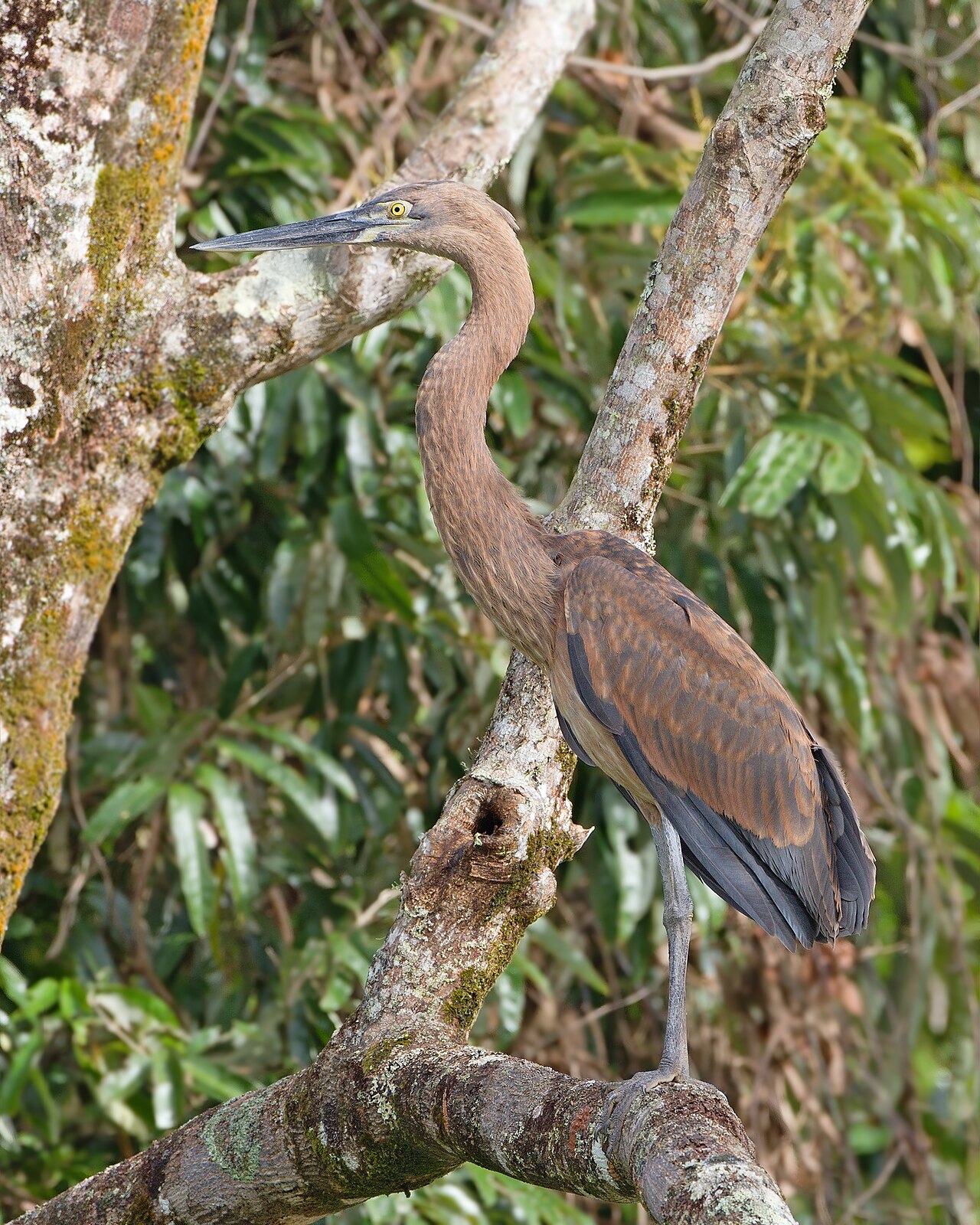
The Great-billed Heron is Australia's largest heron and at the same time one of the hardest birds of the tropical north coast to see: a uniformly dark grey giant of over a metre with a heavy, dagger-shaped bill. It is shy and solitary, stands motionless at the mangrove edge or on a reef, and vanishes at the first movement of a boat.
Voice
An impressive but seldom-heard sound: a deep, hoarse, drawn-out roaring croak that comes out of the mangroves mainly at dawn and dusk and that the Australian literature describes as a roar or a groan — startlingly heavy for a bird if you are not expecting it. When flushed it gives a short, hard croak. Outside the breeding season it is nearly silent, and the voice is less familiar to most observers than the bird itself.
No freely licensed recording has been found for this species yet; what to listen for is described below.
Identification
At over a metre the longest heron of the region, and heavily built: a long neck, long grey legs and an enormous dark grey dagger of a bill, nearly as long as the head. The plumage is uniform dark slate-grey, a little paler and browner on throat, neck and breast, with no white, no pattern and no contrast in the wing — in flight the upperwing too is plain dark grey. Breeding birds add a short nuchal crest, spiky hackles on the foreneck and lanceolate plumes on the back. Young birds are browner. It flies slowly and heavily, neck drawn in and legs trailing far behind.
Confusion species
White-necked Heron (Ardea pacifica) is also dark above but has a clean white head and neck — decisive at any range — and lives inland rather than in the mangroves. Grey Heron (Ardea cinerea), a vagrant here, is paler grey with a white head, a black eye-stripe and a yellow bill. Pacific Reef Heron (Egretta sacra) in its dark morph shares the reef and rocky shore, but is less than half the size, with short legs and a yellowish bill. Australasian Darter (Anhinga novaehollandiae) is also dark and long-necked, but swims with only head and neck above the water.
Habitat
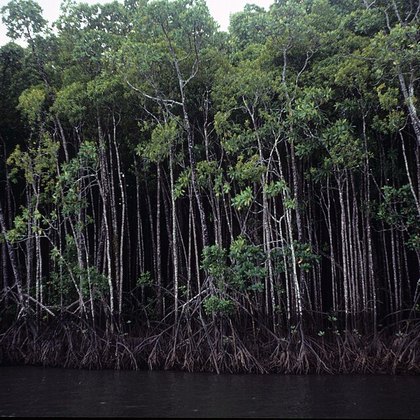
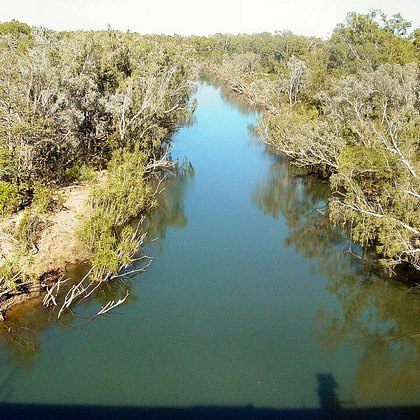
The tidal zone of the tropical coast: mangrove forest and the creeks within it, mudflats, reefs and coral cays, and the lower reaches of the big rivers. Occasionally inland along wooded creeks and at shallow pools. It hunts alone, from a mangrove root or wading in the shallows, and takes crabs, including mud crab, as well as fish.
Where the bird is most often found, arranged by main group and formation.

Range and movements
The tropical north coast of Australia, from King Sound near Derby in the Kimberley through the Top End and the southern shore of the Gulf of Carpentaria to Cape York, and down the Queensland east coast to about the Tropic of Capricorn near Yeppoon. Also on the Great Barrier Reef islands and in Torres Strait. It is sedentary and territorial: a pair uses the same creek for years, which keeps densities low everywhere. Beyond Australia it ranges from southern Myanmar through Indonesia and the Philippines to New Guinea. It does not occur in New Zealand.
- Resident
- Winter
- dark = core range, pale = thinly spread
Where and when to look
Take a boat or a crocodile cruise on a northern river in the dry season — the Daintree near Cairns is the best-known place — and drift slowly with the current early in the morning; the bird often stands on a fallen log or a mud edge right at the mangrove fringe. From the bank your chances are slim: it flies as soon as a walker appears. Listen at sunrise for the deep roaring from the mangroves, which gives it away more often than the eye does.
Conservation
Least Concern (LC) globally, but nowhere numerous in Australia: the population is thinly spread and each pair holds a long stretch of creek. Disturbance at the nest by recreational boating and sport fishing weighs heaviest, along with clearing and reclamation of mangrove for ports, aquaculture and coastal building. Because it is so shy and so thinly spread, every estimate of the Australian population stays uncertain — with this species that is a shortage of data rather than a sign that all is well.
Scientific name
Ardea sumatrana | Raffles, 1822
Raffles described the species in 1822 as Ardea sumatrana, and it has stayed in that genus, so author and year carry no parentheses. Ardea is simply the Latin word for heron; Linnaeus introduced the genus in 1758. sumatrana means 'of Sumatra', which is also the type locality: Raffles drew up his list of Sumatran birds while Lieutenant-Governor of Bencoolen. The English name points at the bill, the feature that marks the bird most sharply.