All species › Pelicans, herons and ibises › Herons, egrets and bitterns › Plumed Egret
Plumed Egret | Ardea plumifera
Middelste zilverreiger | Garceta plumífera
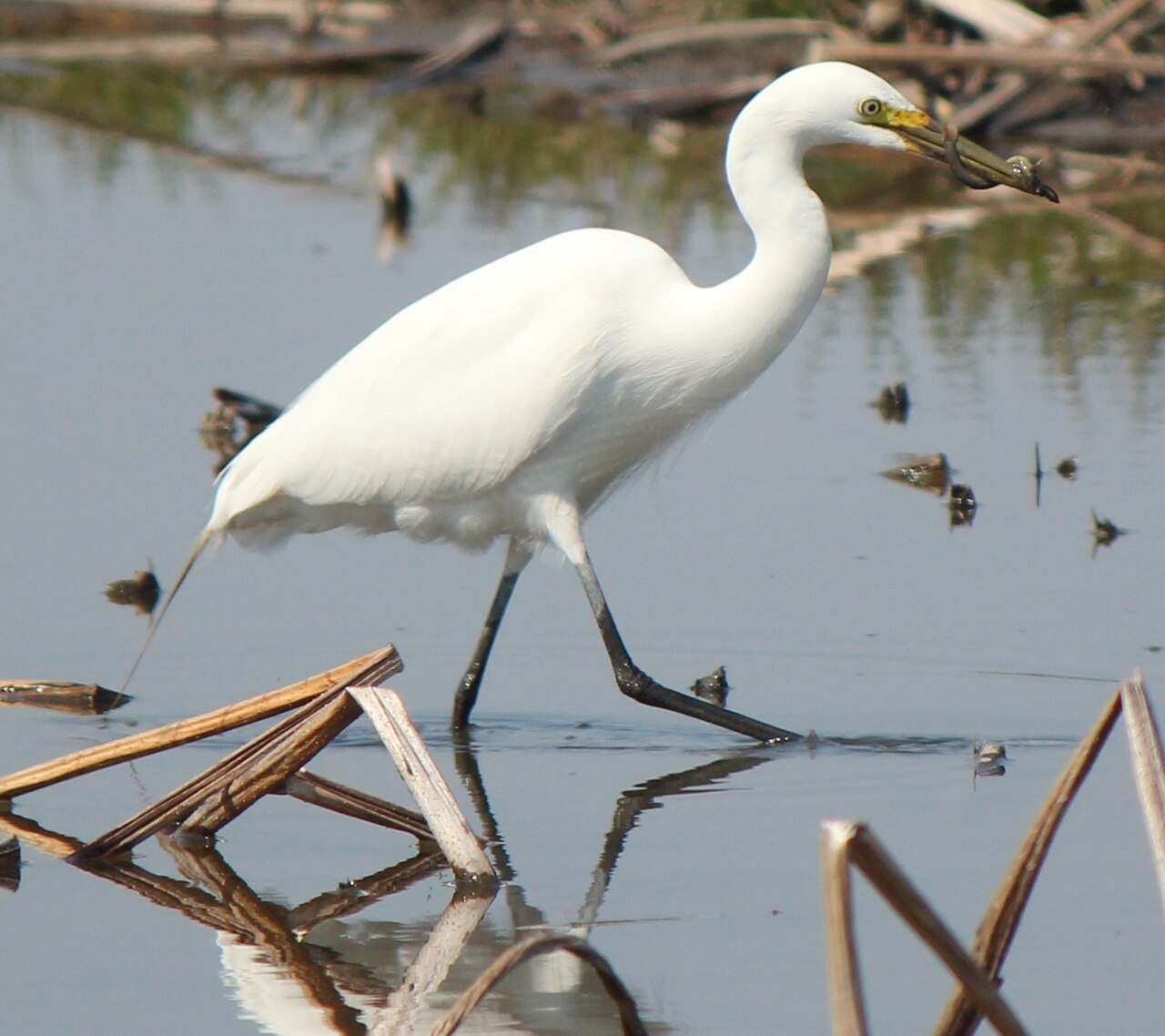
The Plumed Egret sits exactly where its Dutch name puts it — between the Great Egret and the Little Egret — and that is what makes it the hardest of the three. An all-white heron of just over sixty centimetres with a short blunt yellow bill and long dark legs, growing long filmy plumes over breast and shoulders in the breeding season.
Voice
Away from the colony it is seldom heard. Flushed, it gives a short dry croak, lower and softer than the Great Egret's. In the mixed colonies of the north it joins the general clamour with a hard kwaark and a run of short hoarse notes at nest changeovers; the young rattle.
No freely licensed recording has been found for this species yet; what to listen for is described below.
Identification
A medium-sized, entirely white heron of fifty-six to seventy centimetres, the neck about as long as the body and carried in an even S, without the sharp kink of the Great Egret. The bill is short, blunt and yellow, turning orange or red when breeding, with the lores green, the tibia red and the tarsus still black. The telling feature is the gape line: it ends level with the back of the eye and goes no further. In breeding dress back and breast carry long, thread-fine plumes — the plumes its scientific name refers to.
Confusion species
Great Egret (Ardea alba) is clearly larger, with a heavy bill, a neck longer than the body held in a sharp kink, and a gape line running behind the eye; that last mark settles the matter in case of doubt. Little Egret (Egretta garzetta) is smaller and slimmer and has a slender, wholly black bill year round instead of a short yellow one. Eastern Cattle Egret (Ardea coromanda) is conspicuously smaller and stockier, with a much shorter neck and shorter legs, and keeps to dry ground with stock. The white morph of the Pacific Reef Heron (Egretta sacra) has short thick legs and a heavy dull-yellow bill.
Habitat
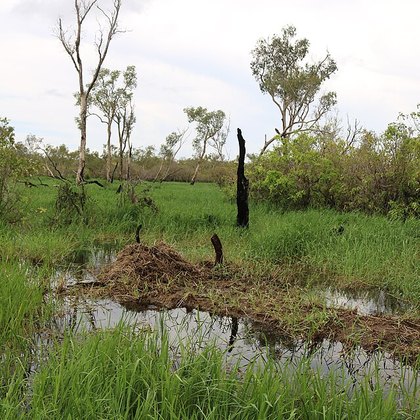
Shallow fresh water with cover: reed swamp, sedgeland, the margins of billabongs and farm dams, flooded grassland, melaleuca swamp forest, rice fields and sewage ponds. It hunts more quietly and closer to vegetation than the Great Egret and goes out onto open mudflat less often. It nests colonially in trees over water, usually among other herons, ibises and cormorants.
Where the bird is most often found, arranged by main group and formation.


Range and movements
Northern and eastern Australia, from the Pilbara and the Kimberley in Western Australia east across the Top End and Queensland into New South Wales, and on to eastern South Australia; beyond that eastern Indonesia and New Guinea. Its core is the tropical northern swamps, where it is most numerous after the wet; southward and inland it thins out fast. In New Zealand it is a vagrant with close to twenty accepted records, from Kaikohe in the north to Lake Ellesmere, almost always in freshwater wetland rather than on estuaries.
- Resident
- Breeding (summer)
- dark = core range, pale = thinly spread
Where and when to look
Work from the bill and the gape, not from an impression of size: a lone white egret in a marsh is hard to judge, but a short blunt yellow bill with a gape stopping at the eye names this bird. Easiest of all is a pool holding both species together, when the difference in neck length and stance does the work. In the Top End the end of the wet, March to May, is the best time.
Conservation
Least Concern (LC), and numerous in tropical northern Australia. The species depends on the annual flooding of the swamps: when that fails, whole colonies do not breed at all, and river regulation and extraction in the Murray-Darling basin have made this plain in the south of its range. Drainage of wetland, trampling of margins by stock and the advance of salt water into coastal swamps press on local numbers besides.
Scientific name
Ardea plumifera | (Gould, 1848)
Gould described the species in 1848 as Herodias plumiferus, from a bird in New South Wales; as it now sits in Ardea, author and year stand in parentheses. plumifera is Latin for 'plume-bearing', from pluma, 'feather', and ferre, 'to carry', after the long thread-fine plumes of the breeding dress. Ardea is the Latin word for heron. The bird long counted as the Australasian subspecies of Asian Ardea intermedia; that species was split three ways in 2023, giving the Australian birds a name of their own. The guide's Dutch name follows the older combined species.