All species › Pelicans, herons and ibises › Herons, egrets and bitterns › White-necked Heron
White-necked Heron | Ardea pacifica
Withalsreiger | Garza cuelliblanca
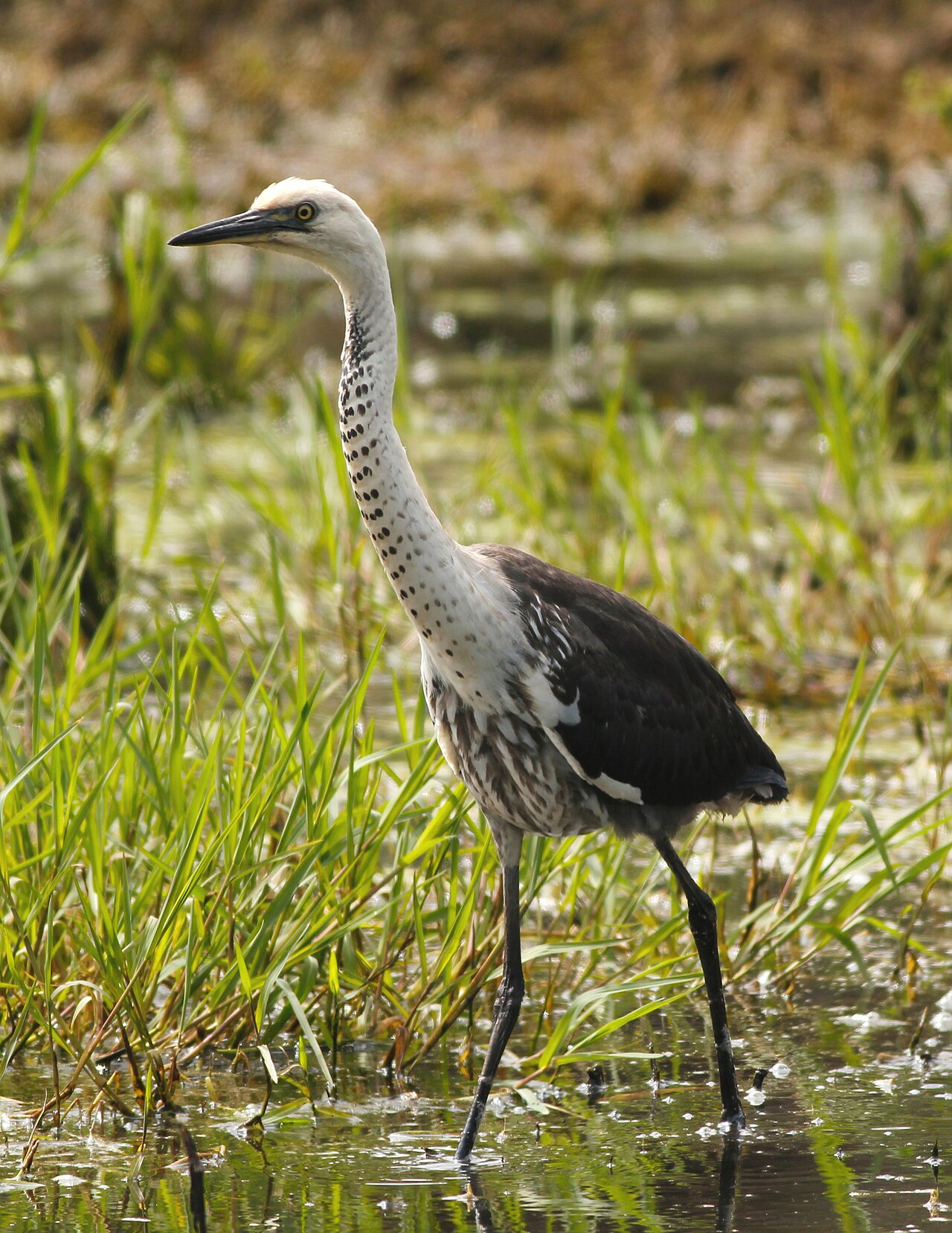
The White-necked Heron is the big dark heron of inland Australia, with a clean white head and neck crossed by a double row of black spots. It belongs to the rain: when a dry plain goes under water, White-necked Herons are standing in it within days, sometimes dozens together, and they are gone again once it dries.
Voice
A silent bird away from the colony. When flushed and in flight it gives a loud, harsh kraak as an alarm, low and clipped. At the nest there is more to hear: deep throaty notes, growling and croaking between the pair, and the rasping squeal of the young. Most observers who see the bird in the field hear nothing at all.
No freely licensed recording has been found for this species yet; what to listen for is described below.
Identification
A large, slender heron averaging just over ninety centimetres, with an all-white head and a long white neck carrying a double line of black spots down the front — the mark that fixes it at a distance. The upperparts are dark slate-grey to almost black, the underparts grey streaked with white, the bill and legs black. Breeding birds carry long wine-red to purple-brown plumes on the shoulders and back. In flight the decisive mark is the conspicuous white patch on the leading edge of the wing at the bend: a white shoulder window against an otherwise dark wing. Young birds have a greyer neck with less distinct spotting.
Confusion species
Great-billed Heron (Ardea sumatrana) is as dark above but has no white on head or neck, is more heavily built with a far thicker bill, and stays in the mangroves of the tropical coast. Pied Heron (Egretta picata) also shows white on the neck but at 43–55 cm is much smaller, with a dark cap running below the eye and with yellow legs and a largely yellow bill. Grey Heron (Ardea cinerea), a vagrant, is paler grey with a black stripe from the eye to the nape and a yellow bill.
Habitat
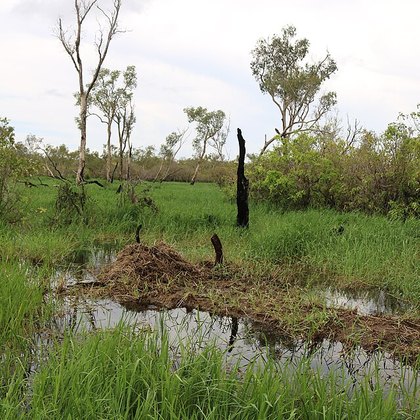
Shallow fresh water in open country: newly flooded pasture, claypans and ephemeral lakes, farm dams, swamps, roadside ditches and the fringes of reservoirs. It hunts wading or walking through wet grass for fish, frogs, crustaceans and insects, and is less tied to open water than the egrets. It uses tidal ground only rarely.
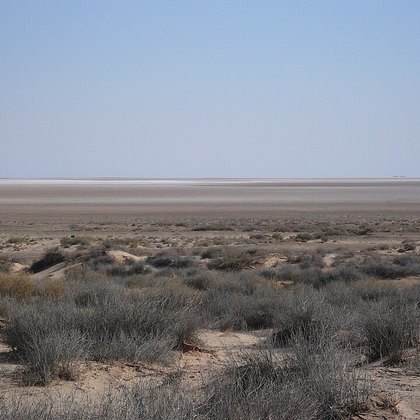
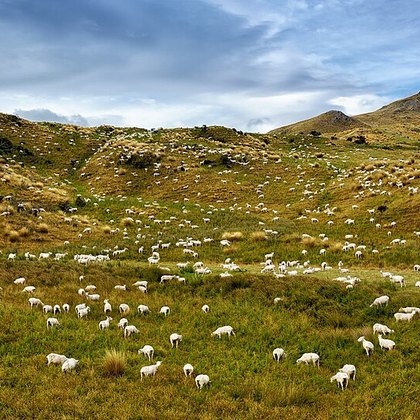
Where the bird is most often found, arranged by main group and formation.

Range and movements
Across the whole Australian mainland, with the weight in the east and south-east, and on Tasmania too; the south-western deserts are missing from its picture. It is a wanderer above all and follows the water: after good inland rain it appears in numbers on the floodplains of the Murray-Darling Basin and the Channel Country, and in dry years it shifts to the coast and the south. Many districts show a regular spring or winter pattern, but the movements are poorly mapped. In New Zealand it is a rare vagrant with a handful of records.
- Resident
- Winter
- dark = core range, pale = thinly spread
Where and when to look
Drive an inland back road after heavy rain and watch the puddles in the paddocks and the roadside ditches: on freshly flooded grassland it often stands alone or in twos, upright and visible from far off by the white neck. Check every dark heron that lifts for the white shoulder patch — that mark survives even against the light. A farm dam in dry country will produce it almost reliably in a good year.
Conservation
Least Concern (LC), widespread and numerous, and it profits from the thousands of farm dams and stock troughs that grazing has scattered across the inland. Its dependence on rain makes numbers erratic from year to year; the real risk lies in the extraction and regulation of water in the Murray-Darling Basin, which makes the floods rarer and shallower and the colonies more likely to fail.
Scientific name
Ardea pacifica | Latham, 1801
Latham described the species in 1801 as Ardea pacifica, and it has stayed in that genus, so author and year carry no parentheses. Ardea is the Latin word for heron; Linnaeus introduced the genus in 1758. pacifica means 'of the Pacific' — Latham called the bird the Pacific Heron in his supplement to the Index ornithologicus, after the region the material came from. The type locality is New South Wales.