All species › Pelicans, herons and ibises › Herons, egrets and bitterns › Eastern Cattle Egret
Eastern Cattle Egret | Ardea coromanda
Koereiger | Garceta
The Eastern Cattle Egret is the white heron that stands not in the water but in the paddock, between the legs of the stock: small, stocky and short-necked, with a thick yellow bill and a conspicuous drooping jowl. In the breeding season crown, breast and back flush orange-buff. It is one of the few birds to have taken half the world under its own power.

Voice
In the field it is almost never heard. At the colony comes a quiet, throaty rick-rack, and a hoarse rasp in disputes over a nest branch. At communal roosts a low, steady muttering builds towards sunset from hundreds of birds at once, carrying across the water.
No freely licensed recording has been found for this species yet; what to listen for is described below.
Identification
A small, stocky white heron of about half a metre, with a short thick neck, a short thick yellow bill and a bulging throat that gives it the outline of a bird with a double chin. The legs are dark, the stance forward-leaning. In breeding dress crown, breast and mantle turn orange-buff — in eastern birds the orange runs further onto neck and cheeks than in western ones — and bill and legs briefly redden, with purple-red lores. Outside the breeding season it is all white with a yellow bill. In flight it is compact, quick-beating, neck drawn in.
Confusion species
It separates quickly from the three white egrets of the wetlands, being smaller, stockier and far shorter-necked, and usually on dry ground. Plumed Egret (Ardea plumifera) has a similar yellow bill but is considerably larger and slimmer with much longer legs and neck; Little Egret (Egretta garzetta) has a thin black bill; Great Egret (Ardea alba) is more than a head taller. A young Australian White Ibis (Threskiornis molucca) walks the same paddocks but has a long curved black bill. Behaviour helps: where the other herons look for water, the cattle egret follows grazing stock.
Habitat
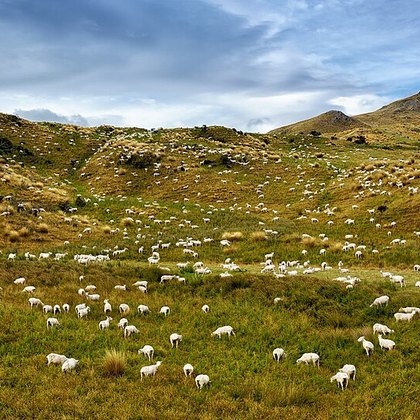
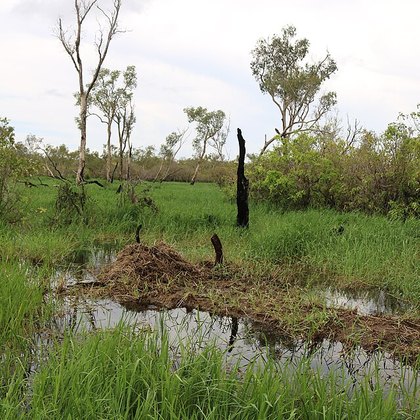
Pasture and grazing land are its core: it walks just behind or among grazing cattle and horses and takes the grasshoppers, crickets, flies and beetles they put up. It also uses cropland, freshly mown or freshly burnt paddocks, flooded grassland, sewage ponds and the edges of swamps. It breeds colonially in trees over water, usually among other herons and ibises, well away from the paddocks it feeds in by day.
Where the bird is most often found, arranged by main group and formation.

Range and movements
In Australia widespread across the north and east, from the Top End and the Kimberley through Queensland and New South Wales to Victoria, south-eastern South Australia and Tasmania; it avoids the arid interior and the western deserts. It arrived under its own power and was breeding by the 1940s. In New Zealand it has appeared regularly since the 1960s and is a winter visitor to pasture on both main islands from about March to October; it does not breed there, and numbers have fallen sharply since the 1980s.
- Resident
- Winter
- dark = core range, pale = thinly spread
Where and when to look
Look along the fence rather than along the water: a mob of cattle in a damp paddock with a knot of white birds shifting along with them is the surest way. In southern spring check the colour — a bird with orange-buff crown and breast is in breeding dress and identified on the spot. In New Zealand the winter months of June to August are the chance, on dairy pasture in the Waikato, Manawatu and Canterbury.
Conservation
Least Concern (LC), and on a world scale one of the great successes among herons: it spread across four continents in the twentieth century in the wake of livestock, settling in Australia unaided around the 1940s and in New Zealand from the 1960s. The other side of that is a fate tied to grazing: where pasture is turned to crop or to intensive indoor dairying its food supply goes, and the New Zealand wintering population has shrunk sharply as a result. As a breeder it depends on swamp trees being left standing.
Scientific name
Ardea coromanda | (Boddaert, 1783)
Boddaert described the species in 1783 as Cancroma coromanda; as it has changed genus since, author and year stand in parentheses. The epithet coromanda refers to the Coromandel Coast of India, where the described specimen came from. For two centuries the bird stood in a genus of its own, Bubulcus, Latin for 'herdsman', exactly after the company it keeps; DNA work returned it to Ardea, the Latin word for heron. Eastern birds long counted as a subspecies of the Western Cattle Egret Ardea ibis; the guide's Dutch name follows that older combined species.