All species › Pelicans, herons and ibises › Herons, egrets and bitterns › Grey Heron
Grey Heron | Ardea cinerea
Blauwe reiger | Garza real
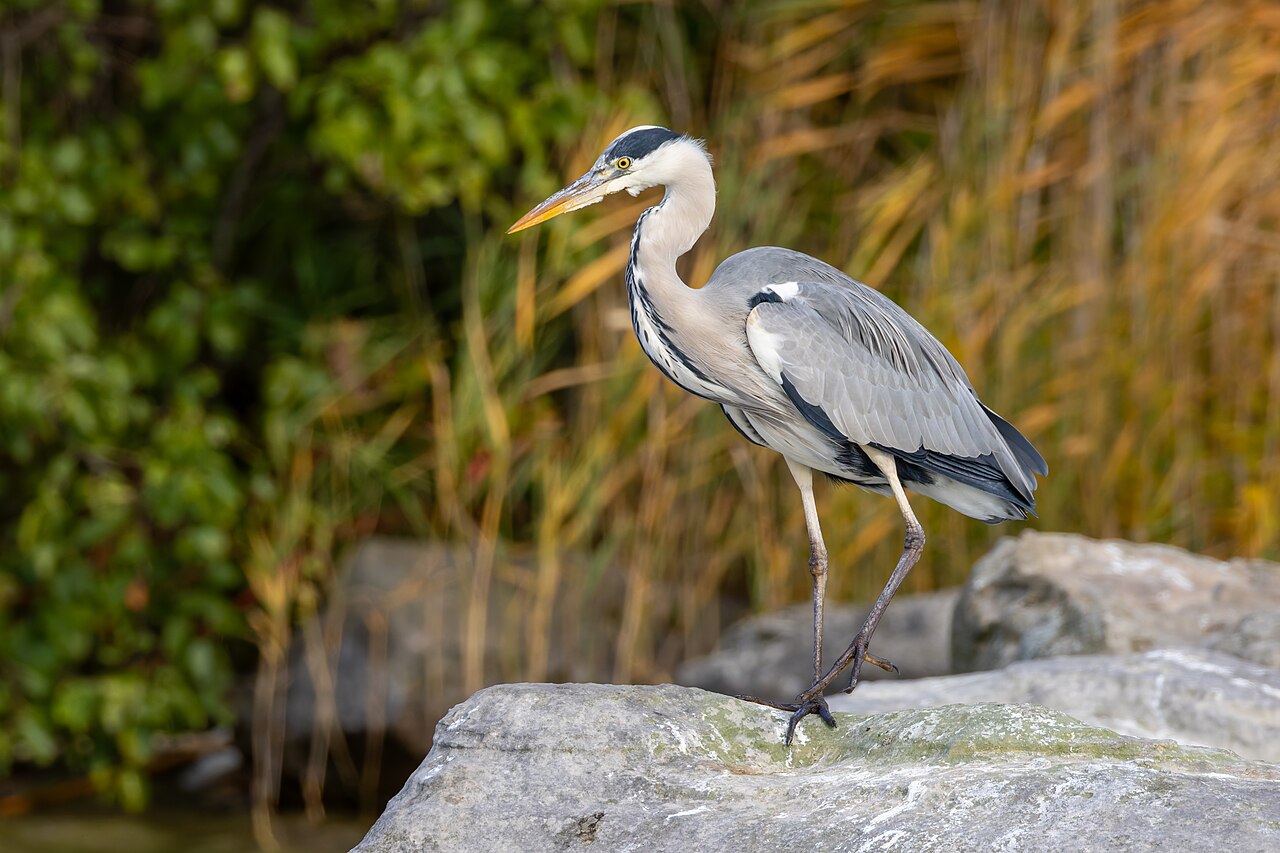
The Grey Heron is the ordinary large heron of Europe and Asia, and in Australasia one of the rarest birds to be had: a heavy grey heron of close to a metre, with a white head, a black eye-stripe running back into a thin crest, and a stout yellow-red dagger of a bill. Every record here is one for the rarities committee.
Voice
A vagrant is seldom heard, but the sound is unmistakable when it comes: a loud, hoarse, far-carrying cry on take-off, written in Europe as frarnk. At the colony — not to be heard here, since it does not breed in this region — it adds a range of guttural notes and bill-clattering.
No freely licensed recording has been found for this species yet; what to listen for is described below.
Identification
A large heron of around ninety-five centimetres, ash-grey on back and wings, white to grey-white below, with black blotching along the flanks and a black shoulder patch. Head and neck are white; a black stripe runs through the eye and ends at the back of the crown in two long thin plumes, and a line of black streaks runs down the foreneck. The bill is long, straight and powerful, yellow-pink and brighter orange when breeding. In flight it carries the neck drawn in, beats slowly, and shows a dark hand against a paler arm.
Confusion species
White-necked Heron (Ardea pacifica) is the first to rule out: also large and dark, but with head and neck wholly white and no black eye-stripe, and with white spots on the wing coverts. White-faced Heron (Egretta novaehollandiae) is far smaller, evenly blue-grey, white on the face only, with a dark rather than yellow bill. Great-billed Heron (Ardea sumatrana) of the northern mangroves is dark brown-grey with an enormous bill and lacks the white crown. A large grey heron with a yellow dagger bill and a black eye-stripe ending in a crest is this species — but document the record, because a worn White-faced Heron in poor light has caused confusion before.
Habitat
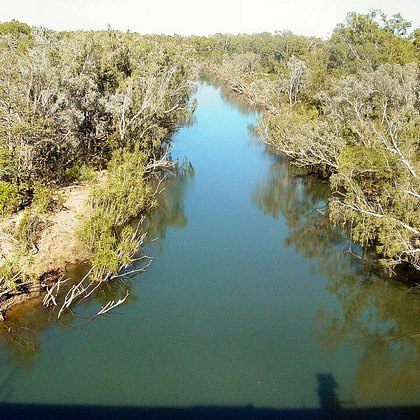
In its breeding range it is a bird of almost any shallow water: riverbanks, ditches, lakes, ponds, estuaries and mudflats. The few birds that reach this map window are found on the same kind of ground — an estuary, a lake margin or a sewage pond — usually alone and often among the local herons.
Where the bird is most often found, arranged by main group and formation.


Range and movements
Breeds outside the map window, across almost all of temperate Europe and Asia and parts of Africa; northern breeders move south for the winter, and that movement produces the overshoots. Within this window it is an extremely rare vagrant: the measurement over 2015–2024 found thirteen records and fourteen observations, all from Australia, and in none of those ten years was it an annual bird; nothing came from New Zealand or Norfolk Island in that period. Records are scattered and follow no fixed pattern.
Where and when to look
Do not count on finding one — hunt for it by taking a quick look at the head of every large grey heron. The picture that counts is the white head with the black eye-stripe and the heavy yellow-red bill; no Australasian heron has that combination. Anyone who thinks they have one should photograph head, bill and wing and submit the record to the rarities committee; without images a record of this species will not be accepted.
Conservation
Least Concern (LC): across Europe and Asia the species is numerous and has increased in many countries since shooting stopped and winters grew milder. Only hard frosts knock holes in northern populations, and temporarily. For this map window conservation is not the issue: the bird does not breed here, and a stray has no population to protect. It is, though, a species that registers water pollution and fish stocks directly, and for that reason serves as a gauge in its breeding range.
Scientific name
Ardea cinerea | Linnaeus, 1758
Linnaeus described the species in 1758 as Ardea cinerea, and unlike many herons it has stayed in that genus, so author and year carry no parentheses. Ardea is the Latin word for 'heron' and also the name of the town of Ardea in Latium; cinerea is Latin for 'ash-coloured', after the grey upperparts. The type locality was at first simply 'Europe'; Hartert restricted it to Sweden in 1920. The Dutch name 'blauwe reiger' rests on the same grey-blue tone, named that way in northern Europe for centuries.