All species › Passerines › Australasian robins › Pale-yellow Robin
Pale-yellow Robin | Eopsaltria capito
Bleekgele vliegenvanger | Petroica amarillenta
The Pale-yellow Robin is the smallest and palest of the yellow robins: a bird of twelve to fourteen centimetres that sits low in the rainforest clamped crosswise to an upright sapling, head angled downwards, and drops from there to the ground. The pale patch in front of the eye is the first thing that shows in the gloom.

Voice
A simple, repeated whistle of one or two even notes, delivered slowly from the lower storey; alongside it a soft, short chop as a contact note and a sharper, plaintive call when unsettled. It sings chiefly at first light, when the rainforest is still dim and it starts well before the other birds.
No freely licensed recording has been found for this species yet; what to listen for is described below.
Identification
Twelve to fourteen centimetres. Head and nape are grey, the back, wings and tail olive-green; the underparts are pale lemon-yellow, clearly lighter and duller than in the other yellow robins, with a whitish throat. The feature everything rests on is the pale patch on the lore, just in front of the eye: buff in the birds of south-eastern Queensland and north-eastern New South Wales, white in those of the wet tropics around the Atherton Tableland. The legs are long, and it almost always perches crosswise on an upright sapling or vine rather than lengthwise along a branch.
Confusion species
Eastern Yellow Robin (Eopsaltria australis) is the species that causes trouble in the field, for both live in eastern Australia and in the same forests: it is larger, brighter and deeper yellow below, has an olive-yellow rump, and lacks the pale patch before the eye. White-faced Robin (Eopsaltria leucops) has a wholly white face and lives far to the north, on Cape York. Western Yellow Robin (Eopsaltria griseogularis) and White-breasted Robin (Eopsaltria georgiana) are Western Australian and do not overlap with this species. Within the rainforest, Grey-headed Robin (Heteromyias cinereifrons) is much larger and has no yellow. The order at every sighting is therefore: first the lore patch, then the shade of yellow, then the district.
Habitat
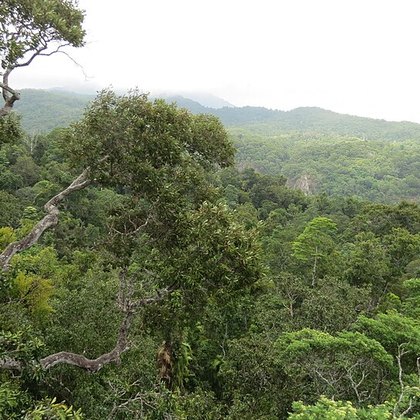
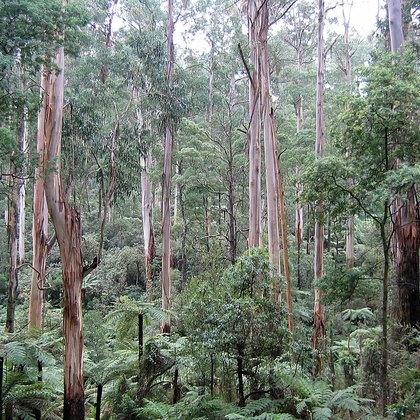
Rainforest and its edges, dry vine scrub, and wet eucalypt forest where a rainforest-like lower storey has formed beneath the canopy. It keeps to the lowest few metres, by preference in the darkest and most tangled parts, often around lawyer vine. A closed canopy keeping the lower storey cool and damp is the condition.
Where the bird is most often found, arranged by main group and formation.

Range and movements
Two separate areas along the east coast of Australia. In the north the wet tropics of Queensland, roughly from Cooktown to near Townsville, with the Atherton Tableland as the core; in the south, south-eastern Queensland and north-eastern New South Wales, south to about the Richmond country. A wide gap lies between the two blocks. Resident: a pair holds the same piece of forest year-round.
- Resident
- dark = core range, pale = thinly spread
Where and when to look
Look at eye level and below, and search for a bird sitting crosswise on an upright sapling with its head angled towards the ground: that posture is the rule among the yellow robins, and in this species it is most often seen just above the ground. In the gloom the pale lore patch registers before the yellow does. It is little shy; stand still and you are often inspected from a few metres. The best time is the first half hour after sunrise.
Conservation
Not threatened. The species holds on in the rainforest remnants of eastern Australia, but its range has been badly fragmented by the history of those forests: on the Atherton Tableland and in north-eastern New South Wales most of the original rainforest was cleared in the nineteenth and twentieth centuries. What remains is now largely protected, and the species benefits where forest edges are replanted. As a bird of a cool, damp lower storey it is exposed in the long run to warming and to the drying out of forest edges.
Scientific name
Eopsaltria capito | Gould, 1854
John Gould described the species in 1854 in the Proceedings of the Zoological Society of London, from a bird taken on the Brisbane River, then still reckoned to New South Wales and now in Queensland. capito is Latin for big-headed, from caput (head), and refers to the heavy head of this small bird. The genus Eopsaltria was introduced by Swainson in 1832, from Greek eos (dawn) and psaltria (female harpist): the harpist of the dawn, after the singing at first light. The species stood for a long time in the genus Tregellasia, named after the Australian ornithologist Thomas Tregellas; in the list used here that genus has been merged into Eopsaltria, and this guide follows that choice.