All species › Passerines › Australasian robins › White-breasted Robin
White-breasted Robin | Eopsaltria georgiana
Grijs-witte vliegenvanger | Petroica pechiblanca
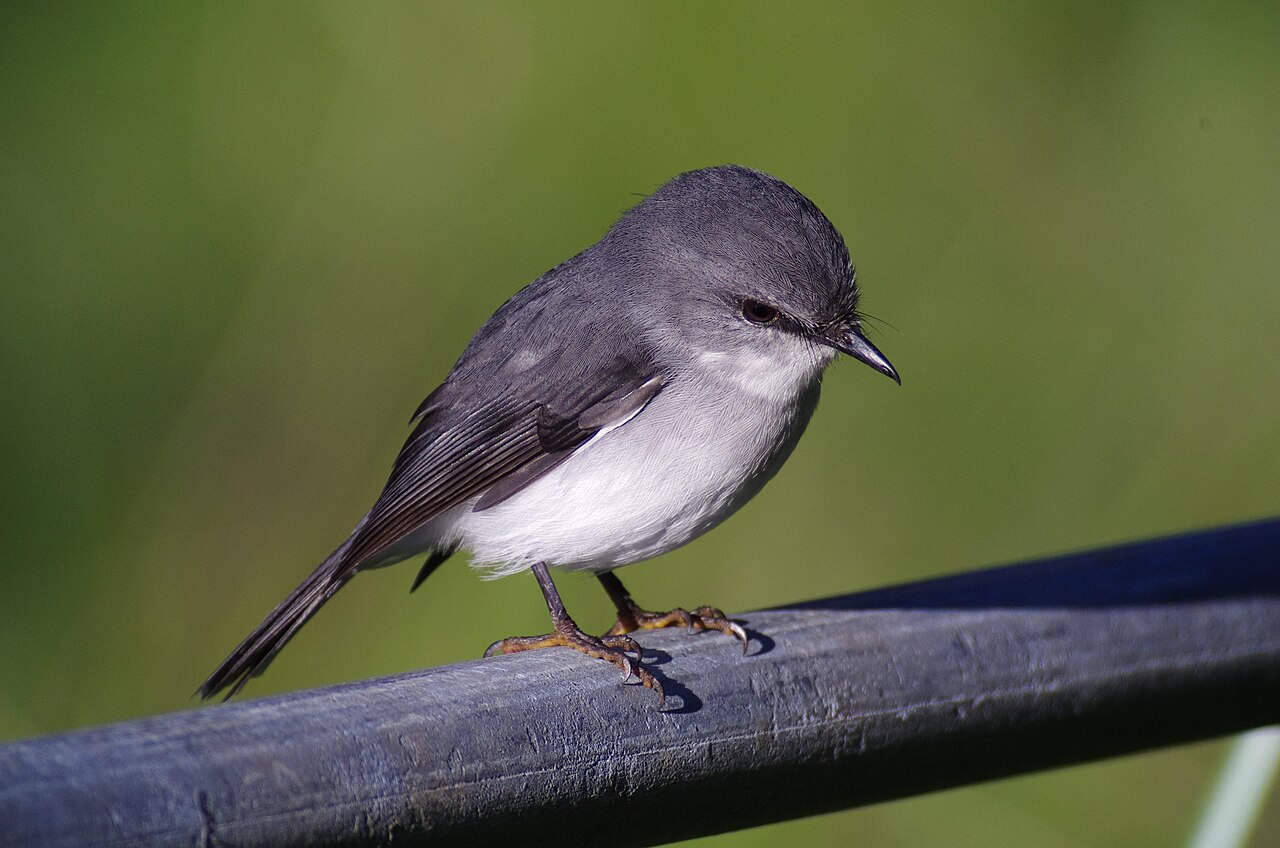
The White-breasted Robin is the odd one out among the yellow robins: it has no yellow at all. Grey above, white below, with a dark tail tipped white on the outer feathers — there is nothing more to see. It lives in the dense understorey of the karri and jarrah forests of south-western Western Australia, where it moves about in family parties and mostly gives itself away by a hard, repeated ticking from the scrub.
Voice
The commonest sound is a hard, dry, sharp chop or chek, often in a rapidly repeated series when a party grows restless; it carries surprisingly far through closed forest. Beyond that a soft rattling throat note between group members, and at first light a series of short piping notes much like the song of the other robins in the genus, but thinner and less full. A persistently ticking party in karri forest is almost certainly this species.
No freely licensed recording has been found for this species yet; what to listen for is described below.
Identification
Fourteen to a little over fifteen centimetres and about nineteen grams — the same size as the other robins in the genus, but coloured quite differently. The upperparts are plain slate grey, the whole underside from chin to undertail is white, and the boundary between the two runs unmarked across the flanks. The lore is dark, the eye black, the bill short and black. In flight and when the tail is fanned, white tips to the outer tail feathers show. The sexes are alike; young birds are browner and faintly streaked on breast and upperparts.
Confusion species
Within the genus the species is unmistakable once you see it — all the others have yellow underparts. The difficulty lies in the angle of view: the very same forest holds Eopsaltria griseogularis, which from the front shows a grey throat and breast and so also looks grey and white from below, but in that species the belly is bright yellow and the upperparts olive-grey rather than clean slate. A bird sitting high in the leaves against the light can be awkward; wait until it comes to the ground. Otherwise Rhipidura fuliginosa shares the same scrub in grey and white but is much smaller, with a long fanned tail constantly spread, and Myiagra inquieta has glossy blue-black upperparts and quivers its tail.
Habitat
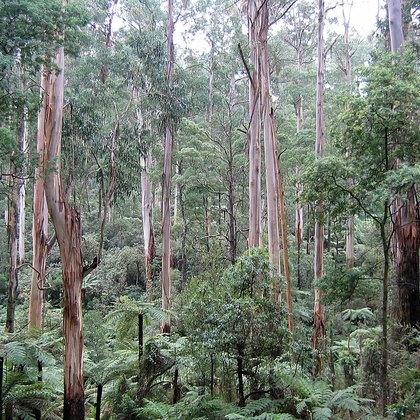
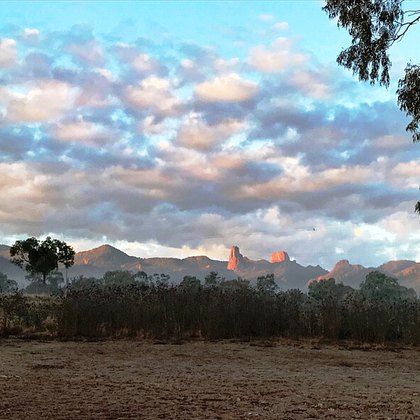
The dense, damp lower layer of forest: karri forest with a shrub layer of Trymalium and ferns, jarrah and marri forest in shaded valleys, and thick growth along creeks. In the northern part of the range, around the lower Murchison and the gorges near Kalbarri, it makes do with something quite different: dense acacia and melaleuca thickets along the river, in a landscape that is otherwise dry. The bird forages low, hops over the ground and climbs trunks and lianas. Breeding is cooperative: a nest often has helpers from earlier broods in attendance.
Where the bird is most often found, arranged by main group and formation.

Range and movements
The south-western corner of Western Australia, from Kalbarri in the north to Esperance in the east. The range is in effect split in two: a small, isolated northern population along the river valleys near Kalbarri and the lower Murchison, and a far larger southern population in the forest belt from Perth to Albany and on eastward along the south coast. Between them lies the dry wheatbelt, where it is absent. It is sedentary and does not leave its territory; wandering across open country is not known of it.
- Resident
- dark = core range, pale = thinly spread
Where and when to look
Look for it in the shaded gully, not on the slope. In the karri forests around Pemberton and Walpole and in the Porongurup country, a track along a creek with a dense shrub layer will nearly always produce it. Stand still and listen for the dry ticking; the party often comes closer of its own accord, for the species is not shy. Watch the moment it drops from a trunk to the ground with its tail spread — then you see the white tail tips, and at once that there is no yellow on the bird anywhere.
Conservation
Least Concern (LC). The species is still common within its limited range and the forest belt of the south-west is largely protected as state forest or reserve. The vulnerability lies in two things: the range is small, and the bird depends entirely on a dense shrub layer, which disappears under too-frequent fire management and under logging. The isolated northern population near Kalbarri is small and deserves separate attention. Foxes and feral cats take a bird that does everything just above the ground easily.
Scientific name
Eopsaltria georgiana | (Quoy & Gaimard, 1832)
Quoy and Gaimard described the bird in 1832 as Muscicapa georgiana, after King George Sound near Albany, the type locality; because it was later placed in another genus, authors and year stand in parentheses. Eopsaltria is formed from Greek eos (dawn) and psaltria (female harpist), after the song at first light. The Dutch name simply describes the plumage. Some authorities place the species in a genus of its own, as Quoyornis georgianus; this guide follows AviList and retains Eopsaltria.