All species › Passerines › Australasian robins › Western Yellow Robin
Western Yellow Robin | Eopsaltria griseogularis
Grijsborstvliegenvanger | Petroica pechigrís
The Western Yellow Robin is the yellow robin of the west: grey head, grey throat and breast, and below that a bright yellow belly that hangs out from under the grey like an apron. It sits still and upright on a low trunk or branch, clamped sideways against the wood, and makes itself heard just before sunrise with a series of piercing piped notes. From the south-western forests far into the dry interior of South Australia it is a familiar bird.

Voice
A series of short, high, piercing piped notes, often three to six in a row and all on the same pitch — the classic chop-chop-chop of the yellow robins, which usually starts long before sunrise, while it is still too dark to see the bird. By day it is far quieter: then you hear a soft, low rattling churr and, when it is uneasy, a sharp scolding note. A persistent piping whistle at dusk in a wandoo woodland is this species.
No freely licensed recording has been found for this species yet; what to listen for is described below.
Identification
A little over fourteen to sixteen centimetres and about nineteen grams. Head, throat and upper breast are plain grey, the upperparts olive-grey, the wing dark with a pale wingbar, and the underparts from the lower breast down bright lemon yellow. The grey bib cuts off sharply against that yellow. The eye is large and dark, the bill short. The sexes are alike. The two subspecies differ mainly in the tone of the rump — olive-grey in the birds of the south-western forests, yellower in those of the drier east — and the form rosinae, from the Eyre Peninsula side, is the yellower of the two.
Confusion species
The main distinction is geographical and also vertical. In the south-western forests it shares ground with Eopsaltria georgiana, which from below looks simply white and from above is clean slate grey, without a trace of yellow or olive. Further east there is no other yellow robin: Eopsaltria australis, the most widespread species in the genus, comes no further west than South Australia and has far more yellow — there the yellow already begins on the breast and only the throat is grey, whereas in this species the whole breast is grey. Eopsaltria capito is an eastern rainforest species with paler, dull yellow underparts and a pale eye-ring, and does not occur in the west. Smaller yellow birds such as Gerygone fusca lack the grey bib and stay high in the foliage.
Habitat
Dry eucalypt forest and woodland with a shrub layer: wandoo, salmon gum and marri woodland, mallee, acacia and allocasuarina scrub, and the dense creek vegetation within them. It avoids both true wet karri forest and bare, grazed-out ground; a layer of shrubs or stumps to hunt from is a condition. Hunting is done from a low, vertical perch: the bird clamps itself sideways against a trunk, looks down, and drops onto prey on the ground. The cup nest of bark and cobweb sits in a fork, often with helpers from earlier broods assisting at the brood.
Where the bird is most often found, arranged by main group and formation.
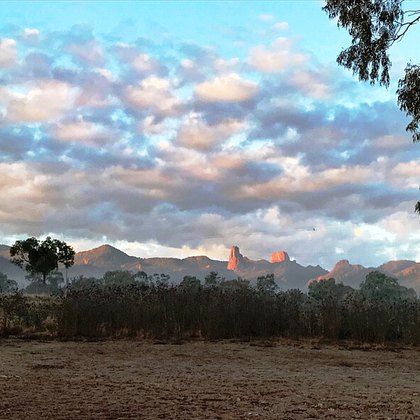

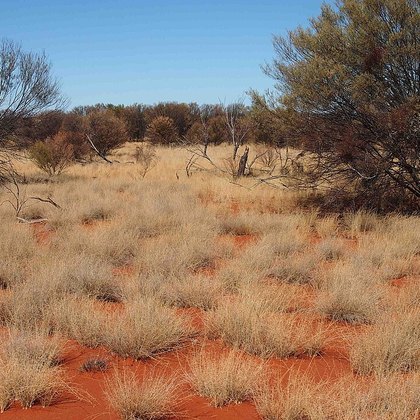
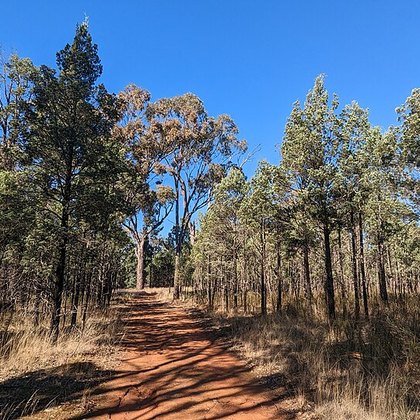
Range and movements
Southern Western Australia and adjoining southern South Australia: from the Murchison country south through the wheatbelt and the forest belt to the south coast, and east along the edge of the Nullarbor into the Gawler Ranges and onto the Eyre Peninsula. It is sedentary and holds the same territory all year. In the wheatbelt it has declined sharply in places through the clearing of woodland and survives mainly in remnant patches and along road verges.
- Resident
- dark = core range, pale = thinly spread
Where and when to look
Go out early — this is a bird of the first half hour. Stand in a wandoo woodland or along a wooded road verge while it is still half dark and wait for the series of piped notes; the bird is often sitting in the open on a bare branch as it calls. Then look deliberately at where the grey ends: if the grey runs past the breast, it is this species; if it stops at the throat and the yellow starts high up, you are outside the range and looking at Eopsaltria australis.
Conservation
Least Concern (LC). The species is still widespread across its range and common in many places. The decline is nonetheless real and locally severe: in the Western Australian wheatbelt most of the original woodland has been cleared, and the species holds on there only in remnants. Too-frequent fire management, which removes the shrub layer, and feral cats do it no good either. Where old patches of woodland and wide verges are kept, it stays put.
Scientific name
Eopsaltria griseogularis | Gould, 1838
Gould described the bird in 1838, directly in the genus Eopsaltria, so author and year stand without parentheses; the type locality is the Swan River near Perth. Eopsaltria is formed from Greek eos (dawn) and psaltria (female harpist), after the song at first light. griseogularis is Latin for grey-throated, from griseus (grey) and gula (throat). The Dutch name names the breast where the scientific name names the throat; both are right, for here the grey covers throat and breast alike.