All species › Passerines › Birds-of-paradise › Paradise Riflebird
Paradise Riflebird | Ptiloris paradiseus
Schildgeweervogel | Ave del paraíso festoneada
The southernmost bird of paradise in the world lives in the subtropical rainforest of the border ranges between Queensland and New South Wales. The male is velvet black with a metallic blue-green crown and a triangular throat shield, and holds his display on a bare stub: wings raised over the head in turn, the head jerking from side to side, the wide-open mouth bright yellow inside.

Voice
A harsh, rasping and explosive yaass, usually in two or three rising calls, carrying far through the rainforest and sounding as though something is being torn open. The male calls from a high bare branch, chiefly from August to December in the early morning. In display soft clicking and rustling sounds are added, produced by the wings themselves.
No freely licensed recording has been found for this species yet; what to listen for is described below.
Identification
The adult male is velvet black with an oily green sheen, with a metallic blue-green crown, a triangular iridescent throat and breast shield closed off below by a dark band, and iridescent central tail feathers; the inside of the mouth is bright yellow in display. The bill is long, black and clearly decurved. Female and young bird are grey-brown on back and head, with a pale eyebrow stripe, rufous wings and cream underparts closely set with dark chevrons. When feeding, the bird levers its long bill into bark crevices and dead wood and prises the bark up — that levering is often the first thing noticed at a distance.
Confusion species
The three riflebirds of the genus Ptiloris are almost entirely separate: this species holds south-eastern Queensland and north-eastern New South Wales, Victoria's Riflebird (Ptiloris victoriae) lives a thousand kilometres further north in the Wet Tropics, and the Magnificent Riflebird (Ptiloris magnificus) only on Cape York; their ranges do not meet. The females of the three closely resemble one another and cannot be separated with certainty outside their ranges. More real is confusion with the male Satin Bowerbird (Ptilonorhynchus violaceus) of the same forest: also glossy black, but with a short pale bill, a violet-blue iris and no iridescent shield at all.
Habitat
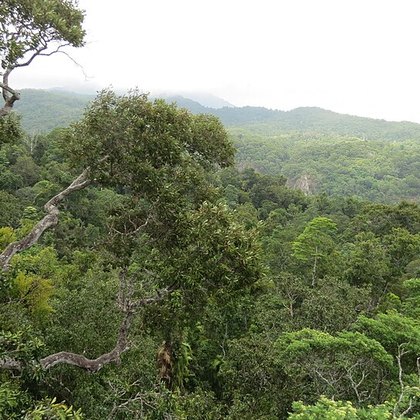
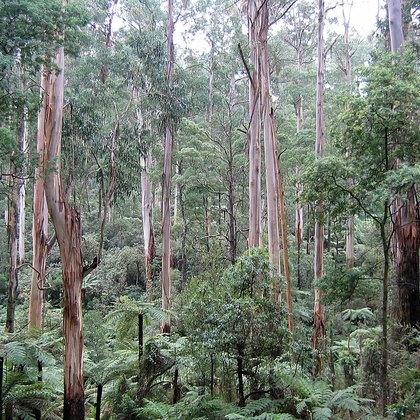
Subtropical rainforest and the adjoining wet sclerophyll forest with a dense understorey, and on the highest ridges the Antarctic beech forest, roughly between three hundred and eleven hundred metres. In winter birds drop to lower forest and to fruiting edges, orchards and gardens along the forest margin. Foraging is in bark, dead wood, vines and epiphyte clumps, and on fruit besides.
Where the bird is most often found, arranged by main group and formation.

Range and movements
A small range along the east coast of Australia, from south-eastern Queensland south through the border ranges into mid-eastern New South Wales, centred on the tableland plateaus and the eastern escarpment forests. Resident with altitudinal movement: lower in the cold months, back on the high display stubs in the breeding season. The range has been fragmented by the historical clearing of coastal rainforest.
- Resident
- dark = core range, pale = thinly spread
Where and when to look
In the southern spring stand in mountain rainforest at first light and wait for the rasping yaass; the male calls from the same bare stub each time, so after one morning it can be found again deliberately. Outside the display season it pays to search trunks with loose bark: the levering of the long bill makes an audible sound and betrays a bird that otherwise stays invisible.
Conservation
Not threatened, but with a small and fragmented range. The large-scale clearing of coastal rainforest in the nineteenth and twentieth centuries, the Big Scrub being the best-known case, reduced the habitat to separate blocks; what remains lies largely within protected World Heritage rainforest reserves. Connecting those blocks and keeping old trees with loose bark are the main points.
Scientific name
Ptiloris paradiseus | Swainson, 1825
Swainson described the species in 1825 and introduced the genus in the same work, so author and year stand without parentheses. Ptiloris is formed from Greek ptilon (feather) and rhis (nostril), after the small feathers over the nostrils. paradiseus refers to the birds of paradise, the family to which the riflebirds belong. Two explanations of the name riflebird stand side by side: the uniform of a British rifleman, and the crack of the call.