All species › Passerines › Birds-of-paradise › Magnificent Riflebird
Magnificent Riflebird | Ptiloris magnificus
Prachtgeweervogel | Ave del paraíso goliazul
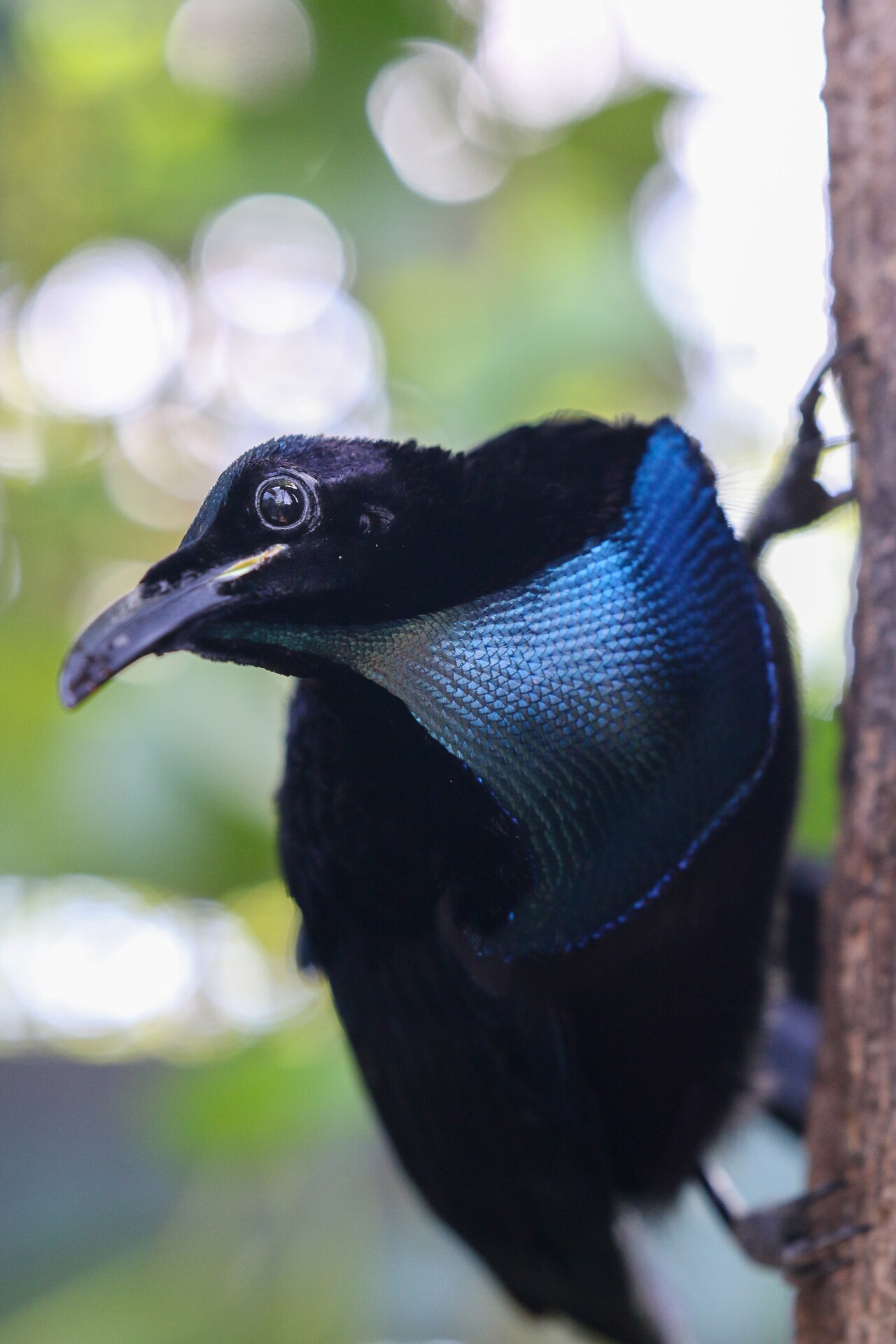
The largest of the three Australian riflebirds, and with that a bird of paradise that reaches the Australian mainland. The male is velvet black with a metallic blue-green crown and breast shield, and in display spreads both wings at once into an almost closed circle around his own head, so that the bird seems to vanish behind a fan.
Voice
A loud, far-carrying two-note whistle, the second note higher and sustained, audible for a kilometre through lowland rainforest and often the first sign of the species. The male calls from a high bare branch or a broken stub and repeats the signal at long intervals, chiefly in the early morning. Females and young birds give a harsh rasping sound at fruiting trees.
No freely licensed recording has been found for this species yet; what to listen for is described below.
Identification
The adult male is deep velvet black with an olive-green sheen, with a metallic blue-green crown, a triangular iridescent breast shield closed off below by a dark band, and iridescent central tail feathers; the flank feathers are elongated and spread as a cape in display, and the inside of the wide-open mouth is bright yellow. The bill is strikingly long and strongly decurved, longer than in either of the other riflebirds. Female and young bird are quite different: rufous-brown on back and wings, with a pale eyebrow stripe and dirty-white underparts closely marked with dark crosswise arrowheads. The display is the best character: the male spreads both wings at once into a round fan around the head and swings the body rhythmically from side to side, with clicking sounds.
Confusion species
The three riflebirds of the genus Ptiloris hardly share any range: this species keeps to Cape York Peninsula, Victoria's Riflebird (Ptiloris victoriae) lives a good four hundred kilometres further south in the Wet Tropics, and the Paradise Riflebird (Ptiloris paradiseus) only in south-eastern Queensland and north-eastern New South Wales. Range is therefore the best character; in appearance this is the largest and longest-billed of the three. The females of all three closely resemble one another and cannot be told apart with certainty outside their ranges — which is more honest than inventing a field mark. A black male at a distance suggests the Spangled Drongo (Dicrurus bracteatus), but that has a forked tail, a red eye and a short straight bill.
Habitat
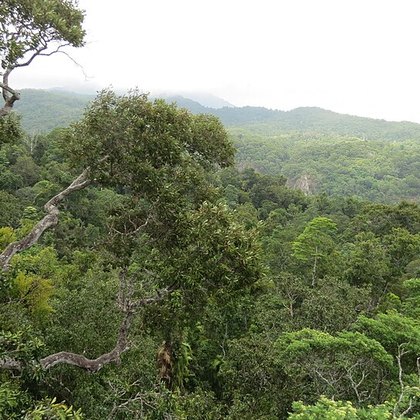
Tropical lowland rainforest, gallery forest along the rivers and the larger blocks of monsoon forest and vine thicket of the peninsula, from sea level into the low hills. The bird feeds on fruit and on insects that it levers from bark crevices, dead wood and epiphyte clumps with its long bill, often hanging upside down on a trunk. The display site is a high bare stub or thick horizontal branch with a clear outlook.
Where the bird is most often found, arranged by main group and formation.

Range and movements
Widespread in the lowlands of New Guinea and on the Aru Islands; in Australia only on Cape York Peninsula in the far north-east of Queensland, centred on the forests of the Iron Range and McIlwraith areas. Resident without migration, though with local movement to fruiting trees. The Australian share of the range is small and lies entirely north of the Wet Tropics.
- Resident
- dark = core range, pale = thinly spread
Where and when to look
Go to the rainforest of Cape York in the months October to December and listen at sunrise for the two-note whistle; walk towards it and find the bare stub it comes from. Then stand still: the bird returns to fixed perches. At fruiting figs, females and young birds are usually easier to see than the far shyer black males.
Conservation
Not threatened; the species is widespread across New Guinea and locally numerous there. The Australian part of the population is small and confined to Cape York, where changing fire regimes at the rainforest edge and savanna fire pushing into the vine thickets are the main concern. The core areas lie within national parks.
Scientific name
Ptiloris magnificus | (Vieillot, 1819)
Vieillot described the species in 1819 in another genus, so author and year stand in parentheses. Ptiloris is formed from Greek ptilon (feather) and rhis (nostril), after the small feathers covering the nostrils. magnificus is Latin for 'magnificent'. Two explanations of the name riflebird circulate side by side: the black with its velvet sheen is said to recall the uniform of a British rifleman, and the harsh call a rifle shot; which is the older cannot be settled. Some authoritative lists split the eastern New Guinean birds as a separate species, Ptiloris intercedens; that split is not universally followed and bears on where the Australian birds are placed.