All species › Passerines › Birds-of-paradise › Trumpet Manucode
Trumpet Manucode | Phonygammus keraudrenii
Trompetparadijskraai | Ave del paraíso trompetera
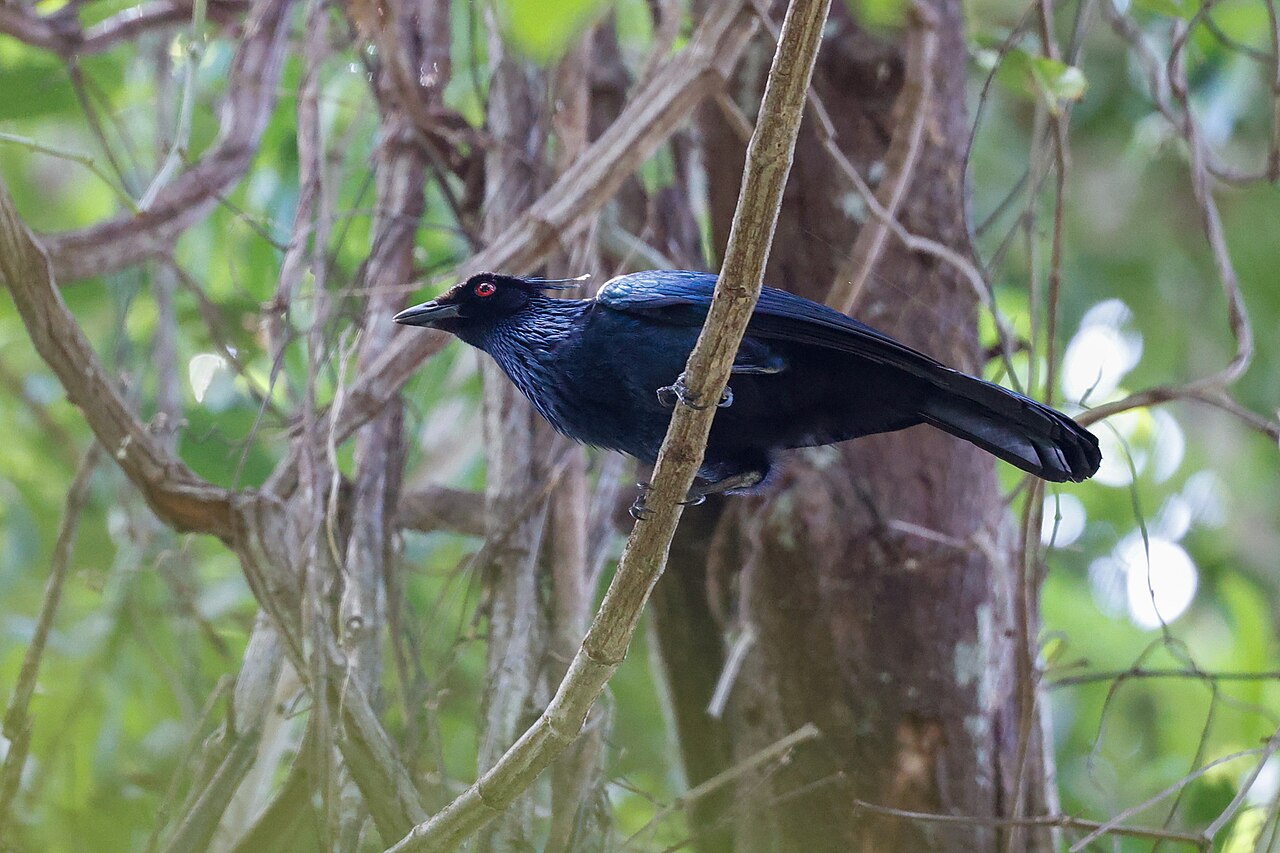
The Trumpet Manucode is the only bird of paradise in Australia that is wholly black and carries no plumes: a compact, glossy bird of the Cape York rainforest, with a red eye and two upstanding horns of feather on the crown. Its windpipe is coiled into a long loop that lies under the skin across the breast muscle, and that is what gives it the deep trumpet blast it is named for.
Voice
The signature sound is a low, booming trumpet that rolls through closed forest and is hard to place: a rising oo-oo-ooAAH, given once or twice and then followed by a long silence. Alongside it comes a harsh barking rasp in disputes at a fruiting fig. Birds call most in the early morning and in the run-up to the wet season, from November to February.
No freely licensed recording has been found for this species yet; what to listen for is described below.
Identification
A stocky black bird of thirty centimetres, short-tailed, broad-winged and heavy-billed. The plumage is not dull but deeply glossed, with blue, green and purple iridescence that comes up only in full light; in shade the bird simply reads as black. Two narrow feather horns stand above the eye, and the neck and breast feathers are drawn out into a loose mane. The eye is bright red, brown in young birds. The female is smaller and a little duller.
Confusion species
In the same forest the black glossy birds are chiefly Torresian Crow (Corvus orru) and Pied Currawong (Strepera graculina): the first is much larger, white-eyed and long-tailed, the second shows white in tail and wing. Female Magnificent Riflebird (Ptiloris magnificus) is brown and barred and no problem at all; the male is black but carries a blue breast shield and a long curved bill. The call remains decisive.
Habitat
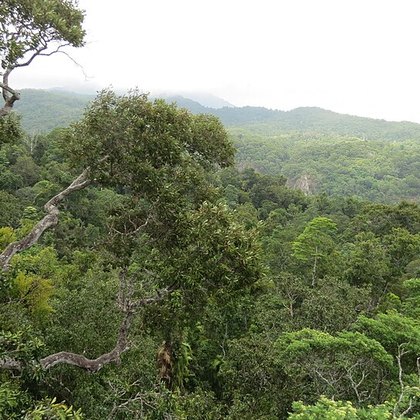
Closed lowland rainforest and the smaller monsoon forests and vine thickets of the north, together with the gallery forest along creeks that ties those patches together. It keeps to the canopy and rarely comes below ten metres. Where figs are fruiting, it is; in the dry season it moves to the moistest strips along water, which stay green through it.
Where the bird is most often found, arranged by main group and formation.


Range and movements
In Australia only the northern part of Cape York Peninsula, roughly from Coen north, with Iron Range and the Lockerbie Scrub the best-known sites. Beyond that it is widespread through the lowlands of New Guinea and on the Aru and D'Entrecasteaux Islands. It does not migrate but wanders within the forest after fruiting trees, so that it can sit in one place for weeks and then be gone.
- Resident
- dark = core range, pale = thinly spread
Where and when to look
Stand at a fruiting fig in Iron Range early in the morning and wait: the bird comes to the fruit and gives itself away with the trumpet before it becomes visible. Look into the light for the iridescence and pick out the two feather horns against the sky; under the canopy shade none of the gloss shows. From November to February it calls most often.
Conservation
Least Concern (LC). The range is large and most of it lies in New Guinea, where lowland forest is still extensive. The Australian population is small and confined to a handful of rainforest blocks on Cape York; those are largely protected, but they remain exposed to cyclones, to fire biting into the forest edge from the surrounding savanna, and to clearing in the country behind them.
Scientific name
Phonygammus keraudrenii | (Lesson & Garnot, 1826)
Lesson and Garnot described the bird in 1826 in another genus, so author and year stand in parentheses. In the same year they introduced the genus Phonygammus; the name plays on Greek phōnē, 'voice, sound', and is read as 'wedded to sound', after the loud call. The epithet keraudrenii honours the French naval physician Pierre François Keraudren (1769–1858). The Cape York breeding form is the subspecies gouldii.