All species › Passerines › Birds-of-paradise › Victoria's Riflebird
Victoria's Riflebird | Ptiloris victoriae
Victoria's geweervogel | Ave fusil de la reina Victoria
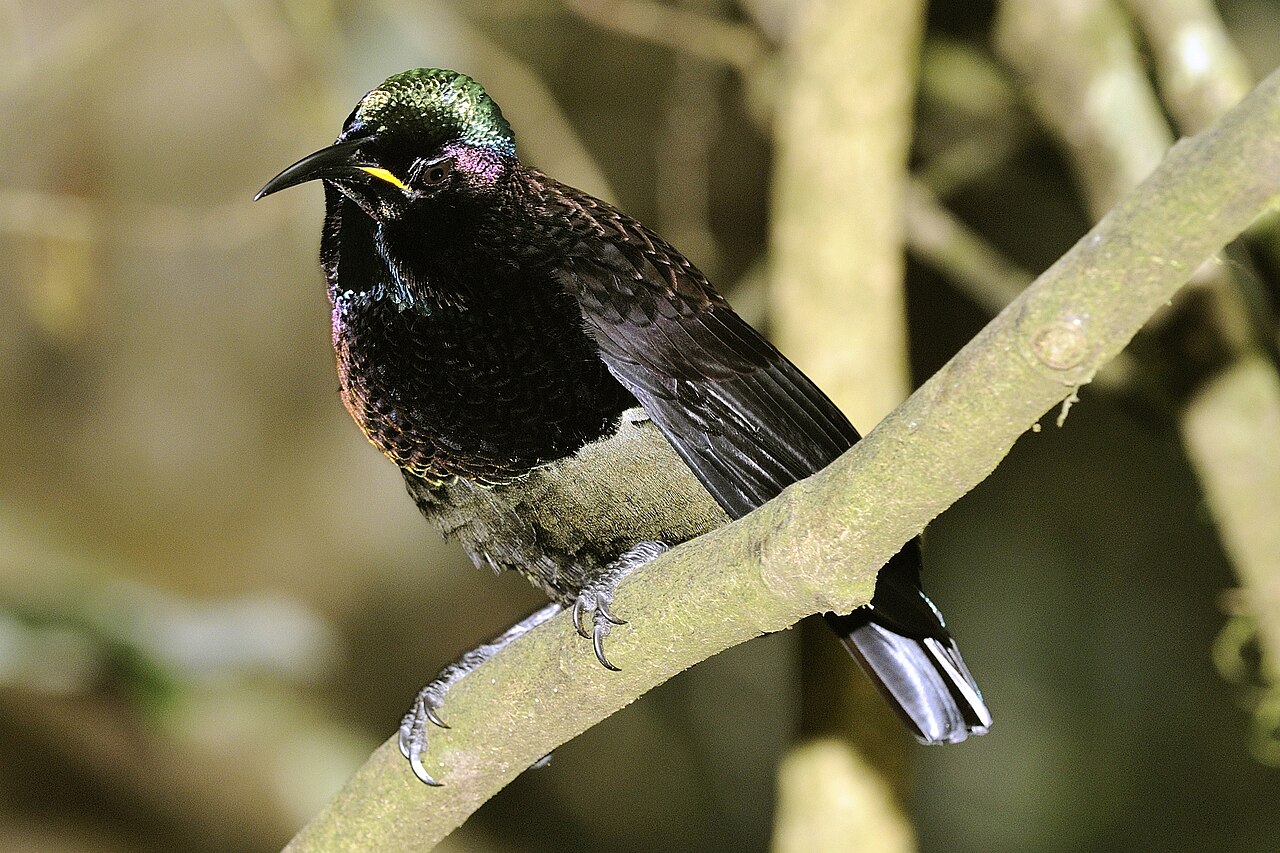
The smallest of the three riflebirds and the only one confined to the Wet Tropics of north-eastern Queensland. The male is velvet black with an iridescent blue-green crown and throat shield and displays on a stub or thick vine: first one wing over the head, then the other, finally both, the head jerking to and fro and the bill wide open.
Voice
A harsh, rasping yaass of two to four rising calls, with the sound of tearing cloth, carrying far through the rainforest from a high branch; calling peaks from August to December in the first hours after sunrise. In display the wings rustle audibly through the air, a sound carried over tens of metres. Females and young birds give short, harsh rasps.
No freely licensed recording has been found for this species yet; what to listen for is described below.
Identification
The adult male is velvet black with an iridescent blue-green crown and a triangular iridescent throat shield, closed off below by a broad dark breast band; the belly gleams bronze-purple in side light and the central tail feathers are iridescent too. The bill is black and decurved, but clearly shorter than in the Magnificent Riflebird. Female and young bird are brown on back and wings, with a conspicuous dirty-white eyebrow stripe and cream underparts closely set with dark chevrons. Young males moult gradually and then show black patches among the brown, a plumage neither parent has.
Confusion species
The three riflebirds of the genus Ptiloris are geographically separate: this species is confined to the Wet Tropics between Cooktown and the Paluma area, the Magnificent Riflebird (Ptiloris magnificus) lies further north on Cape York and the Paradise Riflebird (Ptiloris paradiseus) a thousand kilometres to the south. Within the Wet Tropics there is no other riflebird, so range almost settles the identification. The brown females do resemble the Tooth-billed Bowerbird (Scenopoeetes dentirostris) of the same forest, but that bird is stouter, has a heavy straight notched bill and is streaked lengthwise instead of marked crosswise.
Habitat
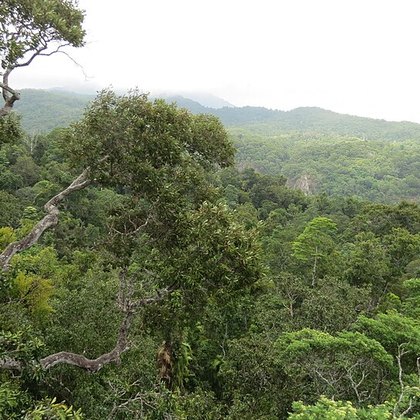
Tropical rainforest and the adjoining wet sclerophyll forest with a moist understorey, from sea level to about twelve hundred metres; the highest numbers are on the tablelands. The bird climbs and hangs along trunks and thick vines and levers with its bill under loose bark, in dead wood and in epiphyte clumps; besides this it eats fruit in the canopy and at the forest edge.
Where the bird is most often found, arranged by main group and formation.

Range and movements
Endemic to the Wet Tropics of north-eastern Queensland, from the hinterland of Cooktown south to about the Paluma area north of Townsville, thus over roughly four hundred kilometres of coastal ranges. Resident with limited altitudinal movement: in the cooler months birds drop to lower forest and to the margins. Outside this area the species has not been recorded.
- Resident
- dark = core range, pale = thinly spread
Where and when to look
Display sites stay on the same stub or thick vine for years, usually two to six metres above the ground. Listen at first light for the tearing yaass and walk towards it carefully. At the visitor lodges of the Atherton Tableland females and young birds come to feeding tables and can be watched at close range, which gives the best practice for the chevron pattern of the underparts.
Conservation
Not threatened and common within its range. The whole habitat lies almost entirely within the Wet Tropics World Heritage Area, where logging has ended. The concerns are the narrowness of the range and the warming of the mountain climate, which may in time thin out the cool upland forests; lower down the species remains numerous for now.
Scientific name
Ptiloris victoriae | Gould, 1850
Gould described the species in 1850 and placed it at once among the riflebirds, so author and year stand without parentheses. Ptiloris is formed from Greek ptilon (feather) and rhis (nostril), after the small feathers over the nostrils. The specific name victoriae honours Queen Victoria, and the English name follows that honour. Two explanations of the name riflebird circulate side by side: the velvet black plumage recalling the uniform of a British rifleman, and the call resembling a shot.