All species › Passerines › Crows, jays and magpies › Little Crow
Little Crow | Corvus bennetti
Bennetts kraai | Cuervo australiano chico
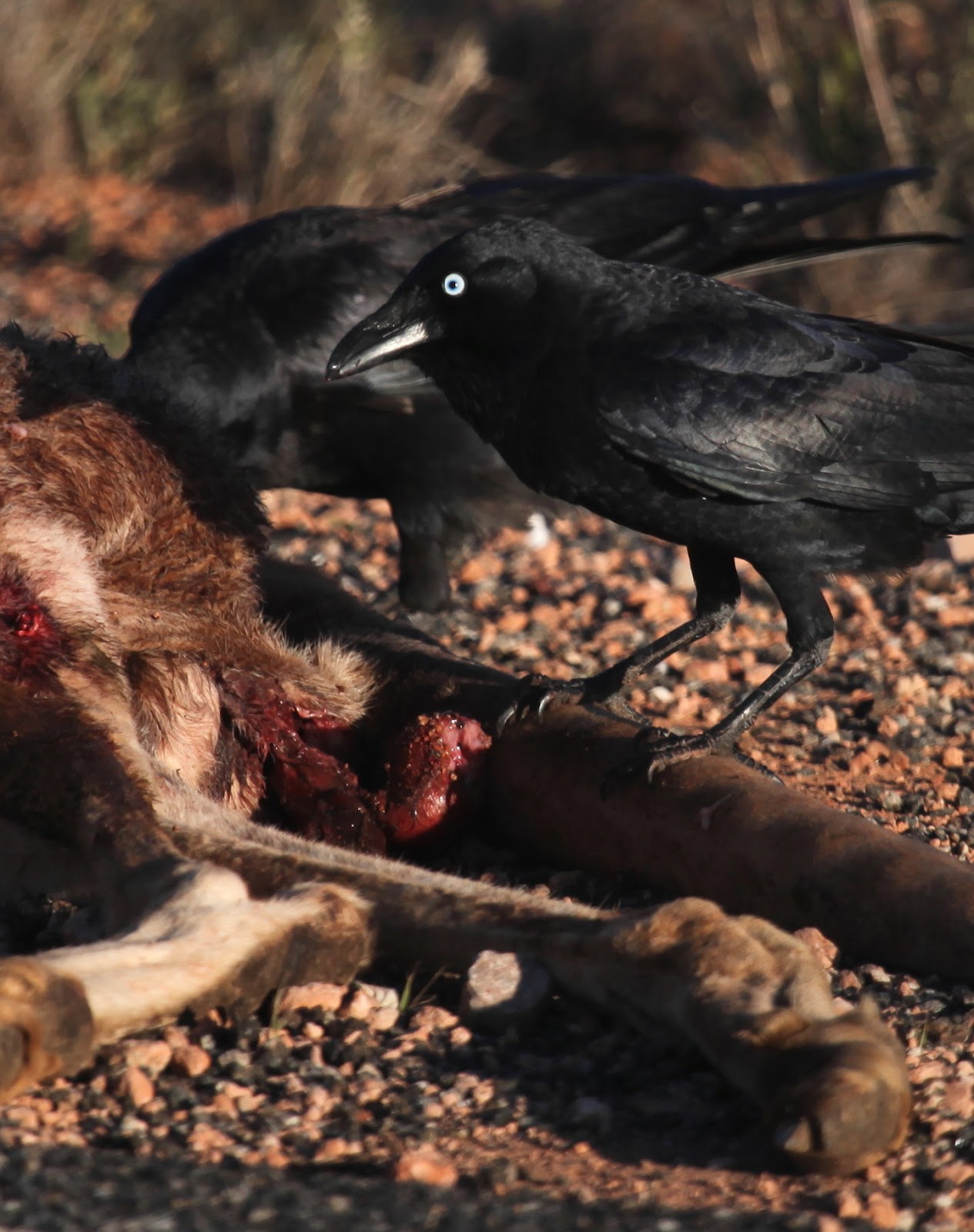
The Little Crow is the crow of the dry interior: the smallest and lightest built of the Australian Corvus species, roaming in loose restless flocks over mulga, saltbush and gibber plain and found at the tip and the stock troughs of every inland town. Identifying it means listening above all: with Australian crows the eye sees little, the ear a great deal.
Voice
A quick nasal series, nark-nark-nark, higher and more clipped than the calls of the other Australian corvids and without the long dying final note of the Australian Raven. Flocks call over one another in flight, which makes for a chattering, almost plaintive whole. Of all its marks, the voice is by far the most reliable in the field.
No freely licensed recording has been found for this species yet; what to listen for is described below.
Identification
An all-black crow of 48 to 50 centimetres with a blue-green gloss, a white eye in adults and strikingly long, pointed wings. It is slimmer and lighter than the other species, with a relatively fine bill and a high domed forehead. The throat feathers are short and lie flat, so the throat forms no shaggy beard when the bird calls. The feather bases are white, but that shows only in the hand.
Confusion species
This is the hardest identification problem in the Australian avifauna, and honesty is in order: a silent Corvus often cannot be named. Australian Raven (Corvus coronoides) is markedly larger, with long pointed throat hackles that stand out as a beard when it calls, and a long drawn-out dying last note. Little Raven (C. mellori) is heavier and calls deeper, with a characteristic wing movement. Torresian Crow (C. orru) is larger and heavier-billed and overlaps in the north. Feather bases — white in crows, grey in ravens — settle it, but cannot be seen in the field.
Habitat
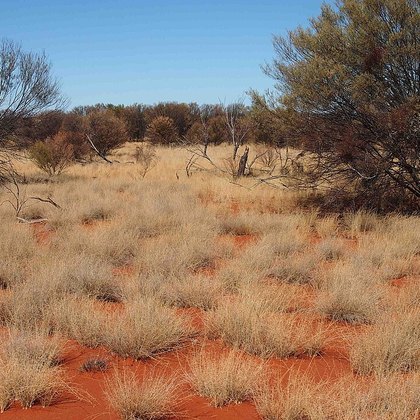
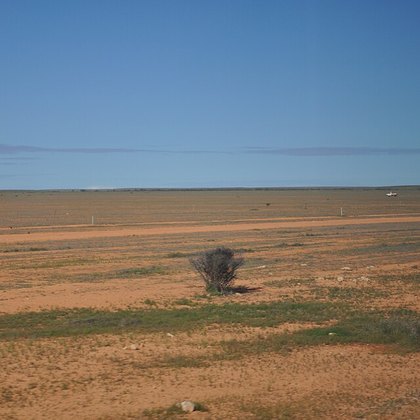
Mulga and acacia scrub, saltbush and bluebush plain, gibber plain and the edges of spinifex country: the open dry interior. Alongside that, emphatically the human landscape of that interior — towns, stock camps, troughs, windmills, roads and rubbish tips — where water and waste yield food all year. It avoids dense forest and the wet coastal strips.
Where the bird is most often found, arranged by main group and formation.


Range and movements
The semi-arid and arid parts of mainland Australia, excluding the tropical north, the wetter east, the southeast and the southwest. It is strongly nomadic: flocks follow rain, harvest and refuse and can build locally into the hundreds, then be absent for weeks. It breeds in loose colonies, including in windmills and pylons.
- Resident
- dark = core range, pale = thinly spread
Where and when to look
Let the voice decide: quick, nasal and high is this species; long drawn-out and dying away is Australian Raven. Note the build — narrow bill, domed forehead, long wings — and the throat, which stays smooth rather than bristling when the bird calls. In the interior, look at the tip or the stock trough: that is where the flocks stand still enough to compare.
Conservation
Least Concern (LC). The species has gained rather than suffered from the opening up of the interior: stock troughs, grain storage, road carrion and rubbish tips have made water and food predictable in country where they rarely are. It is locally regarded as a danger to lambs and shot, without this visibly touching the national population.
Scientific name
Corvus bennetti | North, 1901
North described the species in 1901, with Moolah in western New South Wales as type locality; author and year stand without parentheses, since the genus has not changed. Corvus is the Latin word for raven. The epithet bennetti honours the Australian naturalist and collector Kenric Harold Bennett, who worked in that same western New South Wales; the Dutch name carries that tribute over.