All species › Passerines › Crows, jays and magpies › Australian Raven
Australian Raven | Corvus coronoides
Australische raaf | Cuervo australiano
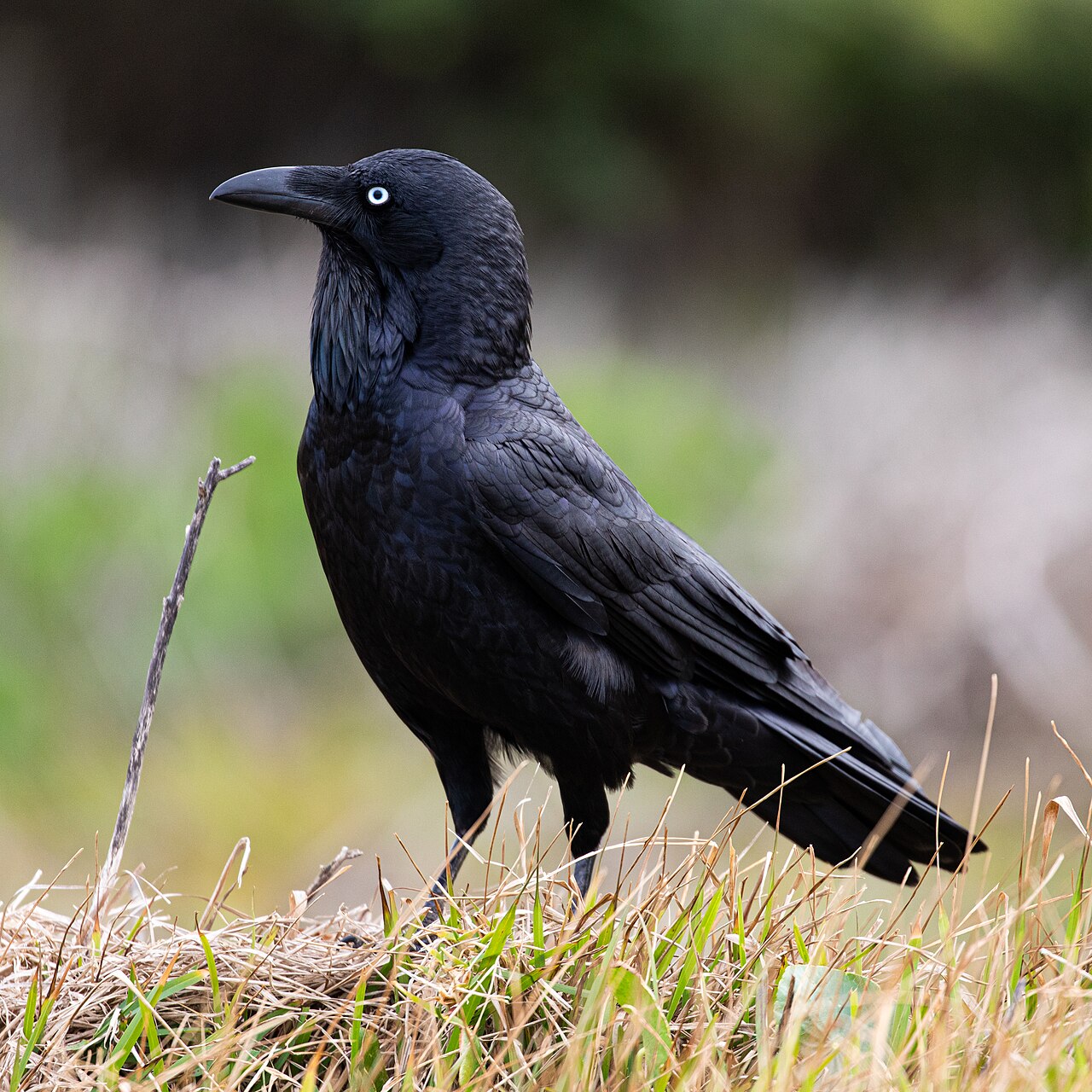
The Australian Raven is the large, solemn corvid of eastern and southern Australia and the bird that sets the sound of the suburbs in Sydney, Canberra, Adelaide and Perth. It is entirely black with a white eye, and it gives itself away by the long throat feathers that fan out into a beard the moment it delivers its famous dying wail.
Voice
The territorial call is slow, high and mournful: aah-aah-aah-aaaaah, the last note held for seconds and fading away as though the bird were running out of air. It calls with the body horizontal and the head thrust forward, and the throat feathers visibly balloon into a bag as it does so. Short rasping notes with a creaking undertone come alongside. That dying final note is the most reliable mark in the whole genus.
No freely licensed recording has been found for this species yet; what to listen for is described below.
Identification
A large, wholly black bird of about half a metre, with a heavy black bill, black legs and a white iris with a fine blue inner rim. The throat feathers are long and lanceolate and hang under the bill like a beard on a calling bird; at close range that is the best mark. The feather bases are grey, not white — visible when wind opens the plumage. Young birds have a brown eye, shorter hackles and often a pink fleshy gape.
Confusion species
Little Raven (Corvus mellori) averages smaller, has shorter hackles that do not balloon, flicks both wings sharply upward with each note, and calls a guttural kar-kar-kar without the long dying wail; it also lives in flocks in open country. Torresian Crow (Corvus orru) has short hackles, white feather bases, shuffles its wings exaggeratedly after landing and calls a staccato uk-uk-uk-uk. In southeastern forest there is also Corvus tasmanicus, bulkier and shorter-tailed with a fast, deep kar-kar-kar.
Habitat
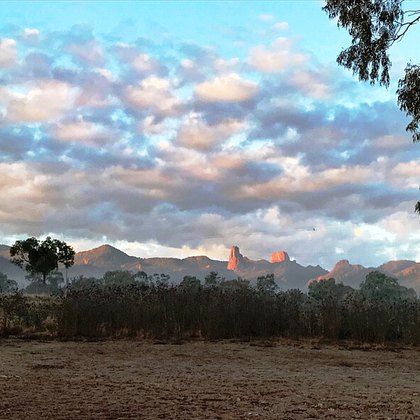
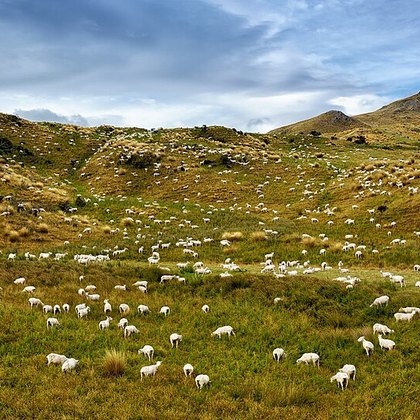
Almost any open landscape with trees: dry eucalypt forest and woodland, cropping country and grazed rangeland with remnant timber, heath and mangrove, and in the cities park, garden, golf course and street trees. It needs tall trees or pylons to nest in and open ground to forage on. Only the driest interior of Western Australia is left to other species.
Where the bird is most often found, arranged by main group and formation.


Range and movements
Eastern, southern and central Australia, with a western arm running across the Nullarbor to the southwestern corner, where the subspecies perplexus breeds. It is all but absent from tropical northern Australia and does not occur in Tasmania. Pairs are sedentary and hold their territory the year round; non-breeding birds roam in loose parties, but the true flocking of the Little Raven is missing.
- Resident
- dark = core range, pale = thinly spread
Where and when to look
Let the bird call before you name it. Find a perched bird in a city park, wait for the call and watch three things at once: the horizontal posture, the ballooning beard and the last note sagging away. If all you have is a black bird on a lamp post, look at the throat: loose points hanging under the bill mean this species and not the crow.
Conservation
Least Concern (LC). The species is numerous and has profited from the human working of the landscape: grazing, road verges, tips and suburban trees supply food and nest sites. Where graziers hold it responsible for lamb losses it is still persecuted, though most of the lambs it cleans up were dead already.
Scientific name
Corvus coronoides | Vigors & Horsfield, 1827
Vigors and Horsfield described the bird in 1827 as Corvus coronoides, and it has stayed in that genus, so author and year carry no parentheses. Corvus is the Latin word for raven; the epithet coronoides is formed on Greek korone, 'crow', and eidos, 'shape', and so means 'crow-like'. The type locality lies in the Parramatta district near Sydney.