All species › Passerines › Crows, jays and magpies › Rook
Rook | Corvus frugilegus
Roek | Graja
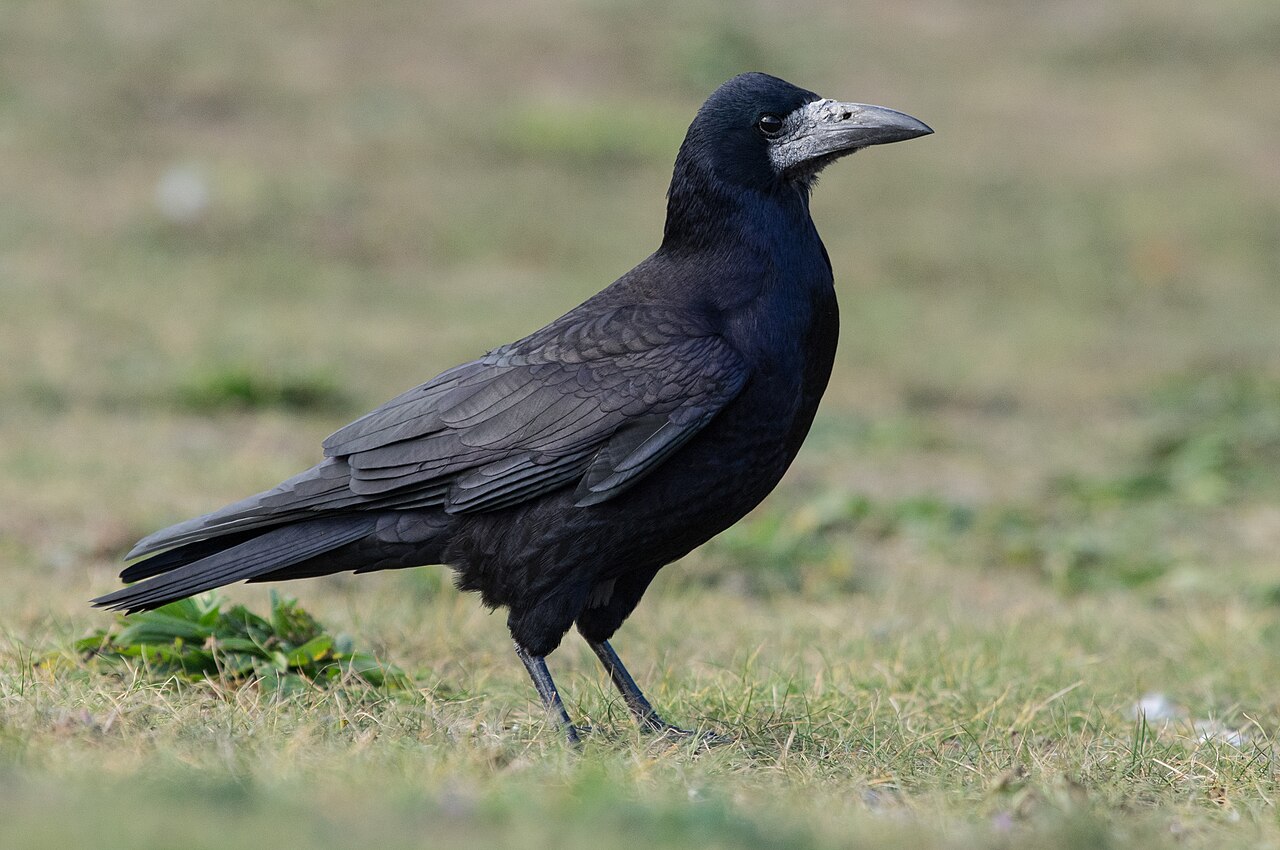
The Rook is the only corvid that has managed to establish itself in New Zealand: a European bird, released by the acclimatisation societies between 1862 and 1874 and never gone since. It is black, with a pointed bill and a bare greyish-white bill base, and where in Europe it nests in noisy colonies, decades of control have here made it quiet and extremely wary.
Voice
The call is a harsh, flat caw, repeated in runs of three or four, with a lower kroh and a grating gag alongside it; at the nest a high kiu is sometimes heard. In Europe a rookery in spring is one continuous din; in New Zealand the birds call far less and mostly only as they take off, which makes finding them considerably harder.
Recording: Philippe Grange — CC0 · Arrondissement de la Roche-sur-Yon (near La Roche-sur-Yon), Vendée, Pays de la Loire, France · xeno-canto
Identification
An all-black bird of forty-five centimetres with a purple-blue gloss, a steep forehead and a pointed, evenly tapering bill. In adults the base of the bill is bare and greyish white, a mark that fixes the species at range; young birds have not yet acquired that bare patch and are duller besides. The thigh feathers hang loose like baggy trousers. In flight the fairly long wedge-shaped tail and the narrow hand of the wing stand out.
Confusion species
New Zealand holds no second black corvid, so confusion runs through other birds: Australian Magpie (Gymnorhina tibicen) is black with white on the nape and wing and far shorter in the tail, and Common Starling (Sturnus vulgaris) is at range a third the size, short-tailed and rowing quickly along. Anyone arriving from Australia should know that the Australian corvids there carry a white eye; the Rook's eye is dark.
Habitat
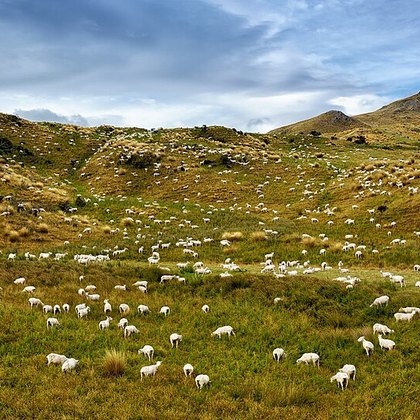
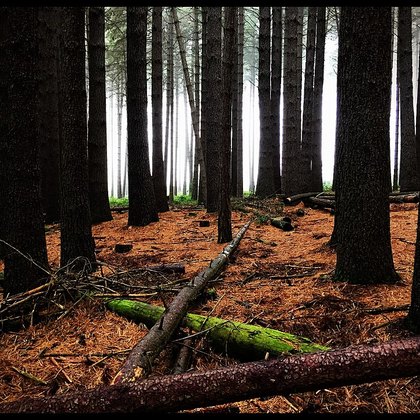
Grain paddocks, pasture and short grazed country, where it probes the soil with its pointed bill for leatherjackets, grubs and worms and where grain is to be had in summer. For nesting it needs tall trees: in New Zealand almost always a row of old conifers, poplars or eucalypts in a shelterbelt or along the edge of a forestry block. It also visits the fringes of towns and rubbish tips.
Where the bird is most often found, arranged by main group and formation.


Range and movements
Scattered across New Zealand, centred on Hawke's Bay with the remnant of a second nucleus in Canterbury; the early releases near Nelson and Auckland failed. The range has contracted sharply since the 1970s and now consists largely of single birds spread over a wide area. The bird is sedentary: it does not leave the district, but wandering individuals turn up far outside the known cores, and those are the ones that get reported.
- Resident
- dark = core range, pale = thinly spread
Where and when to look
Look for it in autumn and winter, from March to August, on ploughed ground and freshly cut pasture, and keep your distance: in New Zealand a Rook will lift at two hundred metres. Scan shelterbelts of tall conifers for old nests, which stay put as dark bundles in the bare crown. Always check the base of the bill; on a perched bird the bare greyish-white patch is the quickest thing to see.
Conservation
Least Concern (LC) globally — the species is numerous across Europe and Asia. In New Zealand the standing is reversed: the Rook is listed as an Unwanted Organism and regional councils control it systematically. Between 1971 and 1985 some fifty thousand birds were killed in Hawke's Bay alone, and in 2012 the regional council there destroyed seven hundred nests. Numbers have fallen steeply as a result.
Scientific name
Corvus frugilegus | Linnaeus, 1758
Linnaeus described the species in 1758 as Corvus frugilegus, and it has stayed in that genus, so author and year carry no parentheses. Corvus is the ordinary Latin word for raven. The epithet frugilegus is built from frux, frugis, 'crop, produce', and legere, 'to gather', and so means 'crop-gathering' — a reference to the feeding on farmland that earned the bird its long bad name in Europe.