All species › Passerines › Crows, jays and magpies › Little Raven
Little Raven | Corvus mellori
Kleine raaf | Cuervo de mellor
The Little Raven is the most sociable of the Australian corvids: where the Australian Raven guards its territory in pairs, this species moves across open country in flocks of tens to hundreds. It is barely smaller than its neighbour and just as black, and the only certain marks are the voice and the short wing-flick with which it punctuates every note.

Voice
The call is guttural and flat: kar-kar-kar-karrr or ark-ark-ark-arrk, usually three to five notes, deeper and more businesslike than the Australian Raven's and without its long dying wail. With each note the bird flicks both wings sharply upward, a movement that carries well through binoculars at range. In a feeding flock the calling runs on continuously, birds overlapping one another.
No freely licensed recording has been found for this species yet; what to listen for is described below.
Identification
A wholly black bird of about half a metre with a white iris, black legs and a bill a little shorter and less heavy than the Australian Raven's. The throat feathers are fairly long but do not balloon into a beard when it calls; at most a small bulge shows under the chin. The legs are well feathered low down. Feather bases are grey. Young birds have a brown eye that passes through hazel to white.
Confusion species
Australian Raven (Corvus coronoides) is the real problem: it averages larger and heavier-billed, balloons its throat feathers into a bag as it calls and holds the final note until it dies away, while precisely not flicking the wings with each note. Torresian Crow (Corvus orru) calls a staccato uk-uk-uk, has white feather bases and shuffles its wings after landing. Corvus tasmanicus of the southeastern forests is bulkier and shorter-tailed. Size alone never settles it.
Habitat
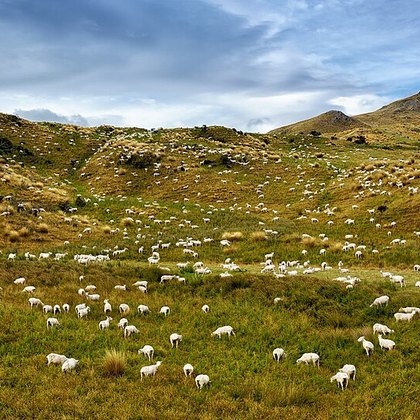
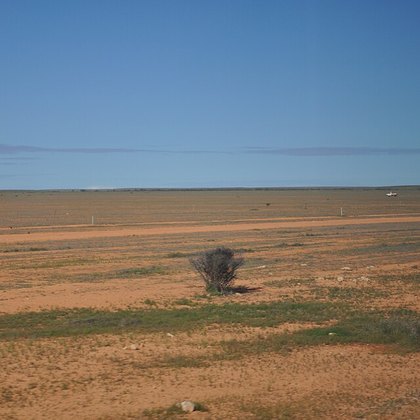
Open country is its element: sown pasture and grazed rangeland, grain paddocks and orchards, saltbush and bluebush plains and treeless flats, right out to the coast and the edge of the suburbs. It nests in loose groups in what few trees there are and roosts communally in dry open woodland. In summer, from December to February, flocks move up to the alpine herbfields of the Australian Alps, where bogong moths aestivate in the scree.
Where the bird is most often found, arranged by main group and formation.


Range and movements
Southeastern Australia: southern South Australia, Victoria, New South Wales chiefly in and west of the Great Dividing Range, plus Kangaroo Island and King Island in Bass Strait. It is absent from west Gippsland. Outside the breeding season it is markedly nomadic: flocks travel far after food, so that a district can be full of ravens one month and empty the next.
- Resident
- dark = core range, pale = thinly spread
Where and when to look
Count first. A flock of thirty or more black corvids on bare pasture in the southeast is nearly always this species; pairs on fixed territories in wooded country nearly never are. Then watch the wings: the short upward flick with each note is the quickest mark to learn and still works at two hundred metres. Finally listen for whether the last note is cut off or fades away.
Conservation
Least Concern (LC). The species has clearly profited from the clearing of the southeast: the opening up of woodland and its conversion to pasture and cropping has enlarged its ground at the expense of more forest-bound relatives, and numbers rose through the twentieth century. Local persecution around sheep enterprises and losses to baits laid for foxes have no visible effect on the national picture.
Scientific name
Corvus mellori | Mathews, 1912
Mathews described the bird in 1912 as Corvus mellori, and it has stayed in that genus, so author and year carry no parentheses. Corvus is the Latin word for raven. The epithet mellori honours the South Australian ornithologist and collector John White Mellor (1868–1931), one of the contemporaries after whom Mathews named several Australian birds.