All species › Passerines › Crows, jays and magpies › Torresian Crow
Torresian Crow | Corvus orru
Australische kraai | Cuervo de Torres
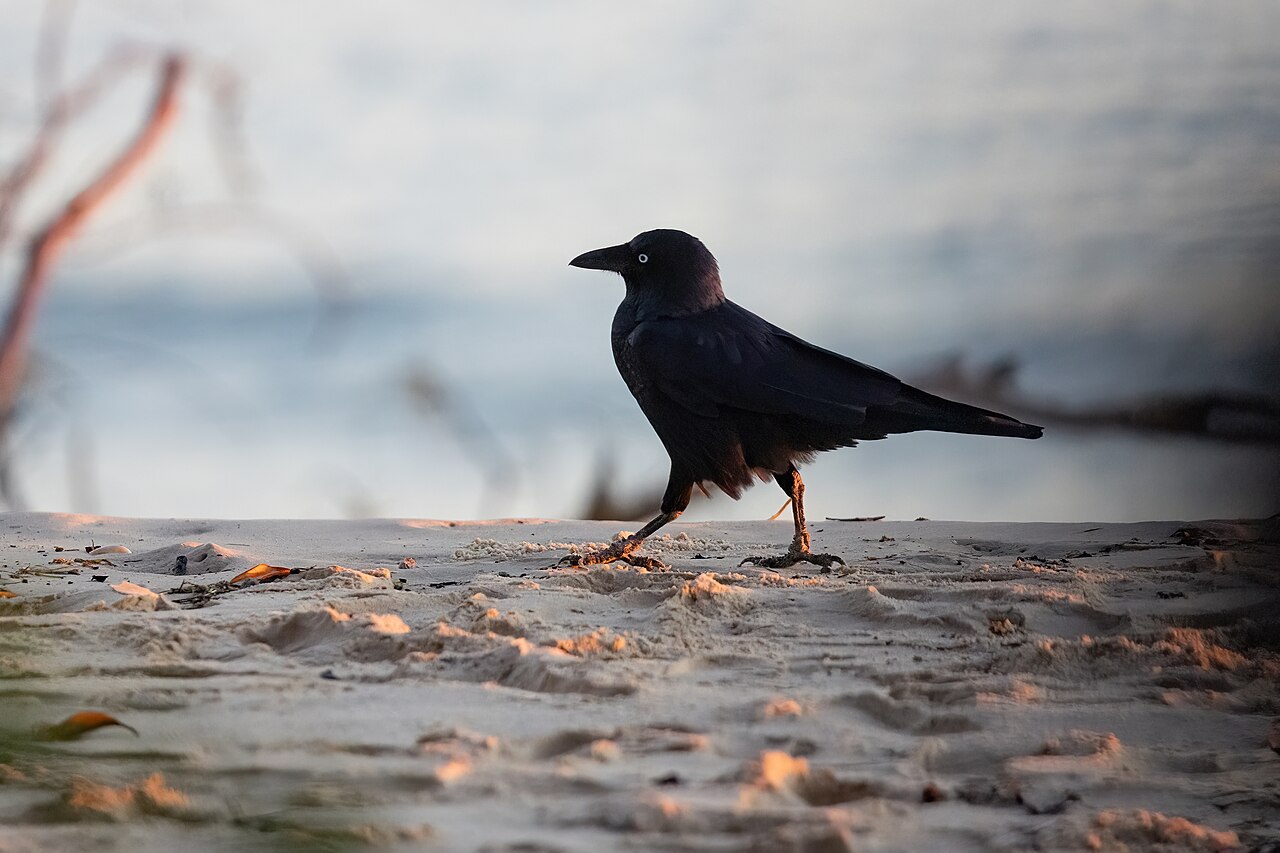
The Torresian Crow is the corvid of the tropical north and the western coast, and in Darwin, Cairns and Brisbane the bird on every roof, every lamp post and every rubbish bin. It is glossy black with a white eye in a fine blue ring, and it gives itself away by a habit none of its relatives has: after every landing it shuffles and resettles its folded wings, exaggeratedly.
Voice
The call is nasal and staccato with a metallic clatter to it: uk-uk-uk-uk or ok-ok-ok-ok, usually more than three notes and all of them equally clipped — never the long dying wail of the Australian Raven. In disputes comes a harsher arr-arr-arr, and sometimes a single rising note that sounds surprisingly like a cat's meow. In town it calls the year round and at night as well.
No freely licensed recording has been found for this species yet; what to listen for is described below.
Identification
A large black bird of half a metre, glossy on the back and duller on the breast, with a dark grey bill about the length of the head and a broad, square-cut tail. The eye is white with a fine blue ring. The decisive mark lies under the plumage: the feather bases on head and neck are white, not grey, and they show the moment wind or the bird itself raises the feathers. Young birds are dull with a blue eye until about nine months.
Confusion species
Australian Raven (Corvus coronoides) has long throat hackles that balloon as it calls, grey feather bases and that long dying final note; the ranges overlap only narrowly, along the east coast and in the southwest. Little Raven (Corvus mellori) flicks both wings upward with each note and sits further south. Corvus bennetti of the arid interior is smaller and has no hackles at all. Here the wing-shuffle on landing is the quickest mark.
Habitat
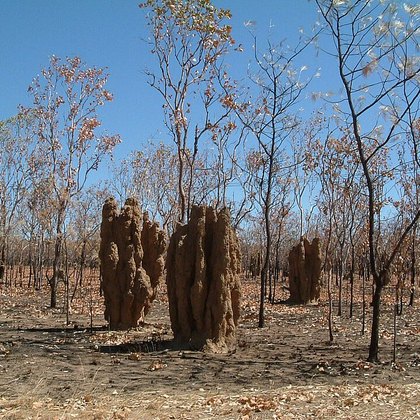
Savanna woodland and the forest edges within it, riverine timber with tall trees along creeks, cropland and cane, beaches and mangrove fringe, and above all the town: roofs, street trees, car parks and tips. It needs tall trees to nest in and stays within reach of permanent water. In the dry season it concentrates along the creeks and in built-up country.
Where the bird is most often found, arranged by main group and formation.


Range and movements
Northern Australia from the Kimberley across the Top End to Cape York and south down the east coast to Forster in New South Wales, with a western arm from Geraldton to Norseman in Western Australia. It is the commonest corvid of the coastal towns between Forster and Brisbane and of Darwin. Beyond Australia it occurs in the Moluccas and New Guinea; it does not migrate but wanders locally after food.
- Resident
- dark = core range, pale = thinly spread
Where and when to look
Watch the moment of landing. If the bird drops onto a post or a roof and then pointedly shuffles its folded wings, it is this species; the ravens do not do it consistently. Then listen: short, nasal, clipped. Anyone who finds a dead or moulting bird should blow the neck feathers open — white feather bases mean the crows, grey ones the ravens.
Conservation
Least Concern (LC). The species is numerous, still expanding at the southeastern edge of its range, and profits from towns, grazing and waste; in Brisbane and Darwin it increased markedly through the twentieth century. Where it calls at night in suburbs and fights over rubbish it counts as a nuisance, but that does not press the numbers down.
Scientific name
Corvus orru | Bonaparte, 1850
Bonaparte described the bird in 1850 as Corvus orru, and it has stayed in that genus, so author and year carry no parentheses. Corvus is the Latin word for raven. The origin of orru is uncertain: Jobling in the Helm Dictionary (p. 285) writes that the name may derive from a Papuan word. The form of the Bismarck Archipelago has since been split off as a species of its own, Corvus insularis; the Australian bird remains Corvus orru.