All species › Pigeons and doves › Doves and pigeons › Peaceful Dove
Peaceful Dove | Geopelia placida
Goulds zebraduif | Tortolita plácida
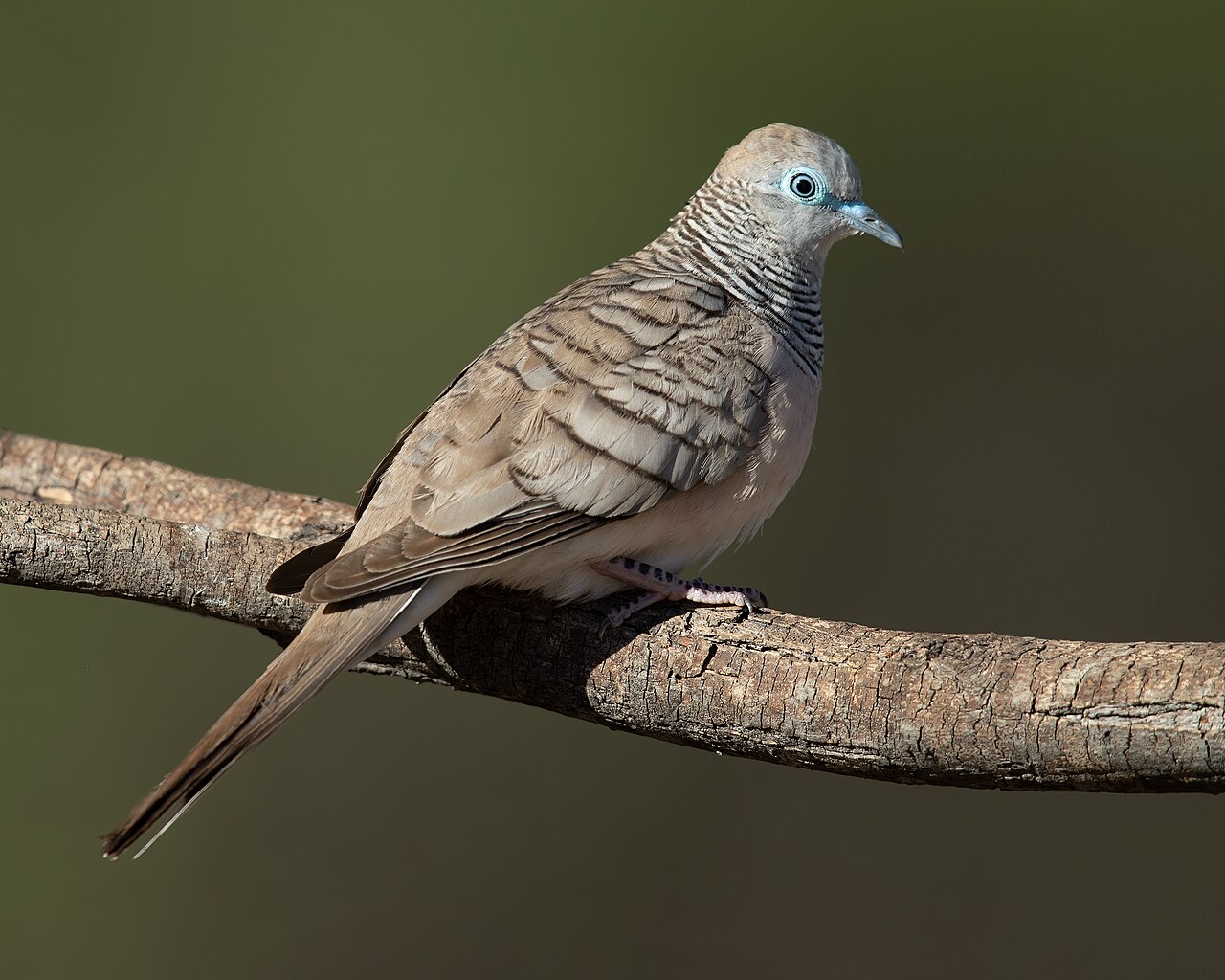
The Peaceful Dove is the small, finely barred dove that supplies the sound of the morning over half of Australia: a soft, musical doodle-doo from a wire or a bare twig. It is barely bigger than a blackbird, with a long graduated tail and a blue-grey ring round the eye, and the whole forebody is covered in hairline black bars.
Voice
A musical, cheerful doo-dle-doo, repeated endlessly and often the first sound of the day; alongside it a louder coo-lo-lue and a rolling croorrr. The tone is high and light and has nothing of the heavy cooing of the larger pigeons. On a hot afternoon it is still going when the rest of the woodland has fallen silent.
No freely licensed recording has been found for this species yet; what to listen for is described below.
Identification
A compact dove of just over twenty centimetres with a long graduated tail and wedge-shaped wings. Head and neck are grey with dense, fine black barring that runs on across the upper breast and upper back; the throat is white, the underside washed pink, the feet deep pink. The ring round the eye is blue-grey, as are the iris and the base of the bill. In flight the white tail corners and the quick, undulating beat stand out.
Confusion species
Diamond Dove (Geopelia cuneata) is smaller and slimmer, with an orange-red eye-ring and loose white spots on the wing instead of barring. Bar-shouldered Dove (Geopelia humeralis) is much larger, heavier in build and carries a copper-red shield on the neck; its call is a full cook-a-wook, not the light doodle-doo. The introduced Spotted Dove is larger, plainer brown and has a black, white-spotted neck patch.
Habitat
Open dry eucalypt forest and woodland with a grassy understorey, rainforest edges, gallery forest along rivers, and pandanus and vine thicket in the drier country. It comes right up to people: streets, gardens, parks, farmyards, roadsides and crop margins. It forages walking on bare, open ground and must drink at least twice a day, so water is never far off.
Where the bird is most often found, arranged by main group and formation.


Range and movements
Over nearly all of Australia except Tasmania, southern Victoria and the far south-west — widespread through the north-west, the north and the whole eastern mainland. Outside the map window it also occurs in southern New Guinea and on the Aru Islands. It is largely sedentary, with local shifts as water dries up.
- Resident
- dark = core range, pale = thinly spread
Where and when to look
Learn the call and you will find it anywhere: doodle-doo from a telephone wire, a bare twig or a fence along a country road. Then look for it on the ground in the verge or on a bare patch among the grass, picking up seed with short steps. On any suspected Diamond Dove, check the eye-ring: blue-grey belongs to this species, orange-red to the Diamond Dove.
Conservation
Least Concern (LC), with a large range and a large population. In parts of the south-east it is declining where the introduced Spotted Dove gains ground around towns, but across the continent the species is common and stable and profits from pastoral watering points.
Scientific name
Geopelia placida | Gould, 1844
Gould described the bird in 1844 as Geopelia placida, and there it has stayed, so author and year carry no parentheses. Geopelia was introduced by Swainson in 1837, from Greek geo-, 'ground', and peleia, 'dove'. placida is Latin for 'calm, peaceful' — the same thought as in the English name. For a long time it was treated as a race of the Zebra Dove (Geopelia striata) of South-East Asia; the Dutch name honours Gould, who first set it apart. The type locality is New South Wales.