All species › Pigeons and doves › Doves and pigeons › Bar-shouldered Dove
Bar-shouldered Dove | Geopelia humeralis
Roodnekzebraduif | Tortolita humeral
The Bar-shouldered Dove is the largest of the Australian Geopelia doves and the most strikingly marked: a long-tailed bird with a blue-grey head and breast and, on the hindneck, a copper-red to bronze shield of feathers each edged in black. It is a bird of dense cover near water and belongs to the sound of every morning across northern Australia.

Voice
Loud, musical and entirely its own: a clear cook-a-wook repeated in long runs, and alongside it a bubbling, descending series that sounds as though the bird is laughing to itself. Australians read coolicoo in the call. It calls persistently from cover at first light and again towards dusk.
No freely licensed recording has been found for this species yet; what to listen for is described below.
Identification
A solid dove of nearly thirty centimetres with a notably long, round-tipped tail. Head, neck and upper breast are blue-grey, the lower breast and belly pale pink, the wings brown with a bronze sheen. The feature that matters sits on the neck: a broad field of copper-red to bronze-olive feathers with black margins, lying like a scaled shield over hindneck and shoulder. The eye-ring is blue-grey, the eye red-brown and brighter when breeding.
Confusion species
Peaceful Dove (Geopelia placida) is the nearest risk, but is much smaller (20–24 against 27–30 cm), finer in build, and barred black and white across neck and upper breast instead of carrying a copper nape; its call is a light doodle-doo against the full cook-a-wook. Diamond Dove (Geopelia cuneata) is smaller still, with white spots on the wing and an orange-red eye-ring. The introduced Spotted Dove matches it in size but has a black, white-spotted neck patch rather than a copper nape.
Habitat
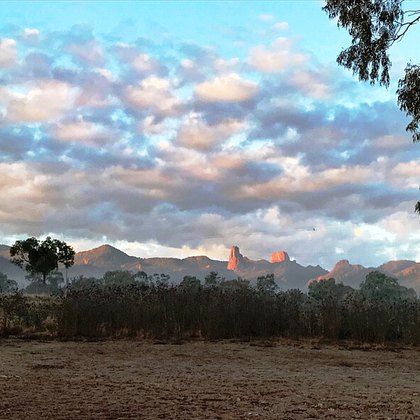
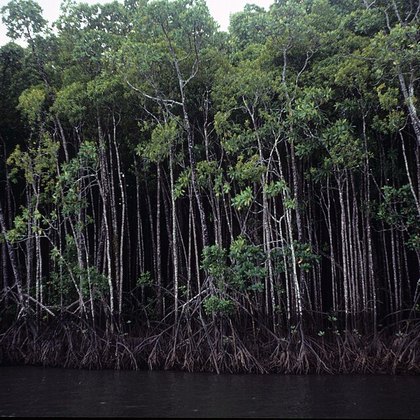
Dense grassy understorey near water is its picture: eucalypt woodland with grass, gallery forest along creeks, mangrove and the edge of monsoon forest and vine thicket, and in the north pandanus stands as well. It does well in gardens, parks, campgrounds and village edges as long as there is shrubbery and drinking water. It feeds walking on short grass close to cover; the nest is a thin twig platform in a dense shrub.
Where the bird is most often found, arranged by main group and formation.



Range and movements
Across the humid, well-wooded parts of north-western, northern and eastern Australia, from about Onslow in Western Australia through the Kimberley and the Top End to Cape York, and south along the east coast to roughly Bega in New South Wales. Outside the map window it also occurs in southern New Guinea. In north-western Victoria it has been turning up more and more over recent decades.
- Resident
- dark = core range, pale = thinly spread
Where and when to look
Walk a campground or a picnic area beside water in the Top End or along the tropical east coast at sunrise; it calls without pause then and lets you approach it on the ground. On any Geopelia, check the neck first — a copper shield settles the identification at once. And learn the call: a bubbling, descending run from dense shrubbery is nearly always this species.
Conservation
Least Concern (LC). It is common throughout its range, adapts well to villages, gardens and campgrounds, and like many doves benefits from permanent drinking water. In the south-east it is even expanding. There is no known threat of any weight; cats and traffic cost birds locally.
Scientific name
Geopelia humeralis | (Temminck, 1821)
Temminck described the bird in 1821 as Columba humeralis; the later move to another genus puts author and year in parentheses. The genus Geopelia is Swainson's (1837) and means 'ground dove', from Greek geo- and peleia. humeralis is Latin for 'of the shoulder' and refers to the copper field over hindneck and shoulder. The type came from New Holland, the name then used for Australia.