All species › Pigeons and doves › Doves and pigeons › Diamond Dove
Diamond Dove | Geopelia cuneata
Diamantduif | Tortolita diamante
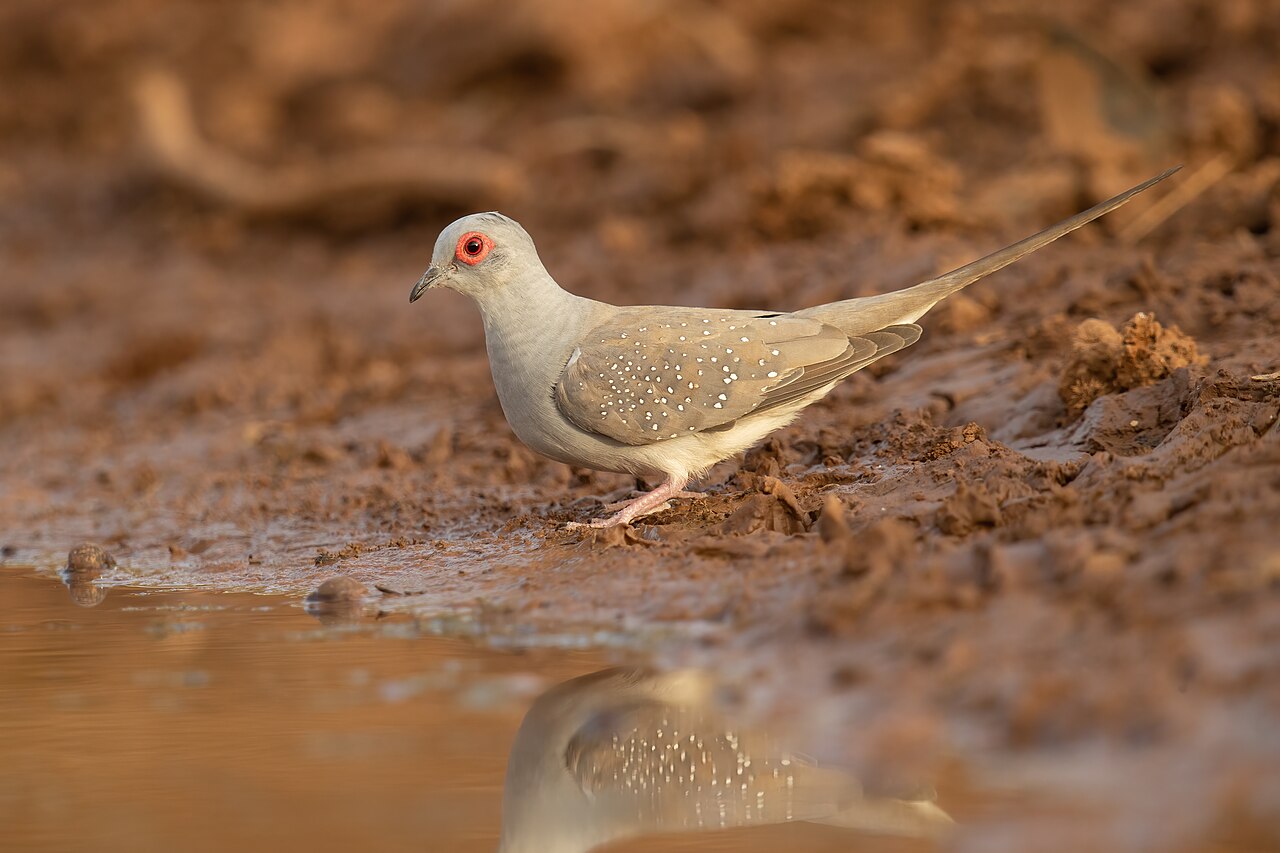
The Diamond Dove is Australia's smallest dove: a slight blue-grey bird of the dry interior with a broad orange-red eye-ring and a wing scattered with fine white spots — the diamonds it is named for. It weighs no more than a sparrow, about thirty-five grams, and the long tapering tail makes it look smaller still.
Voice
A soft, high falsetto coo that is closer to a hum than a call: two drawn-out notes, a pause, then a few more coos — Australian listeners hear oh-my-pa-pa in it. The tone is mournful and slow and carries surprisingly far in the silence of the mulga. Alarmed, the bird swaps it for a handful of short, loud coos.
No freely licensed recording has been found for this species yet; what to listen for is described below.
Identification
About twenty centimetres, much of it tail. Head, neck and breast are blue-grey, the back and wings smoky brown and covered in small white, black-edged spots. The eye is red and sits in a broad, conspicuous orange-red ring, brightest in the male; the female is browner and duller. On take-off a chestnut panel flares in the primaries and the white tail corners show.
Confusion species
Peaceful Dove (Geopelia placida) is the species it is most often taken for, but that bird is larger, has a blue-green rather than orange-red eye-ring, and carries fine black-and-white barring on neck and upper breast instead of white spots. Bar-shouldered Dove (Geopelia humeralis) is larger again, with a copper field on the hindneck. When in doubt the wing decides: only the Diamond Dove has those loose white spots, and only it is this small and this long-tailed.
Habitat
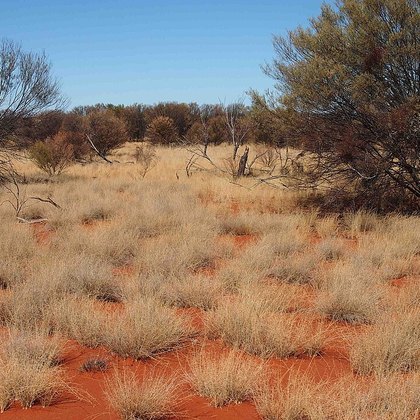
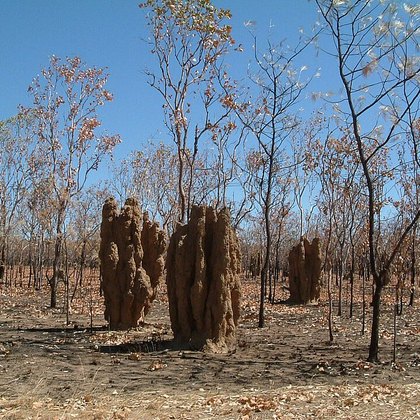
Dry open country with seed and water within reach: mulga and acacia scrub with bare patches, spinifex flats, savanna with scattered eucalypts, and above all the strips of woodland along creeks and dry river beds. It must drink daily and so stays close to a waterhole, stock dam or bore. The nest is a see-through saucer of grass stems in a low shrub.
Where the bird is most often found, arranged by main group and formation.


Range and movements
Endemic to Australia and spread across almost the whole arid and semi-arid interior, from the Pilbara and the Kimberley east into inland Queensland and New South Wales. It is strongly nomadic: after good rain it appears in numbers where it was absent for years, and in prolonged drought flocks push far south, into the parks and gardens of coastal cities. It does not belong in Tasmania or along the wet east coast.
- Resident
- dark = core range, pale = thinly spread
Where and when to look
Sit at an inland waterhole or stock dam in the first hour after sunrise; Diamond Doves come in in small parties, drink briefly and are gone again. Otherwise look for them walking on bare ground beside tracks and along the edges of dry creek beds — they are tame and let you close. The soft mournful cooing usually gives them away before anything moves.
Conservation
Least Concern (LC): the species is numerous, has an enormous range and benefits from the artificial watering points scattered across the interior by the pastoral industry. Only at the southern edge of the range is it doing less well — in Victoria it is listed as near-threatened — but on a continental scale there is no meaningful threat.
Scientific name
Geopelia cuneata | (Latham, 1801)
Latham described the species in 1801 as Columba cuneata; because it was later moved to another genus, author and year take parentheses. The genus Geopelia was introduced by Swainson in 1837 and is built from Greek geo-, 'ground', and peleia, 'dove' — ground dove, for its walking habits. cuneata means 'wedge-shaped' and refers to the tapering tail. The bird came from New Holland, now Australia; both the Dutch and the English name point at the white spots on the wing.